MassWildlife: What to do when you find young wildlife
 |
Do you know what to do if you find a baby bird, a nest of newborn bunnies, or another young animal in your yard this spring?
The arrival of spring means the arrival of young wildlife. Every year, people take young animals from the wild in a well-intentioned attempt to save them, but this often does more harm than good. The Massachusetts Division of Fisheries and Wildlife (MassWildlife) is reminding the public that young wildlife belong in the wild and urging residents to leave young wildlife alone. Finding a young animal alone does not mean it's been abandoned or needs to be rescued. Adults are often nearby and visit their young only occasionally to avoid detection from predators.
Most people quickly find that they can't properly care for young wildlife, and many animals soon die in the hands of people trying to help. Young wildlife removed from the wild are also denied important natural learning experiences which help them survive on their own. Even if these animals are released back into the wild, their chances of survival are reduced. Often, the care given to young wildlife results in some attachment to humans and the animals may return to places where people live, only to be attacked by domestic animals or hit by cars. With little fear of humans, once-tamed wildlife may become nuisances or injure people. It's also important to remember that nearly all wild birds and mammals are protected by law and they may not legally be taken from the wild or kept as pets.
What you should do:
-
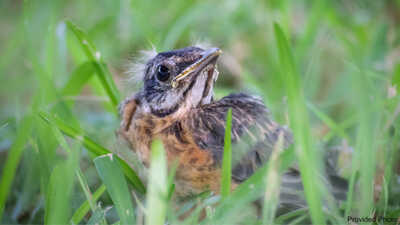
If you find a baby bird: While baby birds may look helpless, they only need assistance if there are clear signs of injury, like a broken wing.
- If you find a hatchling or nestling (a young bird without feathers) outside the nest, you can try to return it to its nest. If you can't see the nest it came from, you can create an artificial nest by securing a small basket or container to a branch in the same tree or shrub. Contrary to popular belief, the parents will not reject a baby bird if you touch it.
- If you find a fledgling (a young, fully feathered bird) outside the nest, the best thing to do is to leave it alone. The parents are usually nearby still taking care of it while it is spending some time hopping around on the ground learning how to fly. If you find a fledgling near a road or exposed to danger, it can be moved to a safer, sheltered location nearby such as a shrub or bush. Young birds naturally have a low survival rate, which keeps populations in balance with available resources.
- If you find bunnies or other young mammals: Generally, young mammals are visited by their mother only a few times a day to avoid attracting predators to the young. For example, a nest of bunnies will only be visited by the adult female twice per day to nurse the young. The young are generally safe when left alone because their color patterns and lack of scent help them remain undetected. In most cases, it's best to leave young animals alone.
- If you find a fawn: Young deer are born in late May and early June. Even if you see a fawn alone for several days, you should still leave it alone. The animal may be motionless and seem vulnerable, but this is the normal behavior for a fawn and the mother (doe) is probably feeding or bedded nearby. Fawns are safest when left alone because their camouflaging color helps them remain undetected. Does visit their fawns to nurse very infrequently, a behavior that helps fawns avoid detection by predators. If sympathetic people repeatedly visit a fawn, it can prolong separation from the doe and delay needed feeding. Fawns cannot be cared for by wildlife rehabilitators; if a fawn is visibly injured or found with its dead mother, call MassWildlife at (508) 389-6300. Click here for more information on finding a fawn.
- Keep pets leashed. Keeping pets indoors or restrained helps wildlife, as pets often like to chase and hunt songbirds and other mammals. This also helps your pets avoid health and safety dangers posed by wild animals, other pets, or automobiles.
Contact a wildlife rehabilitator for advice. In almost all cases, it's best to leave wildlife alone and let nature take its course. In the rare case you find a young animal with a dead parent or if you see visible signs of injury, you can contact a licensed wildlife rehabilitator for assistance. An injured wild animal may be assisted, but a person must deliver the animal immediately to a licensed rehabilitator. MassWildlife licenses wildlife rehabilitators who are qualified to care for most injured or truly orphaned wildlife.
For more information on what to do if you find sick, injured, or young wildlife, please click here.