Pittsfield Health Board Votes to Demolish Blighted Properties
PITTSFIELD, Mass. — Blighted homes in the West Side and Morningside neighborhoods will be demolished as part of the city's yearly effort to address abandoned properties.
Last week, the Board of Health voted to demolish 154 Francis Ave., 48-50 Brown St., and 242 Wahconah St. The Brown Street "house" had a fire in 2018, and is reduced to just the frame.
Director of Public Health Andy Cambi explained that Pittsfield demolishes about three blighted properties per year that have no active owner or heir, and are in such bad condition that a receiver likely wouldn't take on the project.
In May, the BOH reviewed a vacant building list that categorized properties based on condition and time unaddressed. Property owners can request a hearing.
The former multifamily at 48-50 Brown St. had a fire in 2018 and has been vacant since, now just a first-floor wooden frame.
"There's been efforts to sell the property, but it's not a marketable piece of property under my opinion, so I don't feel that a sale will happen," Cambi said.
"I think the only really request for this is to request an order to demolish at this point, and we will hold the owner accountable for this one because, again, they are active, they're up to date with their taxes. So we would send an order to do it within 90 days."
He was actually the one to condemn the property years ago. If it isn't transferred or taken down, the city would have to bring the owner to court.
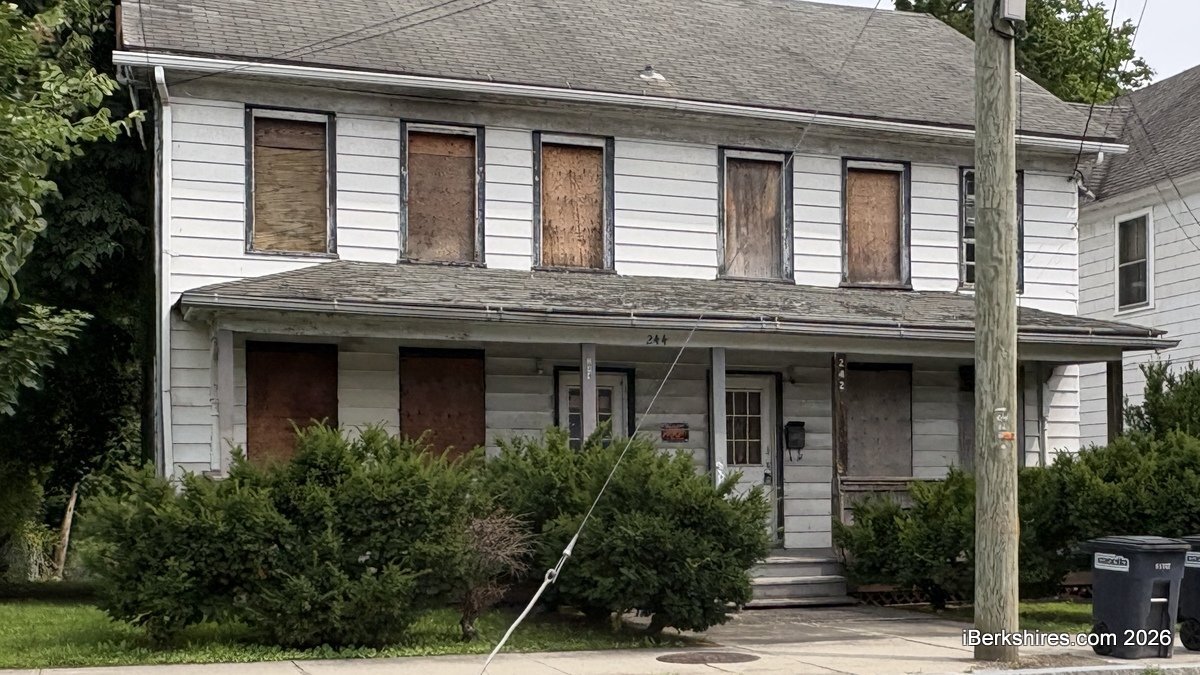
The board also signed off on demolishing 242-244 Wahconah St., which has the same owner as the Brown Street property. Brown Street is listed on Zillow for $65,000, and Wahconah Street is listed for $160,000.
The structure at 242 Wahconah has its windows completely boarded after being exposed to the elements for some time, and Cambi said it has been subject to vandalism and nuisance complaints.
"There was a building permit that was applied for back in 2022, but was not approved and has not been any follow-up since then with building permits," he reported.
"We try to give enough time for owners to gather their resources or their plans or what they need to make efforts to rehab the properties, but at one point after 10 years or so, we do have to really start pushing the envelope and make them move."
The Francis Avenue home became abandoned in 2021 when its owners passed away, and the family vacated, Cambi said. It has since been deemed unsafe by the Pittsfield Fire Department, meaning it is not safe for firefighters to enter.
"From there, we've had throughout those years random vandalizing, entering the property, squatting, becoming unsecured, and we kept having to secure it," he explained, adding that an heir was identified but had no interest in going through the probate process.
"… After multiple attempts of even connecting them with potential buyers to possibly motivate them as far as it being a worthwhile process, we were unsuccessful."
Tags: blight, demolition,