Gateway Fiber Expansion Nears Completion

By Sabrina DammsiBerkshires Staff
Print Story | Email Story
PITTSFIELD, Mass. — Gateway Fiber is nearing completion of its Pittsfield expansion, bringing high-speed internet access to 2,000 additional homes and businesses.
 
The expansion marks another step toward increasing competition among internet providers and strengthening the city's telecommunications infrastructure, bringing service availability to nearly 6,000 homes and businesses.
 
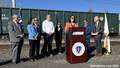
Construction of the expansion began in July 2025, marked by a ribbon-cutting at the Colonial Theatre.
 
At that event, Senior Vice President of Market Growth Sarah Lang said the company is investing millions into Pittsfield to provide a better internet service.
 
The company also emphasized the importance of affordable internet options, particularly with the increased need for accessible, reliable connectivity for jobs, education, and healthcare.
 
Gateway Fiber is a 100 percent fiber internet provider serving residents and small to medium-sized businesses, said John Meyer, Gateway Fiber's chief customer officer John Meyer said.  
 
It provides a "fairer, friendlier, faster" internet experience through transparent pricing, local customer support and high-speed service, he said
 
Gateway Fiber measures its success on being able to provide reliable internet service, positive customer experience, and offering competitive pricing that encourages customers to choose and stay with them, Meyer said.
 
The company has increased internet speed options while keeping prices largely consistent, he said.
 
Its residential plans range from $65 per month for 600 megabits per second to $125 for 5 gigabits per second. Other options include 1 gigabit for $75 and 2 gigabits for $90.
 
Gateway Fiber offers internet speeds of up to 5 gigabits per second, providing the capacity and low latency needed to support modern internet consumption, including remote work, online gaming, education and telemedicine, Meyer said.
 
"We are sort of at the forefront of providing an internet experience that's designed for the AI-driven infrastructure of what's next," he said.
 
Fiber-optic technology transmits data using light rather than the copper wiring traditionally used by cable providers. This technology, Meyer said, offers increased capacity, lower latency and symmetrical upload and download speeds.
 
Beyond providing residents with another internet option, Meyer said the network could have a broader economic impact by supporting local businesses and making properties more attractive to prospective tenants.
 
The infrastructure put into play is "future-proof," built for the long term to accommodate current needs and technological advancements, Meyer said.
 
"There's nothing better than fiber as of right now," he said.
 
Meyer said having fiber-optic internet is a "leg up" economically, making residential and commercial properties more attractive to prospective tenants and enhancing property values, he said.
 
"From an economic development perspective, it's a very attractive asset for any community to have," he said

Tags: Internet,   
If you would like to contribute information on this article, contact us at info@iberkshires.com.

Lanesborough Property Tax Rate Up 5%

By Breanna SteeleiBerkshires Staff

LANESBOROUGH, Mass. — The Select Board on Monday approved a single tax rate that will increase the average homeowner's property bill by at least $670.

With a rate of $18.20 per $1,000 valuation, the average single-family home valued at $373,784 will see a $668 increase, and the average commercial property, estimated at a value of $577,990, will increase by $1,125 per year. This rate is 91 cents higher than last year's $17.29 per $1,000 valuation.

"Historically, as part of their annual budget policy, the Select Board and Finance Committee has endorsed a single tax rate option, providing no exemption or discount to a particular property class or group, voting a residential factor of one, which is what we'll do tonight, affirms a single tax rate and proportionate sharing of the tax levy burden between all classes of property," Principal Assessor Ross Vivori explained during the joint meeting with the Finance Committee and Board of Assessors. 

This year's levy is $11,760,845, which is a 11.28 percent increase from last year, or $1,192,521.

The town's total taxable value is $648,200,324; about $541 million in residential, almost $9 million in industrial, about $52 million in commercial, and about $44 million in personal property. It is 5.7 percent higher than the previous year.

For fiscal 2027 the max allowable levy is $12,313,803, the town is levying $11,760,845, leaving an excess levy capacity of $552,957. There was more than $6.5 million in new growth, which was described as contributing about $112,855 in tax revenue at the prior year's rate.

Finance Committee member Al Terranova suggested that the rate may change if revenues, such as from the state, changed. 
 
"I just don't want people to look at this and, 'Oh my goodness, I'm going to pay $600 more a year,'" he said. "They would  just pick out that one number, because you don't know what the actual number is."
 
Select Board Chair Deborah Maynard said all the figures are based on the tax recapitulation sheet, which includes estimated revenues and state cherry sheet numbers. 
 
"But there's no way around that, that's the number we're paying," added Select Board member Jason A. Breault. "That's the tax rate."
 
Ross said property values are rising because people are paying more for homes, but that's not driving the tax rate — town spending is.
 
"If the [property] value goes up and nothing else changes, the tax rate stays the same," he said. "What's driving the tax rate up is the budget ... everything's gone up and you've got raise the money to operate the town. It is what it is." 

In better news, the board accepted what Accountant Angela Garrity agreed was a "healthy" amount of free cash at $949,833. 

The board also heard from the public about putting a moratorium on data centers and battery storage facilities at its next meeting as well as Old State Road residents asking about the speed bump removed at the intersection of Target and Old State Road.

The residents said two years ago they had asked for the speed bump and were wondering why they were not warned it was being removed. 

The three people said they were afraid to cross the street for their mailbox or walk their dogs. They also said it is very hard for them to leave their driveway at the intersection. 

The Select Board could not respond during public comment, but at its last meeting, it decided to remove the speed bump based on information from police that it was "useless" as a deterrent and from Emergency Medical Services Director Jen Weber that it was dangerous when transporting patients.

An ad hoc committee with Weber and Police Chief Robert Derksen and board members Breault and Jeff Walters to discuss the best options on reduce speeding in some areas. Maynard reminded people that community members wanting to serve are being asked to submit citizens' interest form with the town.

Lastly, Alison Dixon from Berkshire Regional Planning Commission and Berkshire Environmental Action Team's Executive Director Brittany Ebeling presented two Municipal Vulnerability Preparedness action grant projects. 

One project is the road stream crossing prioritization and assessment program for town-owned bridges and culverts to prioritize crossing replacements. Dixon explained that undersized culverts were identified as a vulnerability in the town's MVP and hazard and mitigation plan. The project is expected to span two years and will notify nearby landowners before field crews work around culverts and bridges. Community members were also invited to share knowledge about crossings they believe have been problematic.

The second project will cover ghost dams. BEAT and BRPC will be working with watershed organizations and a youth team from Greenagers over the next two years locating and documenting unmapped, human-made dams, also called ghost dams, which may pose flood risks. The goal is to create a Berkshires-wide map and connect towns and landowners with information and resources for flood-resilience planning.

View Full Story

More Pittsfield Stories