Pittsfield Doughnut Drive-Through Debate Continued

The City Council quizzed representatives of Cafua Management for three hours on Tuesday night. Right, James Scalise of SK Design answers questions about the proposed drive-through. |
PITTSFIELD, Mass. — Cafua Management Co. applied for a permit more than 14 months ago to demolish an ailing former elementary school at the corner of First and Fenn streets to make way for a new Dunkin' Donuts drive-through restaurant.
The City Council decided it will have to wait at least a month longer.
Councilors, able to weigh in for the first time on a plan that has seen strongly opposing views while being vetted at multiple meetings of the Community Development Board and Historical Commission, grilled Cafua's team of development consultants and attorneys for three hours Tuesday evening before continuing the hearing to a May 28.
Representatives for the company were adamant that the council's ruling on the permit should be based strictly on criteria set forth under the ordinance governing drive-through approval, and should not be influenced by past dealings with the entity or community sentiments regarding the historic significance of the existing building.
"The issue is not whether having a Dunkin' Donuts at this site is consistent with the Master Plan, the issue is whether having a drive-through at this location is consistent with the Master Plan," said David Rich, a Boston-based litigator assisting Cafua's Pittsfield representation, who told the council the historic preservation issue had run its course in October.
"Respectfully ... that ship has sailed."
Similar legal opinions were put forth earlier this month to the Community Development Board, which voted against recommending the proposal to the council.
Questioning, therefore, focused primarily on traffic concerns about adding an additional drive-through in an area already known for congestion problems. A traffic study commissioned by Cafua and reviewed by the city engineer suggested that the project would have no "significant adverse impacts," but some on the council expressed skepticism with aspects of the projections made.
Councilor Jonathan Lothrop was wary of claims that existing traffic delays at that intersection would actually be improved with a higher volume of traffic at the First and Fenn intersection.
"We already have our two biggest traffic problems within a block of this location," said Lothrop, referring to perpetual issues at Fenn Street's post office and the current Dunkin' Donuts on First Street. "We have to talk about what the entirety of the conditions are."
Councilors Churchill Cotton and Christine Yon agreed that the data underestimated the practical issues that could be created.
"I think you're going to be surprised," Cotton said. "My feeling is that it's going to create an intersection problem at Fenn and First."
Other councilors were more satisfied by the presentation data and measures taken to try to eliminate traffic snags in designing the new site.
"I'm not a traffic engineer, I have to rely on the information that's been provided, and it really doesn't seem like that is going to be a big issue," said Councilor Barry Clairmont.
"I'm torn on this issue, as I think many of my colleagues are," said Councilor Anthony Simonelli, who said most of the feedback he'd heard from constituents had been negative toward this project. "But I'm very impressed with the design, and the landscaping that's been put forth in front of us, and the appearance accommodations that the developers have done."
The possibility of subsequent litigation in the event that the special permit is not approved by a supermajority of eight councilors loomed throughout the hearing, particularly if they were to object based on reasons not germane to the application criteria. Attorneys for the applicant cited a Land Court decision in favor of a plaintiff in a 2005 instance in which a Wendy's had been denied a drive-through permit.
"I'm sure we all in this room want to make sure that any decision that is rendered by the City Council conforms in all respects with the law," Rich said. "And I hope that in analyzing the facts and the law that the City Council takes into account this decision and others like them that involve very similar characteristics to the application here."
Council President Kevin Sherman said the city should have an opportunity to examine the relevant case law cited through its own legal counsel, and that the council needed time to take additional testimony and deliberate.
"I think there's been a lot of great robust discussion here," said Sherman as the hearing passed the 11 p.m. hour, suggesting it be continued to a future council meeting. "As we've debated this tonight, I think there's still some outstanding questions my colleagues have."
Sherman also asked for a motion to have the city solicitor to create a legal draft of a potential permit denial in the event that the special permit is denied.
Plunkett Building
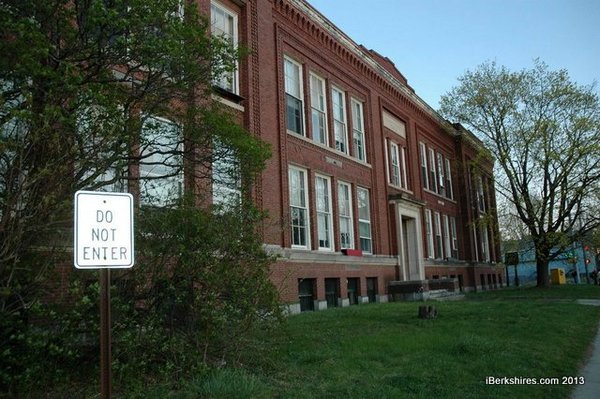
While attorneys for Cafua several times reiterated that the razing of the current site is a foregone conclusion, the ultimate disposition of the 104-year-old former William R. Plunkett School may remain uncertain if the special permit is denied.
 The Historical Commission had hoped a developer would buy and renovate the building. |
"It could be demolished tomorrow," City Planner C.J. Hoss told iBerkshires, noting that permission for the demolition has already been secured by the owner independently of the process for the drive-through permit.
It is not known, however, whether property owner Forer Development Co. would incur the expense of the demolition without an approved plan for redeveloping the lot.
"I honestly don't think it will be torn down if Dunkin' Donuts doesn't go in there at this particular time," said Clairmont. "Unless you are definitely going to go through with the project without the drive-through, there's probably no real reason for the current owner to turn around and tear this building down."
While application materials from Cafua point out that the existing structure has been on the market for 25 years with "no credible buyer" emerging, information previously conveyed by the Department of Community Development to the Historical Commission indicated that another developer had expressed renewed interest to realtor Tucker Welch as recently as last spring.
The prospector buyer was apparently willing to pay full price to redevelop the building for housing using Housing Development Incentive Program (HDIP) funding similar to that which made possible the Rice Silk Mill. The approval process for this, however, would extend out for another one to two years, and if the project funding fell through, they would be able to back out of the purchase.
"We've had developers come through and ask us about the building," Hoss said. "And the opinion we've received is that it's possible for that building to be rehabbed. It'd be difficult, it'd be expensive, but it's possible."
Tags: city council, drive-through, Dunkin Donuts, historical building, school building,