Agricultural Program Aims To Raise Chickens At Melville's Farm
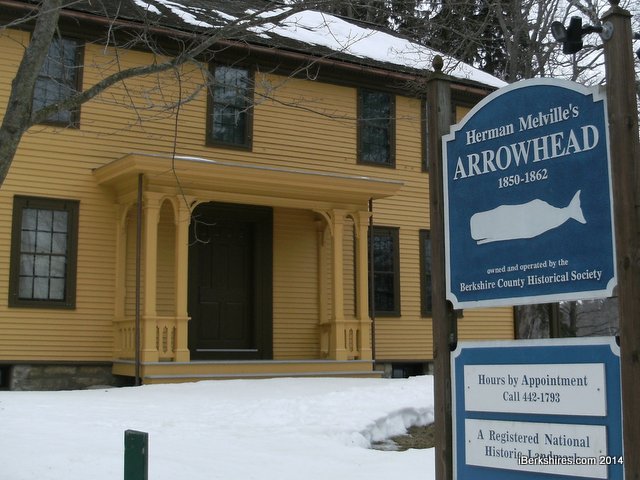 The Berkshire Historical Society is seeking to resume farming on Herman Melville's homestead on Holmes Road. The Berkshire Historical Society is seeking to resume farming on Herman Melville's homestead on Holmes Road. |
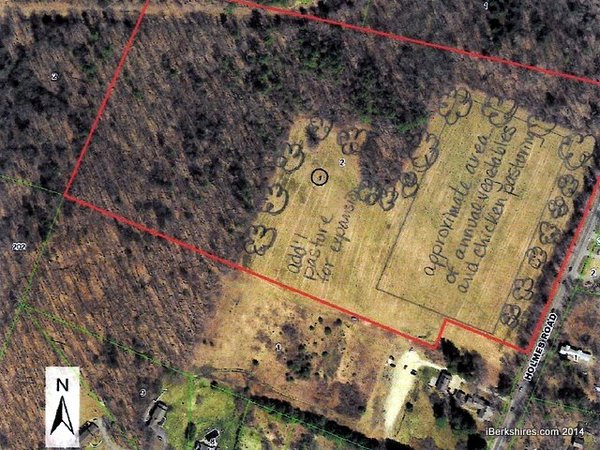
The historical society, which has operated the author's famed home since 1975, has filed an application with the city to add an agricultural land use to its current permitting, in order to convert a piece of the 44-acre Holmes Road estate to accommodate vegetable and herb gardening and an eventual orchard as well as small livestock.
"Historically it's always been farmed," Executive Director Betsy Sherman told iBerkshires. "Since the 18th century, the land was farmed, and continued to be in the 19th century and was a tenant farm when Melville bought it in 1850."
The long-term vision is to integrate with the historical use an agricultural program that includes a one- to three-acre herb garden, orchards, rabbits and pasture-raised chickens. Utilizing modern conservation strategies and intensive chemical-free farming practices, the organization hopes to create a self sustaining program that can provide products both for sale and overflow to help supply local food kitchens.
"It's going to be very small to start with," said Sherman. "It will grow organically, in the sense that it will not be a huge intrusion of farm equipment and all that right away."
A portion of the revenue to support this program, according to the site plan application, will also come from "onsite community education opportunities on a wide variety of topics from gardening and small livestock management to wildlife and the environment."
"If you look at kids today, most of them really don't understand where their food comes from," Sherman said. "There's a disconnect between what's on the supermarket shelves and where it's actually grown and how it's harvested."
"Every step of the planning and execution of this program will provide opportunities for community education and workforce development," according to the site plan statement. "The overarching goal is the creation of a sustainable community resource that fully combines the wealth of human, agricultural and environmental history present in the Berkshires, and more specifically, at this site."
Sherman said the concept of a working farm at Arrowhead had been one that society had favored for some time, but did not become viable until members met their new farm manager, Kristin Laney.
"We were approached by a young woman who really has a plan, and has an idea of how to do this," said Sherman. "She really wants to farm the land."
"The Melville property is ideal in a lot of ways," Laney said of her interest in establishing a farm at the site. "There are some of the best agricultural soils in the area around there."
"I didn't start out in farming," said Laney, who earned a degree in geology but found that motherhood sent her in another trajectory. "Just trying to feed my kids healthy on a limited budget, I got into a lot of creative solutions to do so."
Lahey chalked up further agricultural experience working at Holiday Brook Farm in Dalton and other farms: "I just got bitten by this bug."
More recently, Laney was denied a permit last month to raise six chickens at her own Marlboro Drive home by the city's Zoning Board of Appeals, despite a majority voting in favor of it.
Despite this pushback against recent applications for agricultural uses, particularly chickens, in some residential neighborhoods, the Arrowhead farm does not anticipate resistance on the part of its neighbors.
"We have 44 acres, so we're not the same as some of the other recent applications," offered Sherman, who noted the presence of other larger farms nearby the site along Holmes Road.
"There's an agricultural history there, so people are used to that use occurring there," added Laney, who also pointed out the absence of any closely abutting neighbors to the field where the farming is planned. "There's a huge buffer, there really aren't neighbors to speak of."
The Historical Society believes this will be a great complement to the curation of the museum property that will also have broader educational benefits for the surrounding community.
"I think it will be another piece of the visitor experience," Sherman said. "To look at that field and actually see something happening."
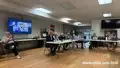
The application will be up for review by the Community Development Board on Tuesday, March 18.
Tags: chickens, farming, historical society, Melville,