New Nonprofit Will Govern PEDA's Innovation Center
 The Pittsfield Economic Development Authority is creating a non-profit to operate its planned life sciences innovation center in the William Stanley Business Park. The Pittsfield Economic Development Authority is creating a non-profit to operate its planned life sciences innovation center in the William Stanley Business Park. |
The entity, which may eventually assume ownership of the center, could be up and running this year.
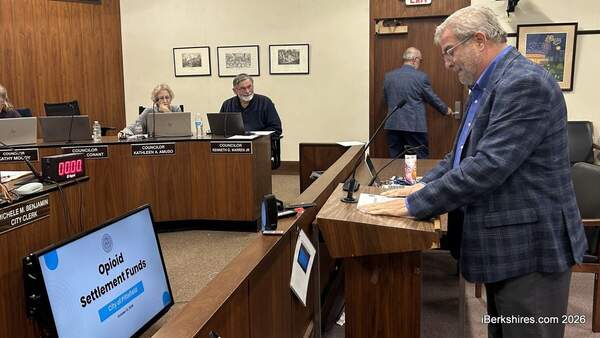
"Our objective is to create a new organization to manage the facility," said Executive Director Corydon Thurston, at a subcommittee meeting of PEDA's board of directors Thursday. "[It will be] built around our existing manufacturers, research institutions and partners that have agreed to come on board."
Planning has accelerated with the announcement last week by Gov. Deval Patrick of a $9.7 million capital grant for the facility, which has been one of PEDA's priorities for the business park since the mid-2000s. The award includes $7,725,000 for facility design and construction and $2 million for equipment, including state-of-the-art tools for precise measurement, precision analysis and microscopy, and rapid 3D prototype printing.
Thurston said this organization would incorporate the commercial businesses and educational entities that will be tenants, users and partners of the facility. This organization would have its own board and ideally guide its design and construction, then manage and maintain the estimated 20,000-square-foot center once it is built. In the long term, the organization could be deeded the building.
"The greatest likelihood for this to succeed is by involving those that are going to be participants in an active way right from the beginning," said Thurston. "Creating that invested equity right out of the gate is, in my opinion, a sure way to see that they stay engaged."
The timetable for its incorporation will depend on how long it takes to work details out with the Massachusetts Life Sciences Center, the grantor for this project, but an initial list of prospective board members are expected to be ready within the next two months.
An final name has not been officially decided upon for the center, which has been referred to in planning variously as the Berkshire Life Sciences Center or Berkshire Innovation Center, and a number of aspects of what it might look like are still being fleshed out. A final report will be a two-phase, $119,000 study and planning process conducted by New England Expansion Strategies.
Phase 1 findings and negotiations with the MLSC reshaped the overall vision for this site over the past year, from a primary focus of biotechnology and applied life sciences to a more broadly defined industrial innovation sector. It has also shifted from a focus on incubation for startups to enabling growth in already existing small to medium-size businesses in the area.
Consultant Rod Jane, Mayor Daniel Bianchi and PEDA officials met with 70 companies that might benefit from potential partnerships in the first phase, and in Phase II have been narrowing down the list to explore possibilities with those that have expressed the greatest interest.
The eventual organizational structure of the facility will be a kind of membership co-op of with two to three levels of participation by commercial and educational institutions.
"This [announcement of funding] has generated a lot of interest, a lot more people want to talk to us about how this going to work, and being members," Thurston told the Special Projects Committee.
Room will still be allotted for biotech work, with a clean room, a wet lab, and other infrastructure, and PEDA is still hopeful for a role in the consortium by Nuclea Biotechnologies, though Thurston said those negotiations are "still a work in progess."
In addition to rates for membership, PEDA anticipates the center will have two other revenue streams, rental of specialized equipment at varying rates to members and non members, and lease income from some startup tenants.
PEDA attorney Elisabeth Goodman and Assistant City Solicitor Darren Lee have begun the legal work to provide a foundation for the planned 501(c)3 entity. An RFP is being crafted for the design of the center, with a bid date to be determined based on further negotiations with the MLSC.
Tags: life sciences, PEDA, startup,