Pittsfield Grapples With Saving Historic Buildings
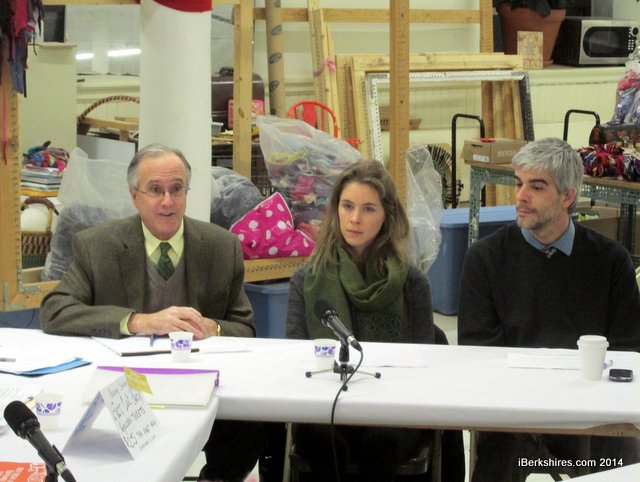 Mayor Daniel Bianchi, Architect Tessa Kelly and Springside Park Conservancy served on the six-member panel Thursday night. Mayor Daniel Bianchi, Architect Tessa Kelly and Springside Park Conservancy served on the six-member panel Thursday night. |
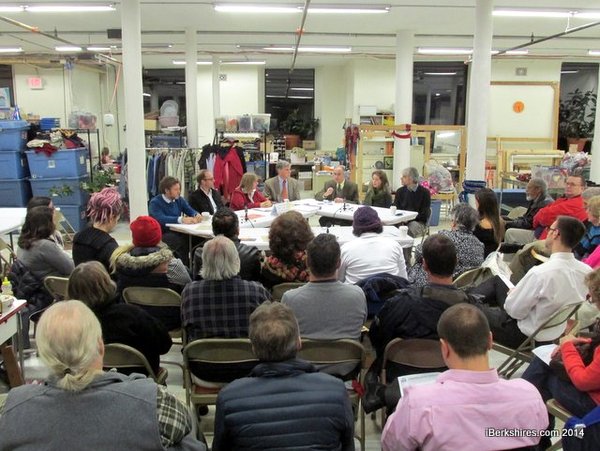
But the importance of those buildings brought together a group of local historians, city officials and a developer on Thursday for the first summit focused on the historic preservation of the city's structures.
The meeting stemmed from the proposal to raze the former St. Mary the Morning Star Church on Tyler Street and build a Dunkin' Donuts, but the gathering mostly focused on ways to avoid other historic structures from reaching that point.
"Tonight is not the abstract idealism about how we value this. It is about the reality," said John Dickson, chairman of the Historical Commission.
And the reality is that repurposing historic buildings is significantly more difficult than other forms.
Ian Rasch, from the development company Allegrone, knows first hand. The company is just finishing work on the Howard building at the intersection of First and Fenn Street, a historic building it purchased in 2010.
"We spent a long time trying to pull together the right people," Rasch said, emphasizing that it took more than four years to complete it.
Rasch outlined some of the major issues the company faced that dragged out the timeline. Getting the financing packaging for a such a large project proved to be the most difficult.
Allegrone spent $5 million renovating the building and needed to convince banks to fund it while applying for various tax credits. Ultimately, the company went to the state and requested both historical tax credits and a grants through a state housing development program.
In total, the organization packaged nearly six different funding sources for its financial plan.
But the funds don't come in until the project is done or nearly done, meaning Allegrone needed to expend its resources first, which translates to borrowing more from a bank.
"Our funding stream package was very simplistic compared to the Beacon Cinema and still it had six sources," Rasch said.
During those four years, Rasch said the company worked closely with city officials, who provided expertise to seek out state funding sources. Without knowing the very different types of programs, the project would never had gotten the funds.
The building was outside of the already established historic Park Square district, so the company had to go through the building and document and identify all of the historic artifacts and pieces to make its case for the historic tax credits.
Kathy Reilly, of the Berkshire Athenaeum's local history department, said the library has focused on maintaining records and preserving documents for exactly that reason. There are all types of material available to complement grant applications, she said.
Those four years of development work was difficult even for a professional development company. Crispina ffrench didn't have that expertise when she bought the former Notre Dame Church on Melville Street.
"We're not architects. We're not developers. We bought the building because we loved it," she said.
Ffrench didn't get help from the city or the state but was able to create Shire City Sanctuary. She said help connecting the resources would have been helpful then and now moving forward with renovations.
In many cases, the needed time and effort to preserve a building isn't worth it for a lot of developers. And, City Planner CJ Hoss said, there isn't a lot of restrictions preventing the destruction of a building. The Historical Commission can delay the demolition of a building but can't stop it — such as what happened with the Former Plunkett School kitty-corner to the Howard building.
"The Historical Commission has been very selective in when they use a delay," Hoss said.
Hoss said the city had boosted control somewhat with the implementation of a downtown overlay zoning district, which lowers the threshold for the amount of redevelopment in a downtown parcel to trigger a special permit. The special permit process gives the city the ability to add conditions to projects.
The city has been successful in giving tax incentives or connecting a developer to the state resources needed to redevelop a building, he said.
|
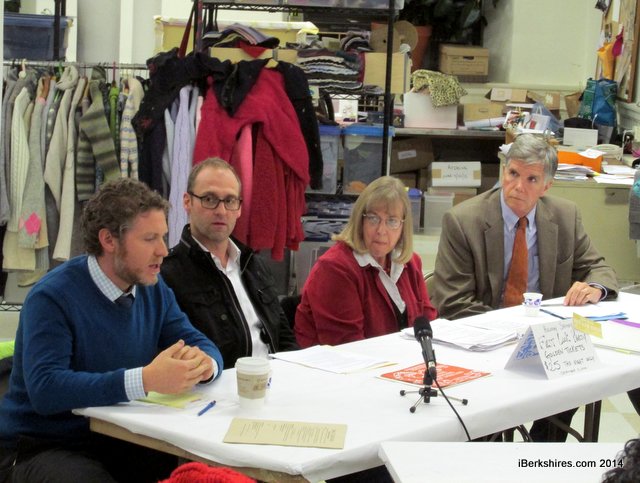
City Planner CJ Hoss, Ian Rasch from Allegrone, Kathy Reilly of the Berkshire Athenaeum's house of local history served on the panel as well. John Dickson, on the right, moderated the discussion. |
That has worked for the Colonial Theatre, the Beacon Cinema, Rice Silk Mill and the Howard building. But for others, the city was powerless in preserving them.
Churches have particularly been a target. The Roman Catholic Diocese of Springfield closed churches throughout the county nearly seven years ago and put them on the market. In North Adams, St. Francis' Church was proposed to be razed to make way for a CVS.
"I just felt like I should get people's voices together and have it be organized," said Darcie Sosa, who headed an effort to save the church.
And she was successful — for now. North Adams doesn't have a redevelopment plan for the building yet but CVS has opted not to demolish it. She gained massive support from the citizens through petitions and gained support of the city administration, which ultimately swayed CVS's decision.
"A lot of residents didn't want to see it torn down," she said.
When St. Mary's was proposed to be demolished, Sosa received multiple emails about it. She headed the same type of effort as she did for St. Francis and has so far gained a lot of support. Dunkin' Donuts franchisee Cafua Management offered to donate the church to the city instead of destroying it. Like North Adams, the city doesn't have a plan for reuse yet.
"The church is a real special place. People are baptized there, married there, laid to rest their loved ones. It is such a meaningful place," Mayor Daniel Bianchi said. "I would love to hear what you ideas are for St. Marys church but I would also like to hear what we should be doing."
The church is in bad condition. City officials toured the building a few weeks ago and cited numerous and expensive problems with the structure. As time goes on, more and more buildings fall into disrepair.
Typically residents don't take action in finding a solution until a proposal to demolish the building is made - and that is often too late. St. Mary's has sat empty for a number of years.
When Springside House was vacated, an array of ideas were talked about but nobody took the lead in development at first. Joe Durwin, president of the Springside Park Conservancy (and a freelance writer for iBerkshires), said the community involvement throughout the entire project is what lead to the development of new plans for the home.
"The Springside House is an interesting example because it was really was a resident, community-driven process," Durwin said.
It took a few years before a group formed and crafted redevelopment plans. Before that, the historic house was essentially forgotten about. As the preservation conversation continued among community members, the momentum grew.
"There were a lot of ideas but nobody was really moving in the same direction. It took time and a lot of willingness to communication," Durwin said.
And they all ended up agreeing. It takes a continual communication among community members and city officials, Durwin said. He said it is important that everybody is heard and all information is out in the open throughout the process so that everybody can be on board with the ultimate plan. And that support needs to continue throughout the entire process.
Durwin suggested strengthening the power of the Historical Commission to get ahead on the historic aspects of the city's buildings, many of which aren't even "on the radar" of the commission.
He also suggested the creation of a countywide agency that will focus on connecting developers with the resources they need — from the research to get tax credits to the grant programs for housing — for an easier redevelopment. That agency could also have a revolving loan fund to help with upfront costs.
Durwin also suggested the city adopt the Community Preservation Act — a property tax program voters rejected about a decade ago.
Architect Tessa Kelly said historic preservation is a driver for urban development — so the effort to save the historic homes is important. She recently spent a year and a half studying the city's relationship between the two.
Tags: church reuse, community forum, demolition, historic preservation, historical building, historical commission,