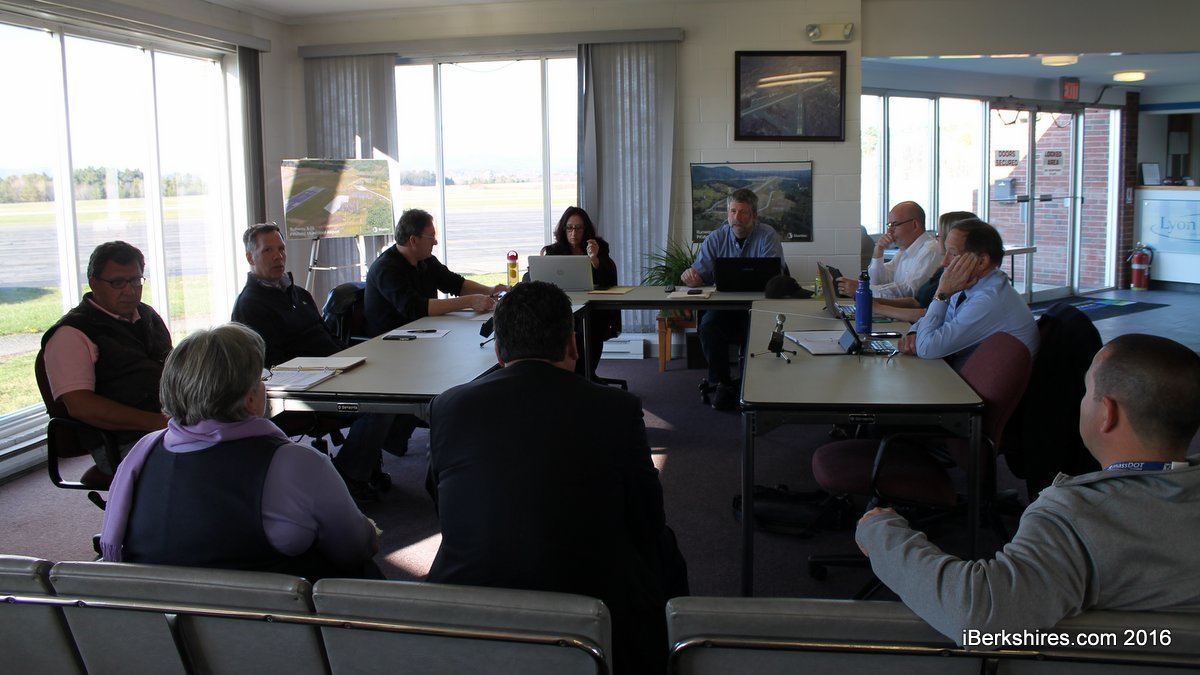
Airport Study Group Continues To Pry Into Westwood Leases
PITTSFIELD, Mass. — PERC President Jay Anderson doesn't think the development of the Westwood Center at Pittsfield Municipal Airport would have happened without FAA approval.
But the only correspondence with the Federal Aviation Agency is a letter disapproving of the leases. Now, a study group is worried that the city could ultimately be on the hook to pay the FAA back for some 30 years worth of leases. The issue was first brought up in March.
In the research so far, it seems there are two federal programs that should have gotten leasing funds on seven parcels.
The city purchased five acres of property abutting airport land and the airport put forth 25 acres of land for the center. The city developed the 30 acres for $506,000 with Community Development Block Grant funding and about $75,000 estimated as the airport's contribution via land value.
The federal Department of Housing and Urban Development administers the CDBG program and requires all income generated to be used for eligible projects. In 1984, the Pittsfield Economic Revitalization Corp. was formed to receive the lease revenue and use it for CDBG activities such as business loans and grants.
However, the FAA also requires that all revenue generated from airport property needs to go back to the airport.
"They want all of your revenues going back into aeronautical use," Airport Commission Chairman Chris Pedersen said.
At the time, an agreement was reached with the Airport Commission that 15 percent of the leases — equivalent to its portion of the development — goes back to the airport and 85 percent goes to PERC. The business park generates around $20,000 each year, with $3,000 going to the city for the airport and $17,000 going to PERC.
"[The leases] were all properly executed. They were all signed off by the Pittsfield Airport Commission," Anderson said.
Pedersen said those 25 acres were purchased by the FAA and in order to construct the park, the FAA would have had to declare the land was excess and could be developed. But the only documentation he can find is a letter from 1986 from the FAA saying it did not approve.
"It seems as if either another deal was struck or it was ignored," Pedersen said.
Pedersen says now that the leases have come to light, officials know there has been non-compliance with the grant assurances, they need to find a resolution. Anderson, however, says he doesn't believe the airport is out of compliance because if city, state and federal officials at the time went through the trouble of creating PERC and developing the land, it doesn't make much sense that the FAA approval was never sought.
"I find it odd that somebody would go this far without approvals," he said.
Former City Councilor Jonathan Lothrop said moving forward, compliance could be a simple fix. Right now the airport is being subsidized by the city so simply creating a "Westwood leases" budget line and funded at the total amount of the leases would be enough of an accounting process to satisfy the FAA requirement on how the revenue is being used. Another option could be to sell the park to pay the FAA back for the land.
But, that doesn't resolve the threat of being audited and being forced to pay 30 years worth of leases, which is the fear of members on the research committee.
"We've opened up this issue and we have to have a solid foundation moving forward," said Ward 5 Councilor Donna Todd Rivers.
Lothrop, however, reminded the group that had the park never been developed, there wouldn't have been any income. Not only is $20,000 or so generated through the land leases, the companies built buildings that are now taxed, generating an estimated $75,000 worth of tax revenue.
"We've created jobs. We've created tax revenue. And we've created revenue for the Airport Commission," Lothrop said.
In the future, Pedersen said the accounting would be smoother if an enterprise fund was created. Right now that $3,000 goes into city coffers and then is allocated back. Each year, the city supplies supplemental funding to keeping the airport afloat.
While the enterprise fund is fairly irrelevant because of the city's contribution, Pedersen said his goal is to make the airport "revenue positive" and a designed airport enterprise account would be vital.
While the leases at the business park had been a center of conversation multiple times during the research phase, the group is continuing to look at raising fees and analyzing the long-term debt. Ward 4 City Councilor Christopher Connell said he'd like to see other models of management be looked at — including leasing the entire operation to a private company.
"That takes us out of the mix and we would only have to worry about the long-term debt," Connell said, adding that a private company would be "more aggressive" in seeking revenue.
Pedersen responded that even if the management was outsourced — as it had been in the past — there is still a require that there is an Airport Commission and the property maintenance would likely still be on the city's shoulders. The airport is managed and maintained by a two-man crew. Lyon Aviation is the fixed-based operator which handles billing and the fuel services.
Connell is also looking at trying to get other communities to chip in for the cost since not all traffic is coming and going for Pittsfield. But, there is nothing to bring those communities to the table nor a way to track where the passengers are going or spending money. He added if not, the city should raise the landing and fuel fees to increase revenues.
Airports are competitive when it comes to revenues so pricing too high could cause more harm than good.
"You might push your business away by increasing," Assistant Airport Manager Brian Spencer said.
Michael Lyon of Lyon Aviation said the local fuel tax charge could go up modestly without harming the business too much. But if all of the fees go up, it could drive traffic away. He said he'd like to see a full proposal of fees before agreeing to raise any prices.
Connell also questioned the cost of maintaining a number of pieces of equipment. The airport is eligible to receive free equipment from military surpluses, including forklifts, sport utility vehicles or parts.
"The cost to repair and maintain some of these vehicles, especially military grade, can be very expensive," Connell said.
Spencer said he is "mechanically inclined" and can maintain the equipment. He said all of the pieces have purposes, such as using the forklift to move tables and boulders. A Hummer SUV was picked up because it has high clearance and is more durable to use for fence inspections that the prior pickup trucks that were getting damaged during the rounds.
"If I use it once throughout the year and it didn't cost us anything but oil, why not?" Spencer said, adding that it makes the work more efficient and the equipment is required to stay on site for only a year. "I'm not just saving the airport money. I'm saving the city money."
Spencer said he can't "buy things for the city" but there are some city vehicles that are used at the airport. For example, if the transmission blows on the "snow fighter" used at the airport, he can get the surplus to fix it so the city doesn't have to.
Tags: airport commission, FAA, leasing, pittsfield airport,