Jarvis Rockwell, 94
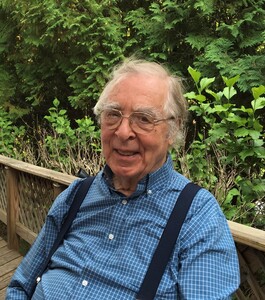
NORTH ADAMS, Mass. — Jarvis Rockwell of North Adams passed away at Bay State Medical Center in Springfield on the morning of April 25, 2026, following a stroke. He had lived his 94 years to the fullest and had rarely been sick, even emerging victorious from a few bouts of cancer.
Jarvis was known for his inventive, detailed artwork which spanned a variety of media, from realistic draftsmanship, to geometric abstractions in pen and ink, to three-dimensional "spider web" installations, to murals, to his massive assemblages of toys.
Jarvis loved to talk with all kinds of people and never passed up the opportunity to start a conversation with a stranger. His booming laughter was instantly recognizable to numerous friends and fans, as were his preoccupations with the afterlife, reincarnation, near-death experiences, alien abductions, modernist poetry, and the burdens associated with having a famous parent. He even enjoyed talking to strangers while creating his art, a rarity among artists, and thrived for many years in a series of Downstreet Art open studios in North Adams, where he worked on murals assembled of found objects, such as googly eyes, used hearing aid batteries, and an assortment of business cards, next to a pyramid of his toys. Toys, he liked to say, were a reflection of "us," of the collective of humankind. He marveled at their ingenuity every day and described them always as "extraordinary."
Jarvis was born on Sept. 3, 1931, to the illustrator Norman Rockwell and his wife, Mary Rockwell, the eldest of three sons. Photos of Jarvis from his earliest days show him erupting in raucous laughter, a trait that he carried with him to the end. In his first year, his parents journeyed to Paris, where his father would spend a year painting. During the journey, it was said that he was temporarily mistaken for the missing Lindbergh baby, although no corroborating evidence has been found to support this claim.
Jarvis spent most of his childhood in Arlington, Vt., where his father moved the family to escape the glare of his celebrity status. He continued on to high school at the Oakwood Friends School in Poughkeepsie, N.Y., where he was full of good humor but showed little academic promise, according to rueful letters written to his mother by the headmaster. Eventually he would follow in his father's footsteps and leave high school for art school, enrolling in The Art Students League in New York City, where he studied drawing with the renowned illustrator George Grosz.
In 1952, he enlisted in the Air Force to avoid the Korean War draft, where he spent a total of two years eight months fourteen days and ten and three-quarters hours, as he liked to remind his family regularly. During that time, he was tasked with drawing portraits and caricatures for the base newspaper, picking up garbage, and giving slide shows to his fellow enlistees about avoiding various diseases. During this time, he also read copiously, a lifelong passion, and fell in love with the works of T.S. Eliot, which would prove an abiding passion for him, and acquired a GED "in a hut on the outskirts of Pusan."
Returning to the U.S. in 1955, he was overwhelmed by depression and anxiety. His worried father consulted with his close friend, the psychoanalyst Erik Erikson, who worked at the Austen Riggs Center in Stockbridge at the time. Erikson advised Jarvis to "go west, young man," by which was meant that he should seek mental health treatment from the analyst Alan Wheelis in San Francisco. Before leaving for San Francisco, Jarvis was asked to judge a children's art show at the Lenox School. He awarded first prize to 13-year-old Susan Merrill, who would become his first wife many years later, for a lipstick on newspaper composition.
Jarvis spent 10 years in San Francisco undergoing analysis with Dr. Wheelis, drawing and showing his work at the Batman Gallery, and working as a delivery man for Lorenzini Brothers Italian Grocery on Fillmore Street. He was also introduced to the legendary Beat poet Alan Ginsberg at this time, in what he felt was a stunt on the part of the introducer, who wanted to see Ginsberg shaking hands with Norman Rockwell's son. The San Francisco years were a happy time for Jarvis, prompting him to regularly remark that he had left his heart there, "underneath the Golden Gate Bridge" (rather than "high up on a hill," as in the song). In 1966, he returned to the East Coast and then embarked on a journey through Europe on a Motovespa which he purchased in Italy.
While visiting his younger brother, the sculptor Peter Rockwell, in Rome, he met Susan Merrill again, now 24 and an art student at L'Accademia di Belle Arti. The two immediately hit it off and set out on a two-month-long odyssey through Europe on the Motovespa. They married soon after their return to the United States and moved to Stockbridge, where they had one child, Daisy, in 1969. The marriage ended in divorce in 1974, but they remained fast friends until the end. At Susan's deathbed in 2017, Jarvis assured her, "I’ll see you up there," referring to heaven, or whatever form the afterlife might take.
Throughout the late sixties, the seventies and the eighties, Jarvis was exhibited, mentored and photographed by the acclaimed photographer Clemens Kalischer, who ran the Images Gallery in downtown Stockbridge. In 1978, following the death of his father, Jarvis purchased a small toy duck and placed it on a shelf in his apartment. Many more toys followed the duck, and the space was soon overrun with action figures, Micronauts, and Transformers.
The toy era in Jarvis' life marked the beginning of a lengthy hiatus from traditional art-making and a focus not only on creating assemblages of toys but surrounding himself and his family with as many toys as possible, for which he enlisted the aid of local carpenter Craig Moffat to build a vast array of meticulously planned shelves in his home on Sargeant Street in Stockbridge. In late 1979, Jarvis arranged a row of action figures in a window facing the house next door, where a woman had recently moved with her two small children. He raised the hand of one action figure in a wave to the children, a heartwarming gesture which won over their mother, an art teacher named Nova Choe, whom he would eventually marry in 1984.
In 2002, Jarvis was delighted to have an exhibition of his toys arrayed on a pyramid, called "Maya," at Massachusetts Museum of Contemporary Art. During that period, he became attached to North Adams, and he and Nova eventually moved there, where he found a rich and fulfilling artistic community and participated actively in Downstreet Art for many years.
Another large-scale pyramid, "Maya II," was commissioned by the Scottsdale (Ariz.) Public Art Program. Although Jarvis declared himself done with making art in his 90s, he continued to surround himself with toys and arrange them in intriguing tableaux all around his house. He also occasionally made impromptu drawings on whatever was at hand, such as paper plates, napkins, milk jugs, or popsicle sticks, and continued to marvel at visual images that startled him with their beauty, such as the refraction of light through a juice glass, the pattern of a tree's branches, or the purple veins on the leaves of a house plant, reminding us that art is all around us and we need only to open our eyes to witness its extraordinary abundance.
Jarvis is survived by his beloved wife, Nova Rockwell; his daughter, Daisy Rockwell, son-in-law, Aaron York, and granddaughter Serafina York; his stepdaughter, SooSun Choe, her partner Joon Park, and step-grandchildren Iksu, Jinsu, Minsu, and Mira; his stepson, Sungwon Choe, and his wife, Gerelmaa Batchuluun, and step-grandchildren Wyatt and Byron.
FUNERAL NOTICE: In lieu of flowers, donations may be sent to the Director's Relief Scholarship fund at the Art Students League of New York here.
To add to the Book of Memories, please visit www.flynndagnolifuneralhomes.com.
Obituary Posted By: