Joan of Archetype: Playwright Explores Timeless Theme With Classic Story
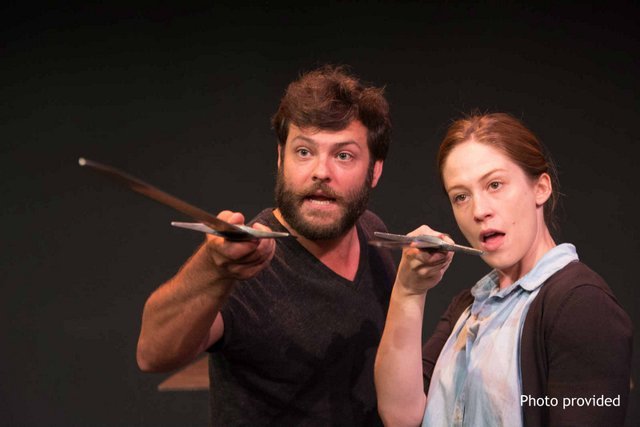
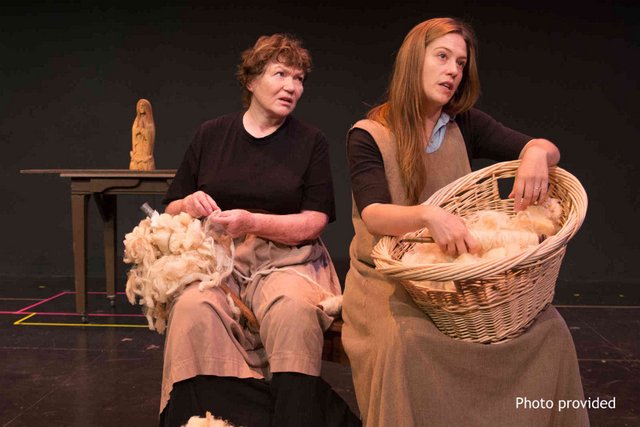 Tina Packer as Isabelle d'Arc and Anne Troup as her daughter Joan. Tina Packer as Isabelle d'Arc and Anne Troup as her daughter Joan. |
This summer, they get both rolled into one.
Thursday marks the world premiere of Jane Anderson's "Mother of the Maid," which tells the story of Joan of Arc through the eyes of her mother, played by the company's founding artistic director Tina Packer.
Like the Shakespeare histories that are a staple at the Kemble Street venue, "Mother of the Maid" uses the famous and the infamous to explore timeless themes and makes the events of yesteryear relevant to a contemporary audience.
"Jane has taken a classical story of Joan of Arc and, first of all, told it through the mother's perspective," director Matthew Penn said recently. "But second of all, she's done this thing where she really told the classical story from a contemporary bent.
"The play, by design, has an anachronistic tone to it. It will seem of the 15th century one moment and of the present day the next. And that's very definitely done by Jane on purpose."
Anderson said she was not striving for the tone of a historical play but appreciates the parallel between her work and, say, "Henry V," which shares the company's Bernstein Stage with "Mother of the Maid" this summer.
"A great history play, like Shakespeare's histories, they're not really about the historical events," she said. "They're about something else. They're about power or betrayal.
"This play is about motherhood. It's about the agony of parenthood. It's not about Joan of Arc."
Like Shakespeare, who wrote about the Roman Empire during the Elizabethan Age, Anderson is using a heroine of the early 1400s in ways that a 21st century audience will comprehend.
"What's been nice is the melding of a new American play, a really vibrant voice, an important American writer and important American actress," Penn said. "Sometimes, the confluence of elements really come together the way you hoped."
Anderson sat down with iBerkshires to talk at length about the development of "Mother of the Maid" and its inaugural production.
Question: Is this your first time in the Berkshires?
Anderson: I love the Berkshires. I was here many years ago. I did a couple of my plays at [the Williamstown Theatre Festival]. I'm a longtime fan of the Berkshires.
Q: Do you live full time on the West Coast or do you split your time?
Anderson: I live full time in the West. I live in Los Angeles, and I have a place in Northern California, where I'm kind of a farmer, country girl. ... Marin, I would say, is like the Berkshires, but it's brown in the summer.
Q: How did this production of 'Mother of the Maid' come about?
Anderson: Matt [Penn] and I were introduced by a dear mutual friend. We were siting at a production at Manhattan Theatre Club. We started talking, and I said I had this play, do you feel like reading it. He said, 'Sure, sure.' And I didn't think anything would come of it. Then he read it and emailed me back and said, 'I love this play. I'd like to do it at [Great Barrington's] Berkshire Playwrights Lab. And Tina Packer and Nigel [Gore] and Lizzie [Aspenlieder] were in the reading last summer.
By a great miracle, we got a production here. Because it's always a miracle when there's a new production of a play. There are so many elements that determine whether a play gets made.
But Matt was insistent and really pushed it through. And Tina wanted to do it. She blows me away, not only here talent and depth as an actress but her astounding intellect as a director and also as a writer and as a visionary of this theater. I'm deeply honored to have her in this play.
Q: When you were writing, did you have an image in mind of the mother, and does Tina Packer fit that image?
Anderson: Yes, because Joan's mother is a peasant woman. She's an earthy, dirt under the fingernails, blowsy, tough, flat-footed lady. And Tina does that kind of working class character really well. Also, my Isabelle Arc is fierce. She is a fierce Mother Courage spirit. And if anybody can do that, Tina can.
Q: What drew you to this subject matter?
Anderson: I've always, always been fascinated with Joan of Arc. When I was a teenage girl, a tomboy, a feisty teenage girl, I just had Joan of Arc books and wanted to wear armor. I loved the idea that a young woman could leave home and do outrageous things and dress like a boy and mix it up on the battlefield.
Then I became a mother, and everything changed. And I understand what an outrageous thing it is for a daughter to ask of a mother to let her do such a thing.
That's what compelled me to write it.
In a way, I'm writing about my younger self and my older self at the same time.
Q: Besides your longtime interest in Joan of Arc did you have to do a lot of historical research for the play?
Anderson: I did a lot of reading. There is a lot of historical information about Joan of Arc, mainly because of her trial. There was a whole army of scribes who took down every word.
... This Joan — I'm not really showing the audience the heroic side of Joan. I'm showing the audience that side of a famous person when they're vulnerable and messy and bratty and with their family and really behaving at their worst.
Because we really have wo sides. We have our public side, which is always fabulous and charismatic and brave and inelligent. And then we have the side of us when we're with our mom and dad and our brothers and sisters. And we're vulnerable. We don't behave really well.
Q: How has the process been being in the room for the development of the world premiere?
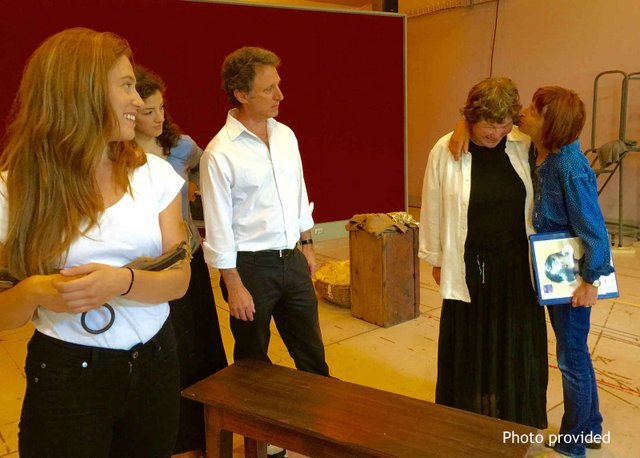
Anderson: Matt Penn is a wonderful director and also a very generous collaborator. He's been perfectly fine with me sitting there and answering questions and cluing the actors in to what's going on in my head, character wise.
Right now, the second week [of rehearsals], I'm staying out of rehearsals so everyone can work on their own. It took me two years to get this in the shape it is now. ... The actors need to have the freedom to try things without me sitting there chewing on my pencil. I now, after two, three years have an absolute image how I wanted the lines to be deliverd and the characters to be portrayed.
And what happens is the writer knows more about the play the first week of rehearsal. But by the end of the month, the actors know more than the playwright. They start teaching me about these characters. They give them a dimension I never dreamed of. That's why you have to walk away.
Q: Is that perspective of yours on the process informed by having been an actress yourself?
Anderson: Yeah. It really, really helps to have been in the vulnerable position of being a performer and knowing what it's like to deconstruct and interpret someone else's words and knowing what it's like to be judged while you're on stage.
I was an OK actor. I was never a great actor. But those years of doing it have made me a really good writer because I know what dialogue feels good in an actor's mouth. I know how to write subtext and beats because I had to struggle with all of that.
Tags: playwright, premiere, Q&A, Shakespeare & Company,