USDA To Destroy 376 Vermont Sheep For Fear Of Mad Cow Disease

Print Story | Email Story
Last week more than 350 sheep were seized from two Vermont farms by the United States Department of Agriculture (USDA), on suspicion that the sheep are infected with a neurological disease that may be bovine spongiform encephalopathy (BSE), more widely known as “mad cow disease.” Early Wednesday morning, March 21, USDA officials seized all 234 sheep from Houghton Freeman’s flock at his farm in Greensboro, Vt. And last Friday morning, another 125 sheep were taken from the Warren, Vt. farm of Larry and Linda Faillace. The sheep have been transported to the USDA’s National Veterinary Services Laboratories in Ames, Iowa, where they will be evaluated and eventually slaughtered. This turn of events has been heavily covered by the national media. Last July the USDA, which has been monitoring the sheep since they were first imported from Belgium and the Netherlands in 1996, determined that six of the sheep had tested positive for a neurological disorder known as “transmissible spongiform encephalopathy” (or TSE). Mad cow disease, along with several other neurological diseases, falls under this larger family of TSEs. Historical background Mad cow disease, hereby referred to as BSE, was first discovered in 1980 in Britain, where cows displaying strange behavior were found to have a rare neurological disorder that, as it progresses, causes brain lesions and sponginess, and ultimately death. Subsequently, millions of cows were slaughtered in Britain and in other European countries through the mid-1990s, devastating the livestock industry in these countries. It is believed that the disease originated from contaminated feed, which often includes ground-up brain material from other animals. These materials are fed to animals because of their source of protein; it is also a protein (actually, an infectious protein called a “prion protein”) that carries the fatal TSE virus into the animal’s brain. A parallel form of BSE that affects humans is called Creutzfeldt-Jakob disease (CJD). Like BSE, CJD attacks the central nervous system and eats away at the brain, causing “symptoms of obvious dysfunction, progressive dementia, vacuolar degeneration of the brain,” and finally death, according to information from the USDA. According to Dr. Elizabeth Adler, a neurobiologist at Williams College, the disease spreads as the diseased prion protein converts the other proteins in the brain to replications of itself. She said TSEs are unusual because a virus almost always has a nucleic acid, as in DNA or RNA, in its cell structure. However, a protein enzyme has no nucleic acid in its structure, which makes it a mystery as to how the disease originated. There are two forms of CJD: “classical CJD,” which was first discovered in the 1920s, affects about one in a million people worldwide, usually those over the age of 65. What is now known as “variant CJD” or “bovine CJD,” was first discovered in 1995 when several Britons were diagnosed with symptoms similar to classical CJD. However, those diagnosed were much younger — between the ages of 14 and 53, with an average age of 28 years — and the disease lasted slightly longer — an average of 13 months until death, compared to six months before death in classical CJD. It was determined, therefore, that this new form of CJD must be related to some other cause, and the most obvious connection to draw was that between the infected cows of the 1980s-early ’90s and the meat these people were eating. Bovine CJD claimed its first victim almost exactly five years ago: March 20, 1996. Since then, 95 deaths from Bovine CJD — 92 in Britain, two in Ireland and one in France — have been reported (as of March 2, 2001), and five living individuals have been diagnosed with the disease. No cases, either of BSE in livestock or of variant Creutzfeldt-Jakob Disease in humans, have ever been reported in the United States. What makes variant CJD so potentially scary is that its incubation period — the time between when the virus first enters the body and when the first symptoms occur — is thought to be more than 10 years, and as many as 30 years. In recent years, annual death tolls have increased, with 27 people dying of Bovine CJD in 2000 compared to 15 in 1999. A sheep has never been diagnosed with BSE. Sheep have, however, been well known, since the early 18th century, to be subject to a fatal neurological disease called “scrapie,” which is also under the TSE family. Unlike BSE, scrapie has a short incubation period of only one to two years, and while being fatal to the sheep, it has been proven not to be harmful to humans. Since the discovery of BSE and Bovine CJD, the U.S. has been extremely vigilant in protecting the food supply from these contaminants. For instance, in 1998 legislation was passed that forbids any person who has spent a cumulative of six months or more in England, between 1980 and 1995, from donating blood through the Red Cross. Similar measures have been taken with regard to the importation of meats and livestock. [On a somewhat related note, the recent epidemic of the foot-and-mouth disease has caused the British government to slaughter more than 380,000 animals, with another 200,000 to be killed in the near future, according to the latest reports. Unlike BSE, foot-and-mouth disease causes no threat to humans (only one human case has ever been reported: a British farmer in 1966 caught the disease, which gave him a mild fever and blisters on his hands and between his toes for five weeks). But being highly communicable, it poses serious threats to the agriculture industry, as its symptoms (which affect cloven-hoofed animals such as sheep, pigs and cows, causing sores, severe weight loss and often death) can wipe out a herd quickly. There is, however, a vaccination; currently, European governments are deciding whether to kill the animals or issue the vaccination — if they do the latter, they would be restricted from exporting their meat products for 12 months.] Controversy in Vermont The sheep confiscations in Vermont date back to an ongoing court battle between the USDA and the two farmers involved. Contacted last Friday, a USDA official from the Vermont Sheep Task Force in Montpelier explained how the situation arose. “For a brief period in 1996, regulations were opened and closed that allowed these sheep to be imported from Holland and Belgium,” he said. During this short window of time, the Freemans and the Faillaces acquired sheep from these countries. Due to stipulations of the initial purchase, the USDA has been actively monitoring both flocks since they arrived in 1996. In 1998, acting on a report that stated the sheep might have been exposed to contaminated feed, the USDA required both farms to quarantine the imported sheep. Then, according to the spokesperson, last summer four of the sheep “became ill” with what seemed to be a neurological disorder. “As soon as we received positive test results [for a TSE],” the USDA commissioner declared an “extreme emergency,” which authorizes the USDA to confiscate the sheep, he said. Subsequently, both farmers took the decision to U.S. District Court, which earlier this month overturned their appeal this month after a nine-month hearing. Both farmers contend that the USDA has overreacted to the situation, and both have sued seeking renumerations higher than those offered by the USDA. The USDA official said the farmers were offered “fair market value” for their sheep — in excess of $2 million — but the farmers contend that doesn’t make up for the losses in products and other income, which they peg at more than $4 million. Apparently, the sheep are a rare breed that is native to Europe and well-known for producing milk that is made into a special blend of gourmet cheese. The USDA maintains that the sheep must be killed because the threat of BSE is too grave. The sheep owners maintain that the USDA is acting too rashly, especially because there has never been a single recorded case of BSE in a sheep. They argue that if sheep were susceptible to BSE, the sheep population in England and Europe would long ago have been infected. What is the likelihood, they ask, for a sheep to suddenly contract BSE in a twice-removed country with no history or known cases of BSE? They also contend that there is a test that could determine whether the disease is BSE or the more benign “scrapie,” which is a far more common disease that is well-documented in sheep. Dozens of protesters were on hand outside the two farms as the USDA officials carted away the sheep. In front of U.S. Rep. Bernie Sanders’ (I-Vt.) Montpelier office, a similar rally was taking place by citizens who were skeptical of the USDA’s decision to cause a national stir over what is probably just another bout of scrapie. Meanwhile, the USDA maintains it will let the public know the full results of the evaluation, once all the results are collected. If you are interested in following this issue, the web site mad-cow.org provides an extensive body of information and news articles about mad cow disease and related topics.
If you would like to contribute information on this article, contact us at info@iberkshires.com.

McCann Recognizes Superintendent Award Recipient

By Tammy DanielsiBerkshires Staff
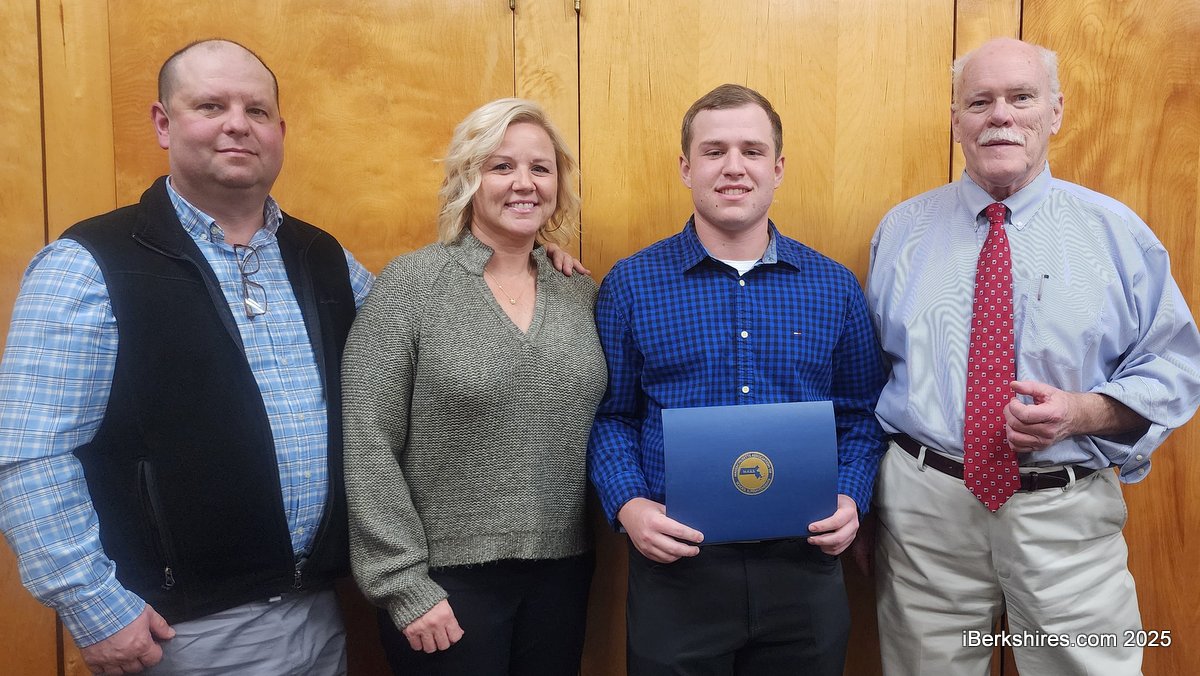
Landon LeClair and Superintendent James Brosnan with Landon's parents Eric and Susan LeClair, who is a teacher at McCann. 
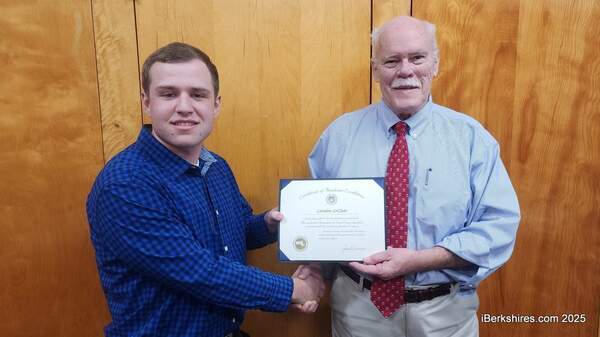
NORTH ADAMS, Mass. — The Superintendent's Award has been presented to Landon LeClair, a senior in McCann Technical School's advanced manufacturing course. 
 
The presentation was made last Thursday by Superintendent Jame Brosnan after Principal Justin Kratz read from teachers' letters extolling LeClair's school work, leadership and dedication. 
 
"He's become somewhat legendary at the Fall State Leadership Conference for trying to be a leader at his dinner table, getting an entire plate of cookies for him and all his friends," read Kratz to chuckles from the School Committee. "Landon was always a dedicated student and a quiet leader who cared about mastering the content."
 
LeClair was also recognized for his participation on the school's golf team and for mentoring younger teammates. 
 
"Landon jumped in tutoring the student so thoroughly that the freshman was able to demonstrate proficiency on an assessment despite the missed class time for golf matches," read Kratz.
 
The principal noted that the school also received feedback from LeClair's co-op employer, who rated him with all fours.
 
"This week, we sent Landon to our other machine shop to help load and run parts in the CNC mill," his employer wrote to the school. LeClair was so competent the supervisor advised the central shop might not get him back. 
 
View Full Story

More North Adams Stories