George Weigel, author of the most definitive biography to date of Pope John Paul II, presented his case for him as the most emblematic figure of the 20th century.
Weigel, author of the 1,016-page biography, Witness To Hope, first published in 1999, indicated that the Pope’s witness and thought will be influential and studied for meaning far into the 21st century. Weigel, a senior fellow of the Ethics and Public Policy Center, spoke at Williams College April 23 to an audience of about 300 at Thompson Memorial Chapel.
In media consideration at the end of 1999 of who was the emblematic figure of the 20th century for good or ill, there was no lack of candidates for the position. Weigel mentioned a number of political leaders, scientific discoverers, and thinkers who were considered.
“We all know that there’s an element of the arbitrary in all of this list-making. But indeed here is an instance where the post-modern passion for hermeneutics or interpretation makes eminent sense. For in choosing who might be the emblematic figure of the 20th century, it really is a matter of how one looks at things, in this instance how one looks at the dynamics of history,†he said. “If one believes that politics is not an independent variable in human affairs, if politics is a function of culture, and if at the heart of culture is ‘cult’ — religion — what we cherish and what we worship and what we honor, then a serious case can be made, I think, for Pope John Paul II, this man who most singularly embodies humanity’s trials and triumphs in the 20th century.
“One facet of that case for John Paul II’s preeminence is the institution. The Roman Catholic Church has arguably been the most influential religious community in the past ten decades in shaping the world the 21st century is now unfolding. The Catholic Church has been decisively formed for this new century by John Paul’s authoritative interpretation of the Second Vatican Council, the most important religious event of the 20th century,†Weigel said. “Therefore, John Paul II can be considered the 20th century’s seminal figure.â€
Moreover, John Paul’s thought will be institutionally developed and carried into the future.
“There is a deeper, and I believe more interesting argument that can and should be explored,†he said. “John Paul II is not arguably the emblematic figure of the 20th century simply because his teaching and witness, which have had such a demonstrable impact on the history of our times, will be institutionally extended into the future, unlike Churchill, Stalin, Mao, or FDR. No, John Paul II is arguably the iconic figure of the 20th century because his life evolved, personally and spiritually and intellectually, the human crises with which Churchill, Lenin, Stalin, and FDR, not to mention Watson and Crick, Einstein...Fermi, Bohr, and Freud were all engaged in their distinctive ways.
“And his teaching, which has emerged from a profound philosophical and theological reflection on those crises, has demonstrated a resilience, indeed the indispensability, of religious conviction in addressing the crisis of contemporary humanism,†Weigel said. “The 20th century, which began with the confident assertion that a maturing humanity had outgrown its need for religion, proved that human beings could indeed organize the world without God. It also proved that in doing so, human beings could only organize the world against each other. And in doing so, humanity was brought to the brink of catastrophe on more than one occasion.
“Finally, if one believes that the Christian movement bears the truth of the world’s story, then John Paul II looms very large indeed. So, of course, do others: Billy Graham, who gave a new dynamism and unprecedented world-wide reach to evangelical Protestantism; Karl Barth, the embodiment of the last great effort within the 16th century Reformation traditions to reconstitute Christian orthodoxy apart from Rome or the Christian East,†he said. “But neither Billy Graham nor Karl Barth became the kind of global moral witness that John Paul II has become. And in that sense, for the Pope insists that his public moral witness is always and everywhere a function of his Christian faith, neither Graham nor Barth was the kind of evangelist that John Paul II has been throughout the worlds within worlds of global humanity.â€
“Inviolable mystery of the personâ€
In 1968, Karol Wojtyla, then-Cardinal of Krakow, Poland, wrote a letter to his friend Henri de Lubac, a French Jesuit theological, about a large-scale philosophical project in which Wojtyla was engaged devoted to the “metaphysical sense and mystery of the person.â€
This was in response to what he saw as the degradation and pulverization of the fundamental uniqueness of each human person. He proposed a kind of recapitulation of “the inviolable mystery of the person,†Weigel said.
“That radical humanism, that life-forming commitment to the inviolable mystery of the person, was and is Karol Wojtyla’s response to an era in which false humanisms had created mountains of corpses, an ocean of blood, Auschwitz and the Gulag, abortion as a widespread means of fertility regulation, and the prospect of the bio-technical remanufacture of the human condition,†he said. “In thinking through, preaching, writing about, and acting upon the implications of a radical humanism worthy of the human person John Paul II addressed three of the most pressing issues on the human agenda in a way that seems likely to shape the debate on those issues long into the future.
“In the first instance, he boldly challenged the notions rampant throughout the 20th century that either politics or economics was the engine of world historical change,†he said. For John Paul II the engine of world historical change is culture. This view is shown in what he said to Poles on a visit in 1979 and to Cubans in 1998. “In both Poland and Cuba, communist regimes had held a historic Christian nation in their grip for 40 years. In both Poland and Cuba, John Paul addressed that particular political form of human pulverization by restoring to a people its authentic history and cultural memory.â€
“In both...John Paul said in various ways without ever making reference to the regime then in power: ‘You are not who they say you are. Let me remind you who you are. You — Poles, Cubans — are Polish or Cuban, because Christianity was the crucial factor in creating the human reality called Poles or Cubans. Reclaim that source of your identity, deepen your commitment to it, and you will be free in a way that no worldly power can ever take away from you,’ †he said. “The results in Poland were evident within 14 months. The ‘revolution of conscience’ launched by John Paul II in June 1979 gave birth in Gdansk in August 1980 to the Solidarity movement, and nine years of non-violent struggle later, communism was finished.
“The results have not been as rapid or as dramatic in Cuba, but Fidel Castro and those who would continue his style of government cannot be optimistic about the ultimate [outcome],†he said.
A second pressing human issue addressed by John Paul II is the sexual revolution, “which viewed in the long run of history is another attempt to redefine the human condition in the name of a certain concept of freedom,†Weigel said.
“World Christianity’s early response to the sexual revolution was not impressive. Much of liberal Protestantism simply surrendered to it. Pope Paul VI’s 1968 encyclical Humanae Vitae [On Human Life], the first major papal attempt to address the implications of the sexual revolution after it had broken out into the mainstream of Western culture had been a pastoral failure despite its courageous affirmation of essential moral truths about love and procreation,†he said. “When John Paul II was elected ten years later, the Humanae Vitae episode had contributed to a serious credibility problem on the part of the Catholic Church on a host of other related issues. And just at the moment when the human wreckage caused by the sexual revolution had begun to cause some second thoughts among its former enthusiasts, especially among women, the Catholic Church it seemed had little to contribute to restructuring the argument. Then came John Paul II and his distinctive and impressive theology of the body.â€
The Pope presented this in 129 general audience addresses in 1979 and 1984.
“Its philosophical core is Karol Wojtyla’s claim that what you might call a ‘law of the gift’ — the law of self-giving — is built into the very structure of human being in the world, and because of that, self-giving not self-assertion, is the royal road to human flourishing,†Weigel said. “Sex, as often experienced in today’s sexual free-fire zone, is instinctive and impersonal. But that kind of sex, Wojtyla argues, does not rise above the level of animal sexuality, which is also instinctive and impersonal. Sex that is the expression of self-giving love, not the use of the other for temporary gratification, is the only sex worthy of human beings.
“Chastity on this analysis is what Wojtyla calls ‘the integrity of love.’ Chastity is the virtue that makes it possible for me to love another as a person. We are made free...so that we can make the free gift of ourselves to others. We are free so that we can love freely and thus love truly,†he said. “Genuine freedom, freedom that disposes of itself in self-giving, is the context of a genuinely humanistic sexual ethic.â€
“It will be well into this 21st century before the Catholic Church, much less the wider culture, even begins to assimilate the contents of John Paul II’s theology of the body,†Weigel said. “But for the moment it is worth noting that the Bishop of Rome, often assumed to be the custodian of a tradition deeply scarred by a...deprecation of human sexuality has in fact articulated a deeply humanistic response to the sexual revolution that says to the readers of Playboy and Cosmopolitan alike, ‘human sexuality is far greater than you imagine.â€
Weigel is author of The Courage To Be Catholic: Crisis, Reform, and the Future of the Church, published in 2001. It is a response to the sexual abuse crisis in the Catholic Church in the U.S., which exploded into the headlines in the first half of that year. Weigel takes what many would call a conservative view — that the crisis was the result of a lack of fidelity to authentic Catholic teaching, both by offending priests and the bishops who in several cases did not put a stop to their crimes and transferred them to new parish assignments. He dismisses calls for married and/or women priests and bishops.
Thirdly, Weigel said at Williams, John Paul’s radical humanism has helped recast the debate about the future of public life in free societies. While John Paul II supports democracy and market-oriented economies, both seemingly ascendant after the fall of communism in 1989, he has seen new threats to the human person in the post-Cold-War world.
“He spent much of the decade of the 1990s trying to explain that freedom detached from moral truth, the ‘freedom of indifference’ that dominated the high culture of the triumphant West, was inevitably self-destroying,†Weigel said. “Freedom, the Pope argued, untethered from truth is freedom’s worst enemy. For, if there is only your truth and my truth and neither one of us recognizes a transcendent moral standard — call it ‘the truth’ — by which to adjudicate our differences, then the only way to settle the argument is for you to impose your power on me, or for me to impose my power on you.â€
“Similarly, on the economic front, unless a vibrant public moral culture disciplines and directs the explosive human energies let loose by the free market, the market ends up destroying the culture that makes it possible,†he said.
“It is self-evidently clear that this vision of the free, prosperous, and virtuous society, itself the product of the radical humanism of Karol Wojtyla, has not won the day in the developed world, but the proposal is out there,†Weigel said.
If you would like to contribute information on this article, contact us at info@iberkshires.com.
Your Comments
iBerkshires.com welcomes critical, respectful dialogue. Name-calling, personal attacks, libel, slander or foul language is not allowed. All comments are reviewed before posting and will be deleted or edited as necessary.
No Comments
McCann Recognizes Superintendent Award Recipient
By Tammy DanielsiBerkshires Staff
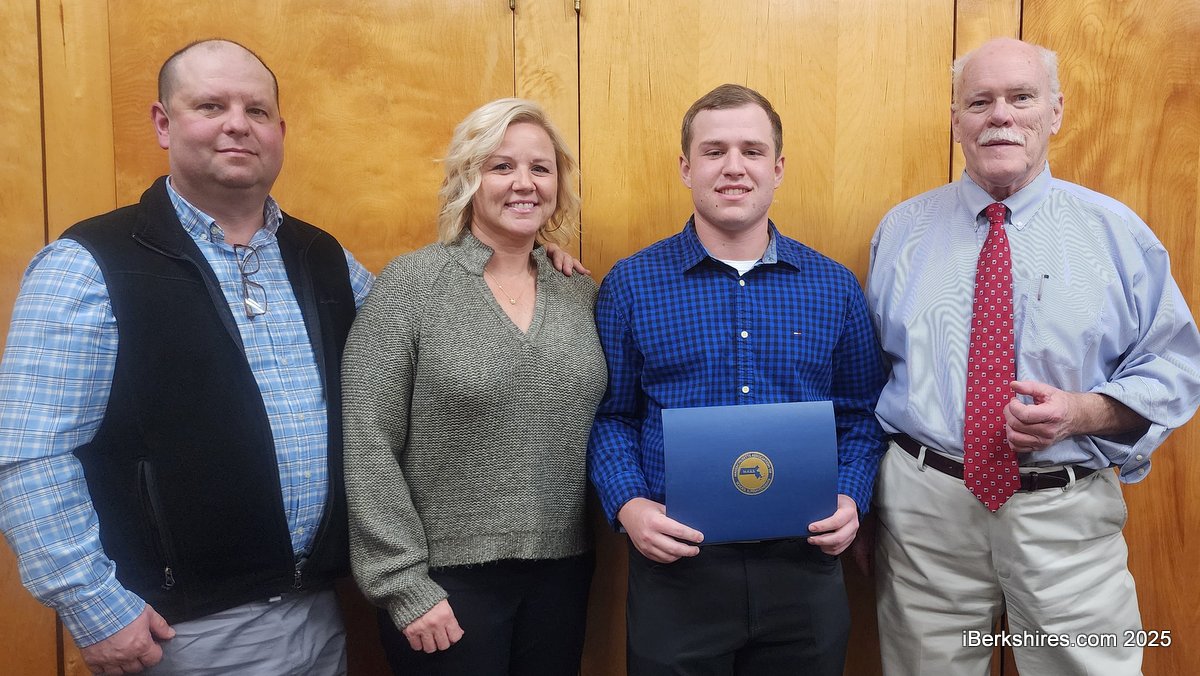
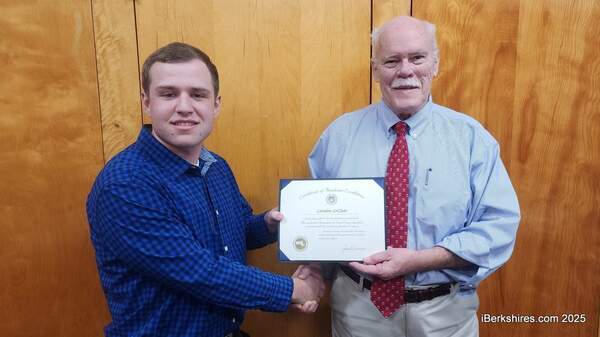
Landon LeClair and Superintendent James Brosnan with Landon's parents Eric and Susan LeClair, who is a teacher at McCann.
NORTH ADAMS, Mass. — The Superintendent's Award has been presented to Landon LeClair, a senior in McCann Technical School's advanced manufacturing course.
The presentation was made last Thursday by Superintendent Jame Brosnan after Principal Justin Kratz read from teachers' letters extolling LeClair's school work, leadership and dedication.
"He's become somewhat legendary at the Fall State Leadership Conference for trying to be a leader at his dinner table, getting an entire plate of cookies for him and all his friends," read Kratz to chuckles from the School Committee. "Landon was always a dedicated student and a quiet leader who cared about mastering the content."
LeClair was also recognized for his participation on the school's golf team and for mentoring younger teammates.
"Landon jumped in tutoring the student so thoroughly that the freshman was able to demonstrate proficiency on an assessment despite the missed class time for golf matches," read Kratz.
The principal noted that the school also received feedback from LeClair's co-op employer, who rated him with all fours.
"This week, we sent Landon to our other machine shop to help load and run parts in the CNC mill," his employer wrote to the school. LeClair was so competent the supervisor advised the central shop might not get him back.
The city has lifted a boil water order — with several exceptions — that was issued late Monday morning following several water line breaks over the weekend. click for more