Re-hearsing for the Halloween Parade
By Kate AbbottPrint Story | Email Story
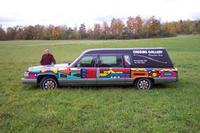
Albert Gordon stands behind his hearse with African symbols in Stephentown, NY (Submitted Photo)
Stockbridge — “It’s a circus car.” “ No, it’s art.” Children walking to school puzzled over a Cadillac hearse painted with bright African symbols, outside of Origins Gallery last week. It may have elements of both art and carnival, but as far as its drivers are concerned, the hearse is primarily sheer fun. Albert Gordon and Judith Schuchalter, who own and run Origins, drove the hearse near the head of the Halloween Parade in New York City, Oct. 31, surrounded by dancers, drummers, stilt dancers, and family and friends in masks and robes that Gordon has collected in more than 50 trips to Africa. Gordon designed the hearse’s new paint job based on symbols the Ndebele people developed in South Africa, he said last week. He admires their abstract designs and colors. “They paint adobe houses in compounds like this. They use these symbols in wedding costumes and textiles. Two years ago, I went to see them. They’re very remote and hard to find,” he said. He has always wanted a funky hearse, he said. He was driving down a small road in Rennssalaer County recently and found a hearse for sale at a country auction. He designed the symbols for it, with the help of his vast library of African art books and found Pittsfield artist Bob Stone to paint it for him. He paint the hubcaps himself, he said. His design merges the symbols for protection, health, joy and connection. “It’s an inside-out car. People’s first reaction to a hearse is sadness, and the sadness gets turned around,” he said. “For the Ndebele, art is a celebration of life, an affirmation. It’s the best instincts of the women — it’s the women who do the decorating — to show how creative and inventive they are.” He said he felt it was appropriate to transfer their symbols to the hearse. There are so many different people in Africa, he said, that they mourn or honor death in many different ways. Some have large celebration funerals, similar to the ones in New Orleans, and some carve elaborate coffins in any shape from fish to Mercedes. “When we were on 139th Street in Harlem, talking to the dancerskids walking by the hearse, they were laughing, high-fiving, giving us the thumbs up,” he said. “It’s a real ice-breaker. It’s an innocent and casual way for people to connect with strangers. People enjoy that. It’s a rare occurrence.” The invitation to bring the hearse to New York came as a complete surprise, he and Schuchalter said. Gordon began driving the hearse around New York state as soon as the paint dried on it. He ran into a photographer on one of these trips, who took pictures of the car. “He must have known someone in the parade, because I got a call a couple of days later, and we were invited to participate,” Gordon said. “We’ve gotten so friendly with the organizers since then, we were bumped from the 10th to the 4th position.” Ben & Jerry’s, who underwrite the entire parade, got the first three positions, Schuchalter said; the hearse could not rise any higher. Fifteen groups of floats marched down 6th Avenue through Greenwich Village, to 21st Street. The parade took four hours to cover the mile-long stretch. “It was amazingly wonderful. They had more people han they expected, and peple were drawn to the heare. They danced on the hood and the roof,” Shuchalter said. The organizers separated every vehicle by 1,000 costumed dancers on either side. The official parade ended about 10 p.m., but masqueraders marched through the streets and gathered in parties for hours afterward. “It’s a Mardi Gras thing,” Gordon said. “It started small, with students from the art schools downtown, and it just grew. We remember when we used to just saunter around the Village streets, and they were just filled with revelers.” Gordon and Schuchalter recruited dancers and musicians to march with them. They found Lamin Thiam, an internationally known Senegalese dancer who taught at Jacob’s Pillow Dance Festival this summer, through friends. He led the dancers with Mamasata, who also danced solo. “He is gentle and powerful. It’s an amazing juxtaposition. She is a young dancer with great vibrancy,” Gordon said. Marku, a stilt dancer, and a group of jembe players — drummers— surrounded the hearse and borrowed it for changing costumes during the three-hour march. Gordon and Schuchalter sent out the word to their friends and families, too, and packed costumes for them from their own collection — a calabash mask showing the heads of two female ancestors, from a Nigerian people decimated in civil war; a coat covered with the symbols of a warrior from Mali; a shirt printed and sewed in a marketplace in the Ivory coast, near the border of Liberia; a chief’s robe from Nigeria; a feathered headdress from Cameroon. “Everything was made to be used,” Gordon said, showing a carved drum-beater, a slender girl of reddish wood, supporting a moon and an antelope above her braided hair, that he had gotten from a missionary and collector on the Ivory coast. “This would have come in a procession, following the king.” Gordon has gathered many ceremonial costumes and works of art on his 50 journeys to Africa over the last 35 years, and he and Schuchalter have traded in art from all corners of the world. Schuchalter has joined him on some of his travels. She came with him to the marketplace in the Ivory Coast, marveled with him at people in bright cloth tending farm animals and caught malaria with him in an isolated game park. Before they came to the Berkshires, they ran two galleries in New York, one uptown near the Museum of Modern Art and a wholesale shop downtown, with a staff of 30 people. African art had just begun to be recognized worldwide, and Gordon said he and Schuchalter became the principal importers in the country. In 1985, they closed both galleries and donated most of their costumes to the Museum of Natural History, when Gordon went into the Peace Corps in Western Africa. They opened Origins in New Lebanon in 1997, and moved it to Stockbridge the following year. Now that the parade is over, Gordon said, he will head off again — this time to Bolivia, Ecuador and Polynesia. He said he will spend 10 days in West Africa on his way home. The hearse will meet him at the airport. It is his and Shuchalter’s primary vehicle now. “And when he’s away, I get to drive it,” Shuchalter said.
If you would like to contribute information on this article, contact us at info@iberkshires.com.

Friends of Great Barrington Libraries Holiday Book Sale

GREAT BARRINGTON, Mass. — The Friends of Great Barrington Libraries invite the community to shop their annual Holiday Good-as-New Book Sale, happening now through the end of the year at the Mason Library, 231 Main Street. 
 
With hundreds of curated gently used books to choose from—fiction, nonfiction, children's favorites, gift-quality selections, cookbooks, and more—it's the perfect local stop for holiday gifting.
 
This year's sale is an addition to the Southern Berkshire Chamber of Commerce's Holiday Stroll on this Saturday, Dec. 13, 3–8 PM. Visitors can swing by the Mason Library for early parking, browse the sale until 3:00 PM, then meet Pete the Cat on the front lawn before heading downtown for the Stroll's shopping, music, and festive eats.
 
Can't make the Holiday Stroll? The book sale is open during regular Mason Library hours throughout December.
 
Proceeds support free library programming and events for all ages.
View Full Story

More Stories