Coyote attack on Hinsdale dog fuels worry
By Anthony FydenPrint Story | Email Story
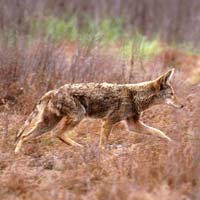
A coyote in a familiar posture:always hunting for prey. (Photo Courtesy of the Massachusetts Division of Fisheries and Wildlife)
Thirty years ago, coyote sightings in Massachusetts were rare. Wildlife officials even speculated that the elusive dog-like animals seen by rural residents were actually lean, long-fanged hybrids of dogs and western coyotes — or perhaps part wolf. These days, it’s common to see coyotes loping across a field on the edge of a forest and to hear their yelping howl at twilight. Unfortunately, it’s not unusual to hear about family pets and livestock, such as cats, small dogs or chickens, disappearing, becoming the victims of hungry coyotes. The latest such attack occurred in Hinsdale this past week, when a small dog named McDougal, left outside for a few minutes on a leash, was attacked and killed by a pair of roaming coyotes. Whether the coyotes viewed the dog as a meal or as a threat is not clear, wildlife experts said. What is apparent is that the lines between coyote and human habitats are blurring. “There will always be clashes between wildlife and people, especially in the densely populated areas where the woods extend right into town — areas of suitable habitat for coyote like Great Barrington or Pittsfield,” said Anthony Gola, a biologist for MassWildlife’s western district office in Pittsfield. Gola emphasized that, given the adaptability of coyotes, humans should use common sense to protect themselves and their pets or livestock. He said the Hinsdale incident underscored how quickly an attack can take place. “It's just an extremely unfortunate incident,” he said. “The dog was outside for about 10 minutes, on a leash but unattended. It may have been [attacked] for food; it may have been perceived as a rival. There’s no way of knowing.” He noted that the hunting season for coyotes extends from Nov. 1 through the end of February, one of the longest hunting seasons for any animal. But the coyote’s only predators are humans, who have limited tools and limited interest in hunting the elusive canines. Since migrating to New England in the early 1950s, coyotes have adapted well to the region. Woodland is relatively plentiful, small game is abundant, and humans are quite accommodating, wasting large amounts of food and making it easily accessible to scavengers. In this environment, coyote populations have spread across the state, from the Berkshires to Provincetown and everywhere in between. The only areas of the state that remain coyote-free are the islands of Martha’s Vineyard and Nantucket, according to wildlife officials. In the most frightening coyote clash, a 3-year-old boy was attacked while playing on a swing set in his back yard in Sandwich in 1996. The boy suffered serious wounds but survived. The coyote, which had apparently harassed other humans, was hunted down and killed. Human attacks, however, are extremely rare; the Sandwich case was the only such tragedy in the state in the last 50 years. With coyote concern growing, people are wondering just how large the population has grown and how close to human centers they are actually living. Wildlife officials are wondering the same thing. Surprisingly, they have no real way of knowing. “We get that question all the time,” said Chrissie Henner, a MassWildlife biologist who specializes in furbearing animals. “Unfortunately, since the trapping ban of 1998, we haven’t been able to get that information.” Wildlife officials would like the ability to use certain traps to capture coyotes, tag them with radios and then let them loose so they could be tracked. But the trapping ban, supported overwhelmingly by voters in the 1996 Question One referendum, effectively prohibits all types of regulated trapping. The ban goes for hunters and encompasses state wildlife officials as well. It covers new, more humane soft-catch traps, as well as the Conibear leg traps that were at the heart of the original law. Henner said she believes the trapping ban brought about a major shift in wildlife monitoring and control, affecting many animal populations such as beaver, raccoon, bear — and coyotes. “It does show the consequences of not having the most effective tools,” she said. “Humans are the coyotes’ only predator. When we start limiting these traps — when we stop playing our role as a predator — they start losing their wariness.” She pointed out, however, that with or without trapping ability, coyotes would be abundant in the state. The animals are highly adaptable, are most active at night and are smart enough to avoid humans in most cases. Basically, as long as food is around, coyotes will be around. Spurred by complaints about beaver, bear, coyotes, skunks, raccoons and other animal conflicts, some state legislators are seeking to modify the trapping laws or eliminate the ban altogether. Some environmentalists are already up in arms over this effort, perhaps setting the stage for a showdown in the near future. State Rep. Shaun Kelly, R-Dalton, is among legislators who want to at least take a hard look at the impact of the trapping ban and perhaps make changes if needed. “My sentiment is that whenever you abruptly change a law, such as what happened with Question One nearly a decade ago, you are really embarking on an experiment,” Kelly said. “As public officials, we need to assess the effectiveness of that policy.” Before the law passed, Kelly noted, trappers, under the state’s regulatory control, checked wildlife populations — at no cost to taxpayers. It followed that when the law changed, certain animal populations were going to grow, and there would be an impact on humans. “My position is we need to have a dialogue and assess where we are right now,” Kelly said. He said he was concerned that many residents may assume that the state is still keeping track and controlling wildlife populations, even though some important tools have been taken away. He said his greatest fear is that only “a truly tragic incident” — a deadly bear or coyote attack on a child or the destruction of homes by a beaver dam breach — will spur the public and the Legislature to act. “These are important issues,” he said. “The black bear population is growing substantially. The beaver population is growing substantially. The number of human interactions is growing substantially. If something catastrophic ever occurred, if just one incident ever occurred, I would guarantee you that the government would react. I don’t want to operate that way. I want to be proactive.” Kelly acknowledged that the issue of animal trapping and population control is an emotional one — the Question One debate included ads showing dogs and other animals with missing limbs. As a public official, however, he said he believes a debate must take place. “I think we need to stick to the facts,” he said. “[Question One] was an experiment, so let’s assess it. I don’t know what it’s going to take, but I don’t want to be a representative who reacts only after something bad happens.” Coyotes are about the size of a medium-size dog, but with longer, thicker fur. They usually carry their long bushy black-tipped tails pointed down. Their snout is long and slender, and their ears pointed and erect. The pelts of Massachusetts coyotes range from grayish-black to blonde, light tan, dark tan or even black. Coyotes can weigh as much 50 to 60 pounds, with males a little bigger than females. Because of their thick fur, coyotes often look heavier than they actually are. They will eat just about anything available, including small rodents, rabbits, deer, birds, snakes, frogs, and insects — and small pets. They will also munch on fruits, berries, vegetables, garbage and pet food left outdoors. They do not hibernate and can be seen year round and at any time of day, although sightings at dawn or dusk are most common. The bottom line is, they are here to stay, and residents should be extremely careful. Even just going for walk in a state forest or local woods can be dangerous for pets. “If you let [a dog] run free-range out in the woods, he may not come back,” Gola warned. “In that one instance, a beloved family pet is gone.” Dealing with coyotes Mass Wildlife has offered the following tips for preventing coyote conflicts: • Secure your garbage: Coyotes will raid open trash materials and compost piles. Use tough plastic containers with tight-fitting lids and keep them in secure buildings when possible. Take out trash the morning its pickup is scheduled, not the previous night. Keep compost piles in containers designed to contain but vent the material. • Don't feed or try to pet coyotes: Keep wild things wild! Feeding, whether direct or indirect, can cause coyotes to act tame and, over time, may lead to bold behavior. Coyotes that rely on natural food items remain wild and wary of humans. • Keep your pets safe: Although free-roaming pets are more likely to be killed by automobiles than by wild animals, coyotes do view cats and small dogs as potential food and larger dogs as competition. For the safety of your pets, keep them restrained at all times. • Keep bird feeder areas clean: Use feeders designed to keep seed off the ground, as the seed attracts many small mammals coyotes prey upon. Remove feeders if coyotes are regularly seen around your yard. • Feed pets indoors: Outdoor feeding attracts many wild animals to your door. • Close off crawl spaces under porches and sheds: Coyotes use such areas for resting and for raising young. • Don't let coyotes intimidate you: Don't hesitate to scare or threaten coyotes with loud noises, bright lights or water. • Cut back brushy edges in your yard: These areas provide cover for coyotes and their prey. • Protect livestock and produce: Coyotes will prey upon livestock. Techniques such as fencing will protect livestock from predation. Clear fallen fruit from around fruit trees. • Educate your neighbors: Pass this information along, since your efforts will be futile if neighbors are providing food or shelter for coyotes.
If you would like to contribute information on this article, contact us at info@iberkshires.com.

Lanesborough Fifth-Graders Win Snowplow Name Contest

LANESBOROUGH, Mass. — One of the snowplows for Highway District 1 has a new name: "The Blizzard Boss."
 
The name comes from teacher Gina Wagner's fifth-grade class at Lanesborough Elementary School. 
 
The state Department of Transportation announced the winners of the fourth annual "Name A Snowplow" contest on Monday. 
 
The department received entries from public elementary and middle school classrooms across the commonwealth to name the 12 MassDOT snowplows that will be in service during the 2025/2026 winter season. 
 
The purpose of the contest is to celebrate the snow and ice season and to recognize the hard work and dedication shown by public works employees and contractors during winter operations. 
 
"Thank you to all of the students who participated. Your creativity allows us to highlight to all, the importance of the work performed by our workforce," said  interim MassDOT Secretary Phil Eng.  
 
"Our workforce takes pride as they clear snow and ice, keeping our roads safe during adverse weather events for all that need to travel. ?To our contest winners and participants, know that you have added some fun to the serious take of operating plows. ?I'm proud of the skill and dedication from our crews and thank the public of the shared responsibility to slow down, give plows space and put safety first every time there is a winter weather event."
 
View Full Story

More Stories