WTF: Recalling its origins, 50 years on
By Linda CarmanPrint Story | Email Story
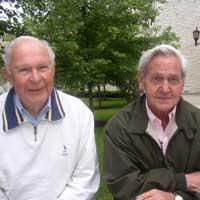
Irwin Shainman, left, and Ralph Renzi. (Photo By Linda Carman)
WILLIAMSTOWN – In the beginning, there was the question – and a vacant stage. Back in 1953, Ralph Renzi, then news director at Williams College, asked David C. Bryant Jr., director of the Adams Memorial Theatre program at Williams College, why he spent summers directing a theater near Boston. “Why do you go there?” Renzi asked Bryant. “There’s a theater here.” With that question, Bryant’s subsequent answer, the help of Williams College and a massive fund-raising effort by townspeople back in 1954, the Williamstown Theatre Festival was born. For the past 50 years, the WTF, as it has become familiarly known, has filled its stage with a succession of bright new faces and established luminaries in an array of plays, to the delight and edification of its enthusiastic audiences. Last weekend, Renzi and Irwin Shainman, who was the organization’s first business manager, talked about the theater’s beginnings and its development. Both are longtime board members now, with emeritus status, and they take enormous satisfaction from their part in the festival’s launching and growth. But they gave the lion’s share of credit to its longtime director, the late Nikos Psacharopoulos, and to the community for its unflagging support over the years. “There was no summer activity here at all,” recalled Shainman, retired professor of music at Williams College. “The college was fallow except for the Bell Telephone executive program (an annual conference that still exists today).” Renzi recalled that Shainman was a natural choice for the board because “He had actually seen Broadway plays.” Renzi and Shainman initially sought support from the Board of Trade to launch the fledgling theater. “We thought, who in this town could run this theater, and we thought, ‘Louis Rudnick, Mary Dempsey and George Schryver.’ We got them all on the board and made Louis Rudnick president,” Shainman said. Planning to present 10 plays over 10 weeks in its first season on the Williams College stage, the company needed an assistant director, someone to give Bryant a hand. “We called the dean of the Yale Drama School, who said, ‘I’ve got just the guy for you, Nikos Psacharopoulos, but if you don’t watch him, he’ll take over,’”Shainman recalled. So Psacharopoulos did, but in so doing managed to establish the festival as one of the best summer theater in the country. Psacharopoulos, energetic, innovative and exacting, after the first summer as assistant director, directed the festival for the next 33 years. The first season’s budget was about $10,000 – it is now $3 million – for 25 people and 10 plays. At season’s end, there was $273 left over. “We were just worrying about surviving,” Shainman said. “We were a hand-to-mouth operation.” The first production, “Time of the Cuckoo,” was a huge success, starring hometown girl Marcia Henderson, whose father ran the Williams Co-op. But following up on that success proved a challenge. Not to worry. Psacharopoulos soon had the entire array of props and costumes from the hugely successful Broadway production of “Ondine” on board for the season finale. “That show packed ’em in,” Shainman said. “We couldn’t afford to advertise. We put table tents at local restaurants and made posters. We never paid anybody more than the Equity minimum, which was then $150 a week – now it’s close to $900 – and many actors donated it back to the theater.” The first season called for some innovative thinking and financing. “We hired a fraternity house, the Beta house across from the theater, for $300 for the summer, and the whole company lived there,” Shainman remembered. “The whole town came forward,” Renzi added. They singled out Robert Sprague, the Hardman family, Lawrence K. “Pete” Miller and Henry N. Flynt Jr. as stalwart supporters. “And the college was very cooperative,” Renzi said. “There was a sense of spirit, the blessing of the majority of people in town.” Psacharopoulos was dynamic, constantly innovating to make the festival a hit, both Renzi and Shainman said. “For the production of ‘Our Town,’ the playwright, Thornton Wilder came up and played the stage manager. Ten years later here, Geraldine Fitzgerald was the first woman to play the role,” Shainman said. The location, Williams College and Williamstown, was a draw for actors and audiences alike, Renzi said. When combined with the quality of performances and plays, “It had everything going for it,” he added. But he and Shainman credited Psacharopoulos again for having the vision and drive to make the theater festival work. “He had a double opening night for “The Greeks,” — a six-hour performance — and a couple of years later, he did a two-night celebration of Tennessee Williams,” Shainman said. The director would soon be celebrated for his numerous adaptations of Williams plays over the years. He did, however, famously turn down Meryl Streep, then at Yale Drama School, for a role in Chekhov’s “Three Sisters.” Psacharopoulos had already cast Blythe Danner in another part and thought the women were too similar. Danner became a regular performer and a favorite of WTF fans. Streep, of course, went on to become a famous movie actress and never did make a festival appearance. One reason for the festival’s early success was its affordability, Shainman and Renzi said. “For a long time, they kept the ticket prices low,” Shainman said. “On Wednesdays and Thursdays, you could get seats in a couple of rows for $5.” These days prices range from $20 to $55 for performances of “Cabaret & Main” on The Main Stage and $22 to $24 for the upcoming world premiere of Richard Nelson’s “Rodney’s Wife” on the Nikos Stage. That’s still considered quite affordable for professional theater. As time moved on, both Renzi’s and Shainman’s children were cast in a number of plays, including Maggie Renzi in “The Miracle Worker,” and Shainman’s children Joan and Jack as the No-Neck Monsters in the 1969 production of “Cat On A Hot Tin Roof.” This summer, Renzi’s grandson Amos Wolff, his daughter Marta’s son, is an apprentice. “[In the early days] our basement was full of scenery and spears,” Shainman recalled. “Now there’s a scene-construction facility in North Adams.” He and Renzi had high praise for Producer Michael Ritchie, who will leave after this, his ninth season, to head the Center Theatre Group in Los Angeles, the organization. And, they noted, Williams College President Morton O. Schapiro has been an enthusiastic supporter. The festival has certainly grown – and continues to grow – well beyond its homegrown beginnings. It established a Second Company, now called the Nikos Stage, to perform new and more experimental works; it launched a respected internship program and branched out to cabarets in local restaurants and nightspots. In recent years, WTF has created The Greylock Project, an outreach program for youngsters from a North Adams housing project. And it produces an outdoor Free Theater program each year. Its achievements earned it a Tony Award in 2002 for excellence as a regional theater. The festival, celebrities and the community will come together for a gala celebration of the 50th anniversary Aug. 28 at 6 p.m. You can bet Renzi and Shainman will be there. They feel something like parental pride for the theater festival that they launched, fostered, nurtured and watched soar into prominence. “My association with the theater is the most important thing I’ve ever done in my life, other than my 40 years of teaching at Williams,” Shainman said. “I feel the same,” Renzi added. “The whole town came forward. The townspeople just loved it. Now, we have 50 years of memories.”
If you would like to contribute information on this article, contact us at info@iberkshires.com.

Dalton Fire District Voters OK 'Surprise' Building Purchase

By Sabrina DammsiBerkshires Staff

An image of 30-32 Flansburgh from the town's assessor data. 
DALTON, Mass. — For several years, the district has been working with limited space, and a vote at the annual meeting is expected to help ease those constraints.
 
During the meeting on Tuesday at the Stationary Factory, 48 voters approved 24 of the 25 articles on the warrant, including the purchase of 30-32 Flansburgh Ave., directly next to the current station. 
 
If the property passes the home inspection, the district would purchase the multi-family home from its current owner Richard Olsted for $350,000. 
 
The property is a two-family duplex built in 1920 with more than 6,000 square feet on a fifth of an acre. Its assessed value according to information in the town's database is $305,200. It's estimated on Zillow at $312,500, with a potential high of $350,000.
 
As part of the agreement for the purchase cost, the district agreed to allow Olsted to reside in one of the building's units for as long as he chooses, with the understanding that he will be responsible for utilities and will not be required to pay rent.
 
The foreseeable purpose of the other units will be to create proper housing for emergency services personnel. 
 
The department currently has three makeshift bedrooms in the fire station that were described as not well suited for a regular ambulance service.
 
View Full Story

More Stories