Eastover’s a home where the buffalo roam
By Deborah RawsonPrint Story | Email Story
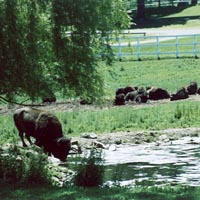
A Bull buffalo pauses for a sip of water as the herd rests. (Photo By Deborah Rawson)
LENOX — After nine months of waiting, two new additions were welcomed to the family at Eastover Resort & Conference Center recently, but not the two-legged kind, as one might expect. These new additions came complete with four legs and a set of horns, and they may eventually stand as tall as 6 feet and weigh as much as a ton. Belonging to the Bovidae, or hoofed mammal family, these small-for-now bison are bringing great excitement to tourists and area natives alike, according to Eastover officials. At one time, bison, (European settlers called them buffalo and the name stuck) ranged throughout nearly the entire continent. But the American bison nearly met its demise by the middle of the 19th century, and for some time many debated the reason for the near extinction of the animal. History, complete with photographs, drawings and personal accounts, has proved that it was due in great part, if not entirely, to an effort by the U.S. government to exterminate the great beast. At the time, the newly formed country was at war with the Indians native to the land, and the forefathers decided if they were to wipe out the bison herds, they would force the Indians out of the territory and onto reserves, so much of their livelihood was derived from this single animal. To Plains Indians, the large animal was like a large walking store, providing “meat, drink, shoes, houses, fire, vessels and their Masters whole substance,” wrote one explorer. Whether it was from intentional extermination, over-hunting or a combination of those and other factors, the result was devastation to the once massive bison population. But the revival of the bison over the last century is proof of the successes, both great and small, of wildlife conservation throughout the world. “We currently have 19 buffalo and the two babies,” said Ticki Winsor, owner and general manager of Eastover, who explained how the animals came to live in Lenox. “About 35 or 36 years ago, my father [George Bisacca] read a story about the near extinction of the buffalo. The government put what was left of the buffalo on reserves out West, and when the herds grew to a certain size and were large enough, the government decided to auction the animals off to pre-approved people. My father read the article and contacted Sylvio Conte, a beloved man in this area who was our representative in Washington at the time and who knew my father quite well, for help. Syl then got a hold of Stuart Udall, then secretary of the interior, and my father was pre-approved to buy buffalo. “The first year he bought a couple, then he went back the next year and got a couple more. He went all the way out to Oklahoma with his truck and trailer and a friend and brought them back. He told us how when he stopped for gas somewhere on the way back, people didn’t believe him when he told them he was hauling buffalo — until they saw them!” Eastover’s slowly but steadily developed herd was reportedly one of the first, if not the first, bison herds east of the Mississippi River. Winsor said each adult animal eats a bale of hey per day, which the resort staff supplies in the fall and winter months. In the spring and summer, it takes less to feed the herd, as there are plenty of available grasses in the fields to eat. However, several times a week, guests of the resort can hop aboard the specially designed hay wagon and get a bird’s eye view of the bison as they come to the wagon for their supplemental feedings. The animals also enjoy apples, pumpkins, cracked corn and cornhusks. Winsor said baby bison are born at the resort each year. “We’ve had as many as four in a year and as few as one,” she said. “Right about this time of year, the males will fight for the right to become the superior bull, and he is the only one who for that season will mate with all the cows. And that’s nature’s way of ensuring that the strongest of the herd survive.” John James Audubon, who camped on the plains in 1843, reported that the din of the numerous conflicts between the bulls striving to be the sole male to sire all the females sounded like “the long continued roll of a hundred drums.” Winsor said calves are born anytime from the end of April until June. “That’s Mother Nature’s way of ensuring that the animals will be large enough, come winter, to withstand the cold weather,” she said. The calves are able to run with the herd within three hours of being born. A grown bison can run as fast as 32 miles per hour in short bursts of speed and can push an object weighing as much as a ton. Both males and females have horns, with the female’s horns being more slender and pointing forward, while the bull’s horns are thicker and curve upward. After rutting season, which is when the bulls are fighting and mating until all the cows are serviced, the adult males will lose a lot of their fur that produces the distinctive “pantaloons.” and they look more like the females. These days, buffalo are seen more than just as an historical image or great photo ops. With a more health-conscience society, people are on the lookout for something new and healthy to add to, or substitute into their diets. “Of course now, because the buffalo meat is low in cholesterol, you can buy it at the supermarkets,” Winsor said. “I know Guido’s carries it, and you can order it off the menu at the Dakota Restaurant. “Not ours!” she added emphatically. Bison have also been bred with steers for “beefalo” because “the steers have more meat, and the buffalo are low in cholesterol, so they feel that it’s a good mixture,” she said. During the hotter days of summer, the pasture may look empty in the middle of the day as the animals find respite from the heat and sun in the coolness and shade of the forest, but as long as they can keep the herd thriving, Winsor and her staff plan to preserve the historical creature for a long time to come. For additional reading on the history of the American bison, “Buffalo Nation — History and Legend of the North American Bison” by Valerius Geist provides a great deal of information, including old photographs and ancient drawings, as well as letters from explorers and Native Indians at the time of the great buffalo hunts.
If you would like to contribute information on this article, contact us at info@iberkshires.com.

Lanesborough Fifth-Graders Win Snowplow Name Contest

LANESBOROUGH, Mass. — One of the snowplows for Highway District 1 has a new name: "The Blizzard Boss."
 
The name comes from teacher Gina Wagner's fifth-grade class at Lanesborough Elementary School. 
 
The state Department of Transportation announced the winners of the fourth annual "Name A Snowplow" contest on Monday. 
 
The department received entries from public elementary and middle school classrooms across the commonwealth to name the 12 MassDOT snowplows that will be in service during the 2025/2026 winter season. 
 
The purpose of the contest is to celebrate the snow and ice season and to recognize the hard work and dedication shown by public works employees and contractors during winter operations. 
 
"Thank you to all of the students who participated. Your creativity allows us to highlight to all, the importance of the work performed by our workforce," said  interim MassDOT Secretary Phil Eng.  
 
"Our workforce takes pride as they clear snow and ice, keeping our roads safe during adverse weather events for all that need to travel. ?To our contest winners and participants, know that you have added some fun to the serious take of operating plows. ?I'm proud of the skill and dedication from our crews and thank the public of the shared responsibility to slow down, give plows space and put safety first every time there is a winter weather event."
 
View Full Story

More Stories