Lenox becomes destination for luxury train

By Bill SamplePrint Story | Email Story
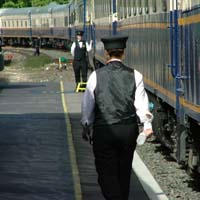
Porters Sarah Bauman, of Manitoba, Canada, foreground, and Michelle Tenner of Saskatchewan, background, carry out their duties outside the American Orient Express. Both are on their first trip with the private railway company that plans five more over
LENOX DALE – It pulled into the Berkshire Scenic Railway station Sunday night, a five-star luxury hotel on steel wheels, 16 cars long, gleaming in brilliant blue and gold. Monday morning, its well- heeled passengers, who paid several thousand dollars apiece for the excursion, began to stir, having a gourmet breakfast and preparing to disembark for a day of sightseeing and shopping in the Berkshires. The train was the American Orient Express, and Lenox is the newest stop in its seven-day round-trip journeys from Montreal through New England and back. Monday morning’s early light revealed the parked train, its immaculately restored vintage 1940s passenger cars stretching out of sight, up around the bend to the north of the historic station. Inside, opulence was on display, with elegant period furniture, decorations and fixtures. “This is a beautiful area,” said John Wall, of Denver, Colo., general manager for the excursion. “Lenox is the quintessential New England town, with the quaint Victorian houses and steepled churches. It gives our passengers a glimpse reminiscent of days gone by. We will be returning five more times before winter.” The trains’ visit and overnight stay in Lenox was the first of six planned excursions through the area called “Autumn in New England and Quebec” by the private company that owns and operates the American Orient Express. The company owns the train cars but contracts with Amtrak to supply the engine that pulls them. Amtrak gets permission and clearance from several railroad companies along the way for the right to use the tracks leading to the various destinations visited during the tour. This year, for the first time, the Housatonic Railway Company, based in Connecticut, gave the tour permission to use the tracks leading to Lenox. Passengers were treated to visits to the Norman Rockwell Museum and Chesterwood in the morning and had free time to explore Lenox all afternoon, as part of the tour. Many of them had never visited the area before. The 76 passengers aboard were mostly American citizens, although the excursion originates in Montreal, so some Canadian nationals also joined the trip from there. Being designated an overnight stop of the American Orient Express is good news for the area, because the train replenishes needed supplies while stopped at the Lenox station, local officials said. Members of the trains’ hotel and engineering staffs were dispatched to buy fresh foods and other needed supplies from vendors in the local area. Hundreds of gallons of fresh potable water, fresh meats, bakery products, produce and a large amount of diesel fuel were some of the purchases made that will contribute to local coffers. Passengers disembarked in the morning and spent the whole day exploring and shopping the nearby surroundings. “It’s great that they decided to come,” said Kevin Chittendon of the Berkshire Scenic Railway. “They buy from local businesses, have a good time, and it’s a beautiful train.” Dick Hedrick, of Harrisonburg, Va., who was very happy with the accommodations, and the five-star meals served on board, declared he was going to do it again. “In 1944 and ’45, I was in the Air Force, and they shuttled us around the country in cattle cars,” he said, “I swore I would never ride a train again as long as I lived after that, but this changed my mind. It’s really a wonderful way to see New England.” Hedrick said he was considering taking one of the many other regional rail tours offered by the American Orient Express. According to a company brochure, one-week trips are offered to The Antebellum South, the Pacific Coast, national parks of the West, the Rocky Mountains, the Canadian Rocky Mountains and Mexico. Longer excursions are available, featuring transcontinental rail journeys across both the United States and Canada. According to Wall, the train carries a full complement of hotel staff, as well as highly qualified train mechanics and technicians. Altogether, the crew numbers 45, which breaks down to about one crewmember for every two passengers. The crew is a diverse group, including young Canadians acting as porters and hotel staff, while many of the mechanics and technicians are from Mexico. Throw in a few Americans in management and other positions, and the result is an international mix of workers catering to the passengers’ every whim. Michelle Tenner, 21, of Regina, Saskatchewan, is a porter whose duty is to ensure the passengers’ comfort in one of the sleeper cars, as well as to assist passengers on and off the train at stops. She unrolls a royal blue rug and places a sturdy yellow step stool in front of the car’s doorsteps before the passengers can exit. She assists everyone off with a gracious smile and a steadying hand if they need it. “This is my first year,” she said. “This is the best job I ever had. I love it. I get to travel all over and get paid for it.” Tenner said the toughest part of the job was living at close quarters with the other crew members, who all live in the first five cars of the train, sharing bunks two to a cabin, with a shower at the end of the car. Managers get their own cabins and showers. She also said being out of touch with her family in Saskatchewan for days at a time had her mom worried, however. “She knows I’m OK, though,” Tenner said in her thick Canadian accent, “I make sure to call her at least once a week, and they know I’m fine on my own.” Behind the five crew cars are 16 spotless and beautifully appointed passenger cars, including sleepers, a domed observation car, a piano-bar lounge car, and two dining cars, all restored from the Golden Age of rail, according to Wall. All the cars feature art deco interiors furnished in mahogany and brass, with rich upholstery and grand floral arrangements. Passengers pay between $3,000 and $5,000 apiece for the seven-day “Autumn in New England tour, depending on the size of the cabin they occupy. The tour begins Fridays in Montreal, then travels to Quebec City and comes to Lenox on Monday. From here, the train pulls out at midnight, and begins Tuesday morning’s trip to Rutland and Bellows Falls, Vt. On Wednesday, the train travels to Montpelier, Vt., and then returns to Montreal to end the trip on Thursday. The American Oriental Express will make five more Monday visits to Lenox, before the tour ends and the train heads south to Mexico for the winter.
If you would like to contribute information on this article, contact us at info@iberkshires.com.

Pittsfield Subcommittee Supports Tax Incentive for St. Joe's Project

By Brittany PolitoiBerkshires Staff

PITTSFIELD, Mass. — The developer of the former St. Joseph's Central High School dreams of a glass rear that floods light into the auditorium and allows for more parking. 

On Tuesday, the subcommittee on Community and Economic Development unanimously supported a proposed 10-year tax increment exemption agreement to redevelop the former Catholic high school. 

They heard details about the plan to convert the shuttered school into a 70 percent residential, 30 percent commercial building with 20 percent of the 19 apartments designated affordable. It is expected to be an 18-month project once begun. 

Over the last decade or so, developer David Carver, of Scarafoni Associates & CT Management Group, has been involved with several overhauls of churches, school buildings, and even a firehouse into apartments. 

"I've always been interested in older historic buildings, especially in downtowns, and as the economy changes, we know there are lots of older buildings, worthy buildings that need a new life, and I've always found it interesting and a challenge to save them and turn around," Carver said. 

"Most of these buildings, I will say, are generally better built and more attractive than some of the new buildings that are built everywhere, and I've always been drawn to that, and it's almost like public art to me."

In 2017, the 120-year-old school ceased operations. After the COVID-19 pandemic hit, it sheltered people without homes before The Pearl, a 40-bed downtown shelter, was finished a few years ago. 

The TIE would freeze the current property value base, starting at 100 percent forgiveness in the first year, decreasing by 10 percent annually over the agreement's 10-year period. 

View Full Story

More Stories