Clark painting confirmed as masterpiece
By Linda CarmanPrint Story | Email Story
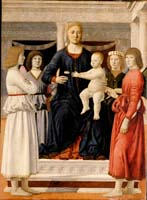
Piero della Francesca's 'Madonna and Child with Four Angels' (Photo Courtsey of the Clark Art)
WILLIAMSTOWN — The Sterling and Francine Clark Art Institute has loaned a prized Italian Renaissance painting, one of the jewels of the collection, to a major exhibition in Italy — where its juxtaposition with a known masterpiece by Piero della Francesca has stilled any remaining doubts about its authenticity. “This is the first time ever that it’s been out on loan, and certainly the first time out of the United States,” said museum Director Michael Conforti, who was in Italy to view the exhibition. “The painting is Piero della Francesca’s most important work in the United States.” The painting, “Madonna and Child with Four Angels,” is displayed in the Brera Gallery of Milan next to Piero’s great, and considerably larger, Brera altarpiece — in which the artist paints the same figures but adds others, including the kneeling donor, the Duke of Urbino. “Everyone is very excited,” senior curator Richard Rand said. “This is the first time our picture has been to Italy since it left in the early 19th century. This is an opportunity for Italian scholars to see our painting in the flesh — and especially to see it next to the great painting in Milan that is similar in many ways. That has clinched the whole question of whether our picture is by Piero. Everyone now acknowledges that it is, and in point of fact, most current art historian specialists accept our painting as an autographed original. This is wonderful confirmation of what we’ve long believed and what younger generations of scholars believed as well.” Some doubts had been raised in the mid-20th century, mostly because, Rand said, “Most scholars who specialized in Piero had never come to Williamstown and knew the painting only from books. All anyone knew about it was from old black and white photographs, and some people were uncomfortable assigning it to Piero’s hand on that basis.” Sterling Clark purchased the painting in 1914 in London but did not exhibit it until 1955, when the museum opened. Williams College art history professor Samuel Y. Edgerton Jr. said the Clark had been asked to lend the painting previously but a former director had declined. “It would have had a chance to be seen,” Edgerton said. “But instead, it remained in obscurity.” Conforti said Italian professionals were delighted that the Clark had agreed to lend its treasured painting and wanted to see his reaction to the sight of the paintings hung together. “Our Piero was up against the closest comparable work by the artist, so people can see for themselves how similar they are,” he said. “Now the question of authenticity has been settled, it’s just a question of exactly when he painted it.” The artist painted in the 1460s to 1480s in Urbino, in the province of Umbria, between Florence and Rome. “He is, for some, the most ethereal of all Renaissance painters. He took classical models and moved them forward with an almost angelic air,” Conforti said. “There are very few of his works outside Italy, only two or three in the National Gallery in London, and, aside from the Clark’s painting, only a couple of fragments in the United States.” Pleased that any lingering doubts had been stilled, he added, “Certain scholars have wondered if a Piero can be in Williamstown.” Rand said, “It’s our greatest Old Master painting.” The painting will travel to the Metropolitan Museum of Art with the exhibition “From Filippo Lippi to Piero della Francesca: Fra Carnevale and the Making of a Renaissance Master,” on display from Feb. 1 to May 1. The Brera alterpiece, deemed too fragile to travel, will not be sent to New York. The exhibition is a collaboration of the Brera Gallery and the Metropolitan — whose curator of European paintings, Keith Christiansen, spearheaded the show and the Clark’s loan. The Clark will, in turn, receive loans from the Metropolitan for a subsequent exhibition. Edgerton said he and Christiansen were “ardent in our belief that the painting was by Piero” and could have been done by no one else. Placed next to the Brera altarpiece, the viewer can see striking similarities. In the Clark painting, Edgerton explained, the Virgin Mary wears a blue cloak over a red garment with a fleur-de-lis design in gold lamé. That same fabric is draped over a figure in the Brera altarpiece. In addition, in the Clark painting, the Virgin Mary wears a four-cornered brooch, also worn by one of the figures in the Brera altarpiece. Edgerton said the most interesting aspect of the paintings is Piero’s characteristic play on perspective. “It’s an intellectual trick, full of gamesmanship,” he said. Edgerton and Christiansen explored Piero’s perspective using a copy done by Sandra Webber of the Williamstown Art Conservation Center, tracing lines out on a huge table. Edgerton also noted that the rightmost angel in the Clark’s painting had likely been painted in the 16th century, while the others are original. He explained that the painting had been badly damaged and was partly repainted. When restored, it was removed from its original wooden panel and put on canvas. The restorer then deliberately left the painting partially unrestored rather than attempt to reconstruct Piero’s creation of the Virgin’s face. That was a choice some people see as “evidence of poor painting rather than as restoration never done,” Edgerton said. “We hope Michael Conforti will build a whole symposium around the painting.”
If you would like to contribute information on this article, contact us at info@iberkshires.com.

Lanesborough Fifth-Graders Win Snowplow Name Contest

LANESBOROUGH, Mass. — One of the snowplows for Highway District 1 has a new name: "The Blizzard Boss."
 
The name comes from teacher Gina Wagner's fifth-grade class at Lanesborough Elementary School. 
 
The state Department of Transportation announced the winners of the fourth annual "Name A Snowplow" contest on Monday. 
 
The department received entries from public elementary and middle school classrooms across the commonwealth to name the 12 MassDOT snowplows that will be in service during the 2025/2026 winter season. 
 
The purpose of the contest is to celebrate the snow and ice season and to recognize the hard work and dedication shown by public works employees and contractors during winter operations. 
 
"Thank you to all of the students who participated. Your creativity allows us to highlight to all, the importance of the work performed by our workforce," said  interim MassDOT Secretary Phil Eng.  
 
"Our workforce takes pride as they clear snow and ice, keeping our roads safe during adverse weather events for all that need to travel. ?To our contest winners and participants, know that you have added some fun to the serious take of operating plows. ?I'm proud of the skill and dedication from our crews and thank the public of the shared responsibility to slow down, give plows space and put safety first every time there is a winter weather event."
 
View Full Story

More Stories