Lenox DPW paves the way, despite cutbacks
By Claire CoxPrint Story | Email Story
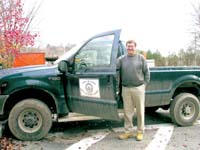
Jeffrey Vincent and his familiar pickup (Photo By Claire Cox)
LENOX — Jeffrey T. Vincent, superintendent of the town Department of Public Works, sees a bumpy road ahead. In past years, the DPW spent $600,000 to $800,000 annually for road paving. Now, as the town manager and Selectmen start to work on the 2005-06 Lenox budget, Vincent has found it necessary to limit his request for roads to $125,000, with only part of that allocated for maintenance. The department’s total budget request for the next fiscal year, which begins July 1, is $630,700, compared to $1,167,000 that was allocated two years ago. The amount the town could provide for the DPW has fallen with the loss of the $1 million income from the room tax abolished by the state and from cuts in other funding. “With the finances the way they have been, we have cut back, like everybody,” Vincent said in a recent interview. “All we did on the roads this year was resurface Housatonic Street east of Route 7 & 20, a little sidewalk work downtown and the one-way section of Housatonic Street in the historic district. Our highway work will again be more preventive- maintenance paving than full road reconstruction.” Even with budgetary restrictions, Vincent’s 15-member department will have plenty of work to do in addition to overseeing the streets and roads. “We also do the water and sewer systems,” he said, “which means the treatment of water at the reservoir and then distribution of treated water throughout the town for people to use. Then, on the wastewater end of it, we have the collection system, which leads to the treatment plant where we treat the wastewater so it can be discharged into the river. “We also maintain the cemeteries, Mountain View and Church on the Hill, and there is also a North Lenox cemetery. We do the burials, the stones, the deeds, when people purchase a lot right through the whole burial process,” he added. “Then there is the general mowing of lawns around downtown and the ballparks, garbage collection and tree trimming. Snow plowing is a major part of our work.” Sometimes the work can be unforeseen. “We do whatever is needed,” Vincent said. “ You never know what is going to pop up, from a tree falling to potholes or pipe work. The water is a little more specialized. Two people try to dedicate their time to water treatment. They have to be at the treatment plant every day to check and make sure all is working. Also, we have two people exclusively for sewer treatment.” Vincent, a resident of Lenox since 1981, headed his own construction business in Albany, N.Y., before being appointed DPW superintendent in 1995. “I am not an engineer,” he said, “My degree is in business administration from the University of Vermont. That suited me for running a business in Albany, and it’s worked out well here. There are a lot of engineering firms around that you can hire to do engineering. This is more of a business. With the wide range of issues we run into, I have found that business-administration knowledge has served me well. We hire engineers as we need them.” With the near completion of the major reservoir reconstruction of the gatehouse and spillways on the two dams, the DPW has another big project on which to start work within the next few months. Vincent’s crew will replace 4,000 feet of an 1896 water main that relies on gravity to convey water from the treatment plant down into the rest of town. The cost is estimated at $500,000. Eventually, 12,000 feet of 10-inch cast-iron pipe will be replaced with a more durable 12-inch metal pipe. “We haven’t had a lot of leaks,” Vincent said, “but the 1896 stamped on the pipe concerns us. We will replace it with a tougher metal and put it deeper into the ground. The money comes out of the Water Enterprise Fund, not tax dollars. The fund comes from the water-usage fees and tie-in fees for new structures to hook up to the water system.” Final plans for replacing the remaining 8,000 feet of pipe have not been made yet. Vincent puts in a 10-hour day at his job, not including the time he spends at evening meetings of boards and commissions that seek his input. He and his wife, Sally Liston Vincent, a lawyer specializing in child-protection cases, and their son, Nicholas, 16, live in a “passive solar” house with the sun and a wood pellet stove as the only sources of heat. Vincent tries to find time for skiing in the winter and hiking and biking in the summer. He is trying to establish bike paths in Lenox and hoping to make some new sidewalks wide enough for bikers and walkers to share. Providing a bike path will figure in another major project still on the drawing board, this one for reconstruction of Route 183 from the monument in the center of town past Tanglewood to the Stockbridge line. The town has been awarded a $1.3 millon Federal Transportation Enhancement Act grant under a Footprint Roads Program that allows replacing roads with scenic and cultural features without widening them. The plan for Route 183 calls for not only resurfacing the road but also adding a sidewalk wide enough for pedestrians and cyclists. Vincent said the cultural significance of Tanglewood appeared to help Lenox become the only town in Berkshire County chosen for such a grant. “Somewhere on paper there is $1.2 mil with our name on it,” he said. “We are hoping that within seven years we will see that. It might be five years, but I doubt it will be sooner. A lot of projects are on the list ahead of us, but it’s in the future somewhere.”
If you would like to contribute information on this article, contact us at info@iberkshires.com.

EPA Seeks Applicants for Environmental Education Grants

WASHINGTON – U.S. Environmental Protection Agency (EPA) announced up to $3.2 million in funding for environmental education grants to support local, community-driven projects that help Americans protect their water, health, and natural surroundings.

EPA expects to award up to 16 grants nationwide, ranging from $200,000 to $250,000 each through the Environmental Education Grant Program.

The Environmental Education Grant Program is designed to give Americans the knowledge and skills they need to make informed decisions about their environment; from protecting local waterways to supporting responsible stewardship in their own backyards. These grants support hands-on projects that help people better understand environmental challenges in their own communities and take practical steps to address them. Projects supported under this program emphasize real-world learning, community engagement, and solutions that can be applied at the local level.

The Notice of Funding Opportunity (NOFO) is now posted on www.grants.gov and the Environmental Education Grant Notice of Funding Opportunity webpage and applications are due on March 3, 2026.

EPA's Environmental Education and Stewardship Division will host a webinar on February 5, 2026, to provide a general overview of the current NOFO, discuss how to write a competitive application, and answer commonly asked questions. Webinar registration details will be available on https://www.epa.gov/education/grants#webinar.

Stay up to date on all environmental education grant information, including announcements related to upcoming webinar registration, by subscribing to the Environmental Education listserv


View Full Story

More Stories