A remarkable transition which promises to keep community-based agriculture growing in South Williamstown forever has been completed with the sale for $427,000 of the historic Caretaker Farm to new farmers and a local land trust.
"It will be an actively working farm affordable to the farmers in perpetuity - for conservation, recycling and diversity," Caretaker co-founder Samuel W. Smith, 70, declared on Saturday.
Smith and his wife, Elizabeth V., 68, who have nurtured the 35-acre vegetable farm since 1969, left on Saturday to visit a daughter in France after a long-delayed legal closing. It involved four attorneys, two land trusts, 12 adults -- and one 2-year-old -- gathered on Friday around and under a Williamstown Savings Bank conference table. The new owners and farmer are Bridget Spann and Don Zasada - and their 2-year-old daughter, Gabriela.
The Smiths are intellectual and practical pioneers of a growing phenomenon -- so-called "community-supported agriculture" (CSA), in which local participants contribute an annual membership fee and in turn get generous allocations of farm-grown food crops through the year.
Caretaker Farm, with 225 households each purchasing a share of farm-grown food for around $550 a year, is one of the "earliest and most notable [U.S.] experiments" of this approach, according to Bill McKibben, the Vermont author of the bestselling book, "The End of Nature."
McKibben will speak at the First Congregational Church in Williamstown at 8 p..m. on April 28 on "Caretaker Farm: Case Study for a Deep Economy" -- a reference to the title of his current book project. He his honorary chairman of the "Campaign for Caretaker: Standing on Common Ground," which will raise $239,000 to complete the transaction.
The first step to preserving Caretaker came in 2000, when the state purchased rights from the Smiths and imposed an agricultural preservation restriction on the croplands. Even with that land barred from development, the house and croplands were still appraised at $575,000 last year. On Friday, the Smiths sold the property for $427,000 to Equity Trust Inc. of Turners Falls, Mass. To pay the Smiths, Equity Trust immediately sold all 35 acres for $50,000 to the Williamstown Rural Lands Foundation, sold the homestead and barn to the new farmers for $177,000, and gave the Smiths a note for $200,000.
The deal includes a 99-year-lease provided to the new farmers to rent the land under and around the Smith's former colonial-style homestead, and a second 99-year lease for the Smiths to rent the land under and around an adjacent renovated cottage. Covenants in the leases and the land deeds restrict the property and tenants to perpetual agricultural use. The community benefits from these restrictions because now Caretaker Farm can only be sold to farmers for its "as-restricted agricultural value" and only sustainable agricultural methods may be utilized here.
"The partnership with the farmers, Equity Trust and the WRLF has been an opportunity to move from preserving farmland to preserving farming, an important distinction and one which is critical to the future of small farms," said Kim Wells, president of the Williamstown Rural Lands Foundation.
The Smiths started a roadside produce farm on the land in 1972, but in the 1980s switched to a membership CSA at a time when the concept was unique. It has grown to be a nearly self-sufficient diversified farm, with livestock, fruits and vegetables, an apiary, orchard and a bakery. Now there are lots of CSAs around New England and the nation - some run by former Caretaker apprentices -- and the big question is how they will be sustained in an era of development-driven, speculative land values.
By working in partnership with the local land trust, WRLF, and the non-profit Equity Trust Inc., the Smiths think they have found a model answer. Equity Trust is a national organization devoted to preserving small farms, affordable housing, and alternative land tenure models.
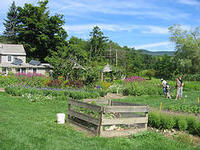
Caretaker Farm sits in a valley between the Taconic and Berkshire mountains, along the rural state Route 43 adjacent to the New York state border. Increasingly, it is surrounded by former farms turned into estates for wealthy second-home owners.
"It's exquisitely beautiful," says McKibben, who has visited Caretaker several times. "It's straight out of a children's book in its location and the beauty of its fields." During one visit, recalls McKibben, he watched as Sam Smith patiently lectured over an outdoor lunch about small-scale agriculture to a group of farm apprentices -- typically recent college graduates who form a seasonal-worker corps at Caretaker. "I quickly understood," says McKibben, "that as Sam says, the apprentices are probably the most important crop he has grown over the years."
One of those apprentices -- in 1993 -- was Chip Giller, a kid from Lexington, Mass., who had just graduated from Brown University with an environmental-science degree. Today, Giller lives in Seattle, where he founded and runs a non-profit website, Grist.com, which McKibben describes as the most influential environmental publication -- print or virtual -- in the nation. In web parlance, it serves 600,000 unique users per month, Giller says.
Giller recalled last week the Smiths' remarkable dedication to the physical labor of a working farm, coupled with an intense commitment to communicate knowledge about not just the practice of farming but the theories and writings about sustainable, small-scale, bio-diverse agriculture.
"What I loved about that experience was to have these mentors who had been through a lot but still have this total can-do spirit of invention everyday," says Giller. "This was a year when they were remodeling the whole first floor of the main house and so we were cooking in the barn and eating communal meals down at the river." Of the apprentices, he recalls: "It wasn't as if we were hired hands. There was an expectation that we would take the learning seriously and that Sam and Elizabeth would provide almost a classroom environment."
The main thing Giller recall taking when he left Caretaker in October 1993 were 50 small yogurt containers of pesto and memories of "endless preserving of sun-dried tomatoes cooked in the convection oven."
But for Elizabeth and Sam, a former international banker and high-school teacher who took to farming in his 30s, age was catching up. So for the last seven years the Smiths have tilled the legal framework for converting their farm to an ownership structure that will transcend their lives and protect the land from other forms of development.
Now, they say, the protection is in place. The first step was the painstaking recruitment of a young couple, Don and Bridget (and their now 2-year-old daughter, Gabriela), to take over as Caretakers' resident farmers. With the couple at work for almost a year, and resident as of January in the farm homestead, the Smiths turned to finishing the task that had taken much longer - completing the legal framework for the transaction.
The Smiths pursued a creative model for preserving Caretaker Farm because they knew that the revenue from the farm business would not support a mortgage at the level such a house would normally fetch in the second-home-driven real estate market of Williamstown, and they wanted to ensure that their farm remained a model of sustainable farming.
Friday's legal closing marks the "soft opening" of a "Campaign for
Caretaker: Standing on Common Ground" fundraising campaign led by a group of CSA shareholders and facilitated by Equity Trust that will raise $239,000 to reimburse the Smiths for a portion of the difference between what the house sold for and its appraised market value. The rest -- $136,000 - is in effect a donation by the Smiths to the farm's future.
McKibben says Caretaker is a case study for his new book topic. "Much of the book is about localism and how we might create economies that are more localized, and as a result more durable, more secure and more rich in relationships," McKibben says. "The only part of this economy that has really begun to take form in this country is around food, and one of the earliest and most notable experiments of this kind in the country is Caretaker Farm."
Following the vacation in France, the Smiths will settle into the residence they call the "Small Red Cottage" adjacent to their former house. Amid a wide expanse of wood floors and a sweeping pasture view they can advise and rally farm supporters from retirement.
But they say more of their time will likely be spent teaching and talking about local, sustainable agriculture - no longer distracted by the relentlessness of daily chores, seasonal growing and harvesting. And that sense of the metaphysical carries through to Sam Smith's view of the transaction finally completed.
"The real value here is not even the soil, or these ecological things," he says. "It is in the fact that the people in the community are connected to the farm, hundreds of kids come to it, parents pick up their food here. It just deepens the dimension of the world they live in - the human kind. Every human being ought to have a connection to a place like Caretaker Farm that is a little more than a nature preserve."
If you would like to contribute information on this article, contact us at info@iberkshires.com.
Your Comments
iBerkshires.com welcomes critical, respectful dialogue. Name-calling, personal attacks, libel, slander or foul language is not allowed. All comments are reviewed before posting and will be deleted or edited as necessary.
No Comments
St. Stan's Students Spread Holiday Cheer at Williamstown Commons
By Jack GuerinoiBerkshires Staff
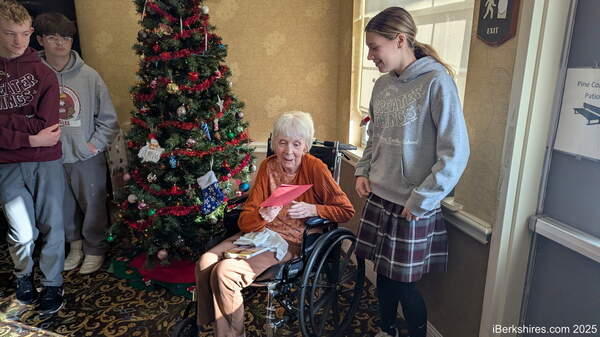
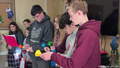
WILLIAMSTOWN, Mass. — Students from St. Stanislaus Kostka School in Adams brought the holiday spirit to Williamstown Commons on Thursday, delivering handmade Christmas cards and leading residents in a community caroling session.
"It honestly means the world to us because it means the world to them," said nursing home Administrator Alex Fox on Thursday morning. "This made their days. This could have even made their weeks. It could have made their Christmas, seeing the children and interacting with the community."
Teacher Kate Mendonca said this is the first year her class has visited the facility, noting that the initiative was driven entirely by the students.
"This came from the kids. They said they wanted to create something and give back," Mendonca said. "We want our students involved in the community instead of just reading from a religion book."
Preparation for the event began in early December, with students crafting bells to accompany their singing. The handmade cards were completed last week.
"It's important for them to know that it's not just about them during Christmas," Mendonca said. "It's about everyone, for sure. I hope that they know they really helped a lot of people today and hopefully it brought joy to the residents here."
Preparation for the event began in early December, with students crafting bells to accompany their singing. The handmade cards were completed last week.
click for more
The urgent care center will occupies a suite of rooms off the right side of the entry, with two treatment rooms, offices, amenities and X-ray room.
click for more
The group planning a new skate park for a town-owned site on Stetson Road hopes to get construction underway in the spring — if it can raise a little more than $500,000 needed to reach its goal. click for more