The Bennington Museum will be hosting local artists through the Local Artist Program in the upcoming months. The first artist featured is Bennington native Daniel Richmond. He will be exhibiting his works until April 9th. To accompany the exhibit there will be an artist's talk at 3p.m. on Saturday April 1. The talk will be followed by a reception at the museum.
This exhibition explores the variety and continuity of Daniel Richmond's artistic output over the course of the last decade. It includes sculpture from past installations and documentation of a three year project completed on the Navajo Nation in Sanders, Arizona.
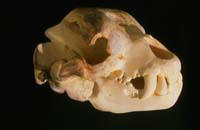
His art is heavily influenced by his personal experience with the landscape. Richmond's art engages elemental materials, namely wood and earth, to bring viewers back in touch with the state of the natural world that we live in. Ranging from realistically carved skulls of extinct animals to life size anthropomorphic figures in butternut and pine, Richmond's art prompts one to think about the sustainability of our environment and its inherent natural beauty.
About his work Richmond writes, "In the recent past, trees were the sacred objects of religion and the primary economic building blocks for many cultures the world over. To this very day, the Hopi people of the Southwest use spruce in sacred ceremonies to help bring rain for their cornfields. All of humankind depends on trees to provide the Earth with oxygen, food, energy, medicine and continued diversity of species in this age of extinction. However, most of us have lost sight of those crucial cords that bind both the ancient history and future success of human existence to the health of our world's forests.
I use different approaches including realistic carvings and multi-sensory installations, to communicate ideas and emotions using a language of wood. My recent work also includes: earth, stone, plantings, natural pigments, water and performance. These formal changes are a direct result of time spent on the Navajo Nation as an Artist-In-Residence in the Sanders school system and visits to the Hopi mesas and Southern Ute Nation of Southern Colorado."
Daniel Richmond attended the Syracuse University Studio Art Program in Florence, Italy. He went on to obtain his Bachelor of Arts in Studio Art from the University of Vermont in Burlington, and his Master of Arts in sculpture from the University of Wyoming. He has had nine solo exhibitions, including one in New York City covered by the New York Times. Richmond's extensive resume includes numerous group exhibitions, lectures, and articles, and several awards.
You can view the exhibition with regular admission to the museum. Or better yet buy a membership! It's a bargain, with free admission to the museum and discounts on many events and the shop. The Bennington Museum is located at 75 Main St. (Route 9) one mile west of the intersection of Routes 7 and 9 in downtown Bennington, Vermont. Open daily from 10 a.m. to 5 p.m. closed Wednesdays.
For more information, visit the website at www.benningtonmuseum.org.
If you would like to contribute information on this article, contact us at info@iberkshires.com.
Your Comments
iBerkshires.com welcomes critical, respectful dialogue. Name-calling, personal attacks, libel, slander or foul language is not allowed. All comments are reviewed before posting and will be deleted or edited as necessary.
No Comments
Berkshire Towns Can Tap State Seasonal Communities Resources
BOSTON — Governor Maura Healey announced that 18 additional municipalities across Massachusetts have been designated as Seasonal Communities, opening up new tools, support and grant funding to help them manage seasonal housing pressures.
Created as part of the historic Affordable Homes Act signed into law by Governor Healey in 2024, the Seasonal Communities designation was designed to recognize Massachusetts communities that experience substantial variation in seasonal employment and to create distinctive tools to address their unique housing needs. The law also established the Seasonal Communities Advisory Council (SCAC).
All municipalities in the counties of Dukes and Nantucket;
All municipalities with over 35 percent seasonal housing units in Barnstable County; and
All municipalities with more than 40 percent seasonal housing units in Berkshire County.
To identify additional communities, the Executive Office of Housing and Livable Communities (HLC) reviewed available data, specifically focusing on cities and towns with high levels of short-term rentals and a high share of second- or vacation homes.
In Berkshire County, Egremont, Great Barrington, Lee, Lenox, New Marlborough, Richmond, Sandisfield, Sheffield, West Stockbridge and Williamstown have been designated.
"Our seasonal communities are a vital part of Massachusetts' cultural and economic fabric, but they're also home to essential workers, families, seniors, and longtime residents who deserve a place to live year-round," said Governor Healey. "That's why we're committed to supporting these communities with innovative solutions like the Seasonal Communities designation to meet their unique needs, and I'm thrilled that we're offering this opportunity to 18 additional communities across the state. Everyone who calls these places home should be able to live, work and grow here, no matter the season."
As with the statutorily identified communities, acceptance of the designation for municipalities is voluntary and requires a local legislative vote. HLC will open an application for newly eligible communities that haven't accepted the Seasonal Communities designation to request consideration.
The Affordable Homes Act created several new tools for communities who accept the Seasonal Communities designation to be able to:
Acquire deed restrictions to create or preserve year-round housing
Develop housing with a preference for municipal workers, so that our public safety personnel, teachers, public works and town hall workers have a place to live
Establish a Year-Round Housing Trust Fund to create and preserve affordable and attainable housing for year-round residents
Create year-round housing for artists
Allow seasonal communities to develop a comprehensive housing needs assessment
Permit tiny homes to be built and used as year-round housing
Permit year-round, attainable residential development on undersized lots
Increase the property tax exemption for homes that are the owners' primary residence
The Wildcats marched 84 yards in a drive that consumed 11 minutes, 17 seconds of the third quarter for a critical touchdown in a 48-36 win over Boston’s Cathedral High in the quarter-finals of the Division 8 Tournament. click for more
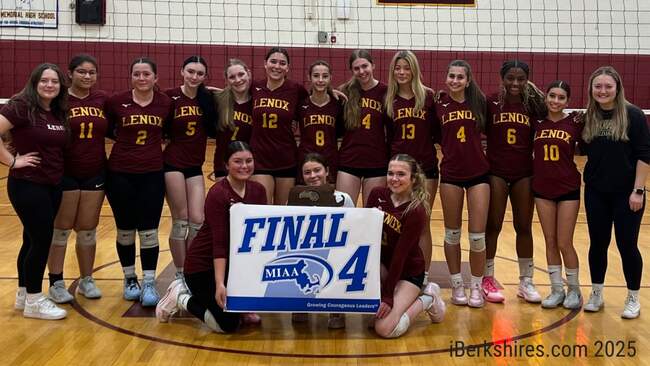
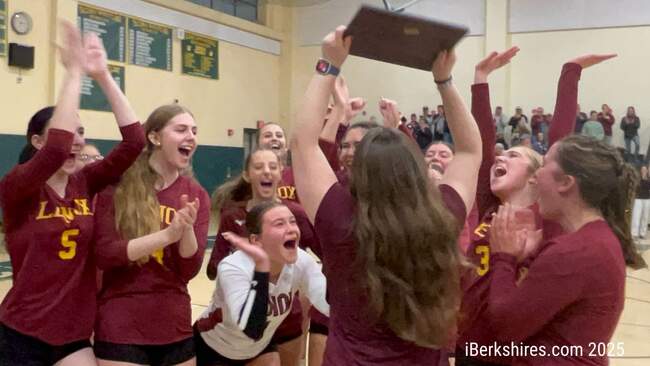
Evelyn Julieano and Leanne Maschino each put down seven kills, and the Lenox volleyball team came out strong in advancing past Whitinsville Christian in three sets in the Division 5 State Tournament quarter-finals on Friday.
click for more
Kofi Roberts and Everett Bayliss remained tied for the team lead with 14 goals apiece, and Lucas Burrow notched his second goal as Mount Greylock (11-6-1) won for the fourth time in five games and earned its third shutout victory in the Western Mass tournament. click for more
GG Nicastro scored in the 37th minute to break a 1-1 tie, and the Mount Greylock girls soccer team Wednesday went on to a 2-1 win over Monson in the Western Massachusetts Class C Championship Game at Berkshire Community College.
click for more
Primary setter Grace Julieano had 22 assists – 10 of them to her sister Evelyn and eight to Sara Isby in Saturday's three-set win over Mount Greylock. click for more
Darius Taliaferro and Cameron Coon each scored a goal on Friday to lead the Mount Everett boys soccer team to a 2-1 win over Gateway Regional. click for more