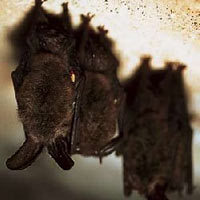
With hot, humid weather in full swing, some Bay State homeowners may discover bats residing in their home. Attics are the most common portion of a house in which bats roost and raise their young.
After a few hot summer days, an attic becomes too warm for the bats, forcing them into people's living quarters as they search for cooler places to roost. Inexperienced young bats may fall down a chimney, fly in open windows or down attic stairs. The discovery of a bat flying through the house can create anything from excitement to hysteria. What's a homeowner to do?
Fortunately, a single bat flying in a room can usually be dealt with quite easily. Put away that broom or tennis racket, open an outside window or door in the room containing the bat and close off the rest of the room. It's usually only a matter of a few minutes of circling before the bat locates the open window and leaves the house. Bats do not attack people or fly into people's hair.
If a bat has landed, it can be assisted out of a house in several ways. For a bat on a curtain, place a jar, coffee can or small box over the bat, carefully working the animal into the container, and cover it. A bat on the floor can be covered with a towel. Another method is to put on leather gloves and simply pick up the bat and release it outdoors-don't use cotton gloves or handle a bat with bare hands.
Whatever method is used, don't worry when the bat squeaks loudly while being handled. Take the bat outdoors and release it. If anyone has had direct contact with a bat or if a bat is found in a room with a sleeping person, the bat should be safely captured and not released. Contact local health officials for assistance in evaluating potential rabies risk and submitting the bat to the Department of Public Health for rabies testing.
"If a homeowner discovers a bat colony in his or her home there are several options to consider," says MassWildlife Information Biologist Marion Larson. "Little Brown Bats and Big Brown Bats are the most likely species to be found in buildings. In some cases, with small numbers of bats, people don't mind their presence and concentrate on blocking holes and cracks leading into the human living quarters. Where there is a large colony in house walls, biologists recommend that homeowners wait to initiate eviction proceedings until the first week of August through November." Waiting to evict the colony allows time for young bats to mature and leave the house on their own.
The do-it-yourself homeowner can learn how to evict bats safely with "A Homeowner's Guide to Bats" booklet available from MassWildlife. This publication contains tips on handling a bat in the house, designs for one-way doors, bat house plans, and a key to identifying the nine bat species in Massachusetts. The booklet is available in a pdf file in the Wildlife area of the agency website at www.mass.gov/masswildlife and is also available in hard copy at MassWildlife District Offices and the Westborough Field Headquarters.
To receive a hard copy of the booklet by mail, send a business sized, self-addressed, 63 cent stamped envelope to: Bat Booklet, MassWildlife Field Headquarters, 1 Rabbit Hill Rd, Westboro, MA 01581. Homeowners who wish to hire someone to evict a bat colony can find a list of licensed Problem Animal Control agents in the Wildlife area of MassWildlife's website.
If you would like to contribute information on this article, contact us at info@iberkshires.com.
Your Comments
iBerkshires.com welcomes critical, respectful dialogue. Name-calling, personal attacks, libel, slander or foul language is not allowed. All comments are reviewed before posting and will be deleted or edited as necessary.
No Comments
Dalton Announces New Supplier for Energy Program
DALTON, Mass. – The Town of Dalton has signed a thirty-four month contract with a new supplier, First Point Power.
Beginning with the January 2026 meter reads, the Dalton Community Choice Power Supply Program will have a new rate of $0.13042 per kWh. The Program will also continue to offer an optional 100 percent green product, which is derived from National Wind Renewable Energy Certificates (RECs), at a rate of $0.13142 per kWh.
For Dalton residents and businesses who are enrolled in the Town's Program, the current rate of $0.13849 per kWh will expire with the January 2026 meter reads and the new rate of $0.13042 per kWh will take effect. This represents a decrease of $5 per month on the supply side of the bill given average usage of 600 kWh. Additionally, this new rate is 3 percent lower than Eversource's Residential Basic Service rate of $0.13493 per kWh. Residents can expect to see an
average savings of $3 per month for the month of January 2026. Eversource's Basic Service rates
will change on Feb. 1, 2026.
Dalton launched its electricity program in January 2015 in an effort to develop an energy program that would be stable and affordable. From inception through June 2025, the Program has saved residents and small businesses over $1.7 million in electricity costs as compared to Eversource Basic Service.
It is important to note that no action is required by current participants. This change will be seen on the February 2026 bills. All accounts currently enrolled in the Program will remain with their current product offering and see the new rate and First Point Power printed under the "Supplier Services" section of their monthly bill.
The Dalton Community Choice Power Supply Program has no fees or charges. However, anyone switching from a contract with a third-party supplier may be subject to penalties or early termination fees charged by that supplier. Ratepayers should verify terms before switching.
The Wildcats marched 84 yards in a drive that consumed 11 minutes, 17 seconds of the third quarter for a critical touchdown in a 48-36 win over Boston’s Cathedral High in the quarter-finals of the Division 8 Tournament. click for more
Evelyn Julieano and Leanne Maschino each put down seven kills, and the Lenox volleyball team came out strong in advancing past Whitinsville Christian in three sets in the Division 5 State Tournament quarter-finals on Friday.
click for more
Kofi Roberts and Everett Bayliss remained tied for the team lead with 14 goals apiece, and Lucas Burrow notched his second goal as Mount Greylock (11-6-1) won for the fourth time in five games and earned its third shutout victory in the Western Mass tournament. click for more
GG Nicastro scored in the 37th minute to break a 1-1 tie, and the Mount Greylock girls soccer team Wednesday went on to a 2-1 win over Monson in the Western Massachusetts Class C Championship Game at Berkshire Community College.
click for more
Primary setter Grace Julieano had 22 assists – 10 of them to her sister Evelyn and eight to Sara Isby in Saturday's three-set win over Mount Greylock. click for more
The License Commission will be informing local establishments of a new law allows restaurants serving beer and wine to change their license to all-alcoholic. click for more