Three pioneer papermakers at the Crane Museum of Papermaking

Print Story | Email Story
Nestled amidst modern office and factory buildings in the heart of the Crane & Company Inc. complex in Dalton, the Crane Museum of Papermaking is housed within a conspicuous ivy-covered stone mill. Listed on the National Register of Historic Places, Crane’s Old Stone Mill is situated on the banks of the Housatonic River, which supplied water to wash the rags and drive the machinery of the early Crane mills. Built in 1844, this historic structure was originally used as the rag room for the paper mill and refurbished for use as a museum in 1930. Since its opening to the public, the building, with it’s own rich history apart from the exhibit within, has provided a pleasant stop for those who travel through Berkshire County. The cool stone walls, tall windows, and vaulted ceiling supported by thick-hewn wood beams gives the museum an almost sacred air. In this appropriate setting, you will find spirits of the past who will trace the history of American papermaking from Revolutionary times: a scale model of the vat house of the first Crane mill, samples of hand molds used from 1801 to 1830, a ledger noting the sale of currency paper to American patriot Paul Revere. Now, on the occasion of the 200th anniversary of the founding of Crane & Company Inc., a special exhibition celebrating the vision of three pioneers in the world of papermaking will open Monday, Aug. 6. The “Three Pioneer Papermakers: Zenas Crane, Dard Hunter, Douglass Howell” exhibit is to be presented in cooperation by the Crane Museum of Papermaking, the Robert C. Williams American Museum of Papermaking, Elisabeth Howell King, and the Dieu Donne Papermill. “This is a special opportunity for us,” stated Peter Hopkins, the museum’s director of special exhibits. “It lets us help people understand how paper was made in the beginning to now, and the revival of handmade paper as well as handmade paper used as an artist’s medium.” Hopkins gestured to perpendicular wood frames hung with paper, “This is our paper wall. It divides the room into three sections, one for Zenas’ exhibit, one for Dard Hunter, and one for Douglass Howell.” It is his feeling that the current exhibit, which focuses on Zenas Crane’s contributions to the papermaking industry, will be well-complimented by Hunter’s and Howell’s displays. Zenas Crane was the third member of the Crane family to come to appreciate papermaking: the first was his father who ran a Massachusetts paper mill in 1770, then his older brother who had a mill in Newton. Crane went on to operate a mill in Sutton, which was owned by noted patriot and printer Isaiah Thomas. Crane set off on his own in 1799 in search of an area with a water source for power, rags for raw material, and a market for his products. He found all he needed on the Housatonic River in Dalton. His first mill became the foundation for the 200-year-old tradition of fine papermaking by Crane & Company and promoted the growth of the paper industry in the Berkshires. However, with the advent of the paper machine in the mid-1800s, handmade paper virtually disappeared in the U.S. “It became a lost art,” explained Hopkins. “Fortunately, in the early 1900s, Dard Hunter became fascinated with hand papermaking. He traveled around the world and studied traditional papermaking techniques and developed an extensive collection.” Hunter came from a family with a long tradition in printing and publishing. In 1911, he visited London where he learned about early European papermaking and printing. Upon his return to the U.S., Hunter set up a shop in Marlborough-on-Hudson, N.Y., where he printed his first book, The Etchings of Figures, by William Bradley. Hunter decided to devote his life to researching, collecting and writing the world’s history of hand papermaking. He started up a second paper mill in Lime Rock, Conn., and by the time he passed away, Hunter was credited with the resurgence in popularity of hand papermaking in the U.S. Hopkins continued, “Doug Howell was originally interested in handmade paper for fine books. He was an artist, but a different kind of artist for the time after World War II. He came in right at the beginning of the contemporary art movement. He used handmade paper as a medium for his art; he used different color pulp and experimented with different fibers to create his images.” It is said that Howell stumbled into papermaking while seeking better paper for his wood engravings in the 1930s. Inspired by the writings of Dard Hunter, Howell set up his first papermill in New York City, then followed with a paper studio on Long Island, N.Y. Howell then began creating paper art with inclusions of fiber, fabric, and subtly placed filaments. He experimented with three-dimensional works on wire molds. He pursued historical and scientific research on paper, and lectured on the properties of paper and their use in fine bookmaking and printmaking. While it is not clear that the artistic elevation of handmade paper was Howell’s primary goal, one of his students was quoted as stating that “he emancipated paper from its role as a printing surface alone. He focused instead on the nature, aesthetics, and creative possibilities of paper itself.” Donna Daigle, owner of Whimsey’s Child, Interiors by Design, agrees with this observation of Howell’s contribution to the arts, “I’ve used them [handmade papers] for everything from matting and framing, to placemats and window material. Handmade paper is beautiful against windows because it captures light, and the light, in turn, captures the paper’s texture and colors. It’s a wonderful way to integrate nature with interior design.” Carol Shea, the museum’s coordinator of archival works, stated that “people take paper for granted, probably because they don’t know much about what goes into making it. Crane is the only company that produces [U.S.] currency paper. They’ve had the contract since 1879 and there are a lot of government rules and regulations we have to follow. Also, trees aren’t ‘hurt’ by making this paper.” Hopkins verified, “all our paper is cotton paper. We make it all from discarded materials like T-shirt cuttings and rags. The [U.S.] currency paper has some flax — which would otherwise be burned as waste and just add to air pollution — and denim; that’s why it’s so strong.” Shea added, “I’ve always been fascinated by the way they made paper back then. It’s an amazing craft and this museum gives us a great opportunity to tell the story.” The Crane Museum of Papermaking is open from June through mid-October, Mondays through Fridays, from 2 to 5 p.m. “Three Pioneer Papermakers” will run through Oct. 15. For more information on the museum or to schedule a guided group tour, call 684-6481. For more information on Dard Hunter, The Friends of Dard Hunter Inc. can be found online at: www.slis.ua.edu/ba/dardo.html. Further information on Douglass Howell can be acquired through the Estate of Douglass Morse Howell, P.O. Box 285, Monterey, MA 01245, 528-3615. Donna Daigle of Whimsey’s Child, Interiors by Design can be reached at (860) 584-8898.
If you would like to contribute information on this article, contact us at info@iberkshires.com.

McCann Recognizes Superintendent Award Recipient

By Tammy DanielsiBerkshires Staff
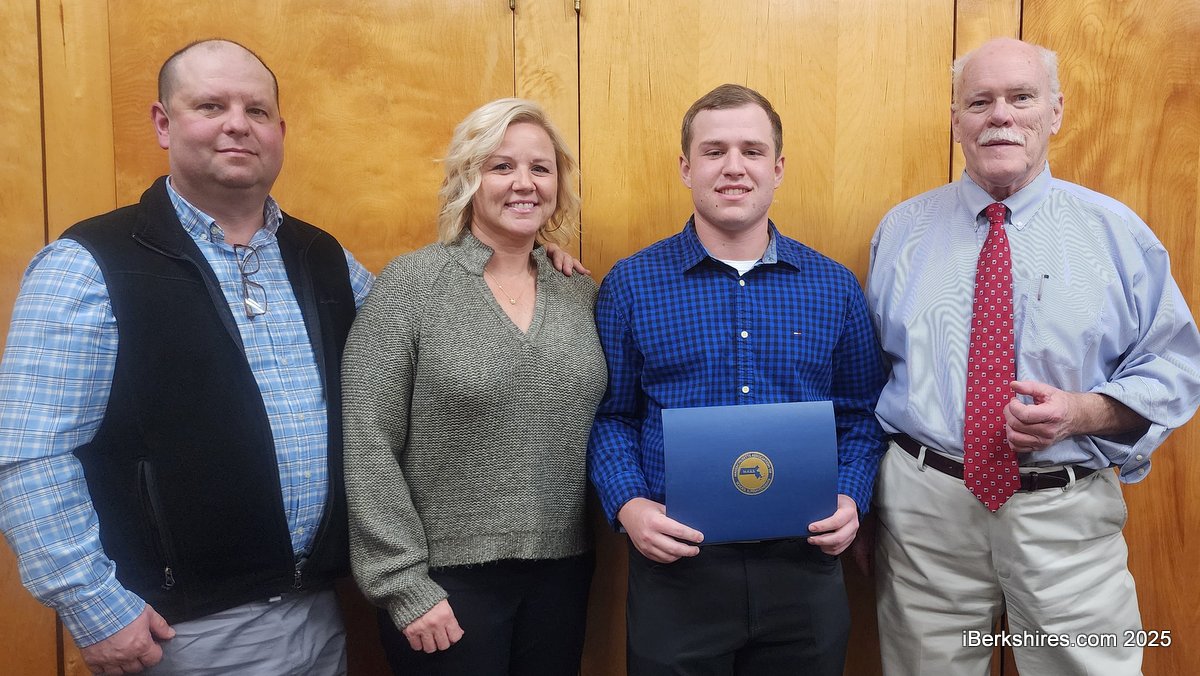
Landon LeClair and Superintendent James Brosnan with Landon's parents Eric and Susan LeClair, who is a teacher at McCann. 
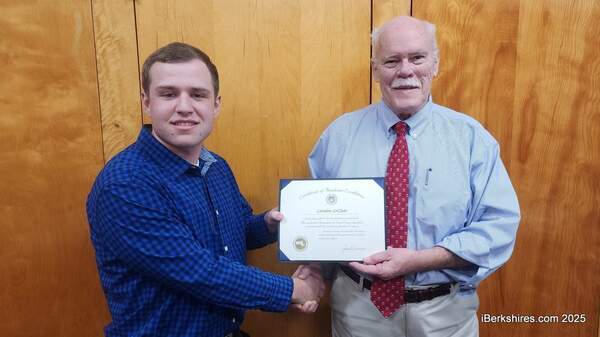
NORTH ADAMS, Mass. — The Superintendent's Award has been presented to Landon LeClair, a senior in McCann Technical School's advanced manufacturing course. 
 
The presentation was made last Thursday by Superintendent Jame Brosnan after Principal Justin Kratz read from teachers' letters extolling LeClair's school work, leadership and dedication. 
 
"He's become somewhat legendary at the Fall State Leadership Conference for trying to be a leader at his dinner table, getting an entire plate of cookies for him and all his friends," read Kratz to chuckles from the School Committee. "Landon was always a dedicated student and a quiet leader who cared about mastering the content."
 
LeClair was also recognized for his participation on the school's golf team and for mentoring younger teammates. 
 
"Landon jumped in tutoring the student so thoroughly that the freshman was able to demonstrate proficiency on an assessment despite the missed class time for golf matches," read Kratz.
 
The principal noted that the school also received feedback from LeClair's co-op employer, who rated him with all fours.
 
"This week, we sent Landon to our other machine shop to help load and run parts in the CNC mill," his employer wrote to the school. LeClair was so competent the supervisor advised the central shop might not get him back. 
 
View Full Story

More North Adams Stories