Nestled amidst modern office and factory buildings in the heart of the Crane & Company Inc. complex in Dalton, the Crane Museum of Papermaking is housed within a conspicuous ivy-covered stone mill. Listed on the National Register of Historic Places, Crane’s Old Stone Mill is situated on the banks of the Housatonic River, which supplied water to wash the rags and drive the machinery of the early Crane mills.
Built in 1844, this historic structure was originally used as the rag room for the paper mill and refurbished for use as a museum in 1930. Since its opening to the public, the building, with it’s own rich history apart from the exhibit within, has provided a pleasant stop for those who travel through Berkshire County.
The cool stone walls, tall windows, and vaulted ceiling supported by thick-hewn wood beams gives the museum an almost sacred air. In this appropriate setting, you will find spirits of the past who will trace the history of American papermaking from Revolutionary times: a scale model of the vat house of the first Crane mill, samples of hand molds used from 1801 to 1830, a ledger noting the sale of currency paper to American patriot Paul Revere.
Now, on the occasion of the 200th anniversary of the founding of Crane & Company Inc., a special exhibition celebrating the vision of three pioneers in the world of papermaking will open Monday, Aug. 6. The “Three Pioneer Papermakers: Zenas Crane, Dard Hunter, Douglass Howell†exhibit is to be presented in cooperation by the Crane Museum of Papermaking, the Robert C. Williams American Museum of Papermaking, Elisabeth Howell King, and the Dieu Donne Papermill.
“This is a special opportunity for us,†stated Peter Hopkins, the museum’s director of special exhibits. “It lets us help people understand how paper was made in the beginning to now, and the revival of handmade paper as well as handmade paper used as an artist’s medium.â€
Hopkins gestured to perpendicular wood frames hung with paper, “This is our paper wall. It divides the room into three sections, one for Zenas’ exhibit, one for Dard Hunter, and one for Douglass Howell.†It is his feeling that the current exhibit, which focuses on Zenas Crane’s contributions to the papermaking industry, will be well-complimented by Hunter’s and Howell’s displays.
Zenas Crane was the third member of the Crane family to come to appreciate papermaking: the first was his father who ran a Massachusetts paper mill in 1770, then his older brother who had a mill in Newton. Crane went on to operate a mill in Sutton, which was owned by noted patriot and printer Isaiah Thomas. Crane set off on his own in 1799 in search of an area with a water source for power, rags for raw material, and a market for his products. He found all he needed on the Housatonic River in Dalton. His first mill became the foundation for the 200-year-old tradition of fine papermaking by Crane & Company and promoted the growth of the paper industry in the Berkshires.
However, with the advent of the paper machine in the mid-1800s, handmade paper virtually disappeared in the U.S. “It became a lost art,†explained Hopkins. “Fortunately, in the early 1900s, Dard Hunter became fascinated with hand papermaking. He traveled around the world and studied traditional papermaking techniques and developed an extensive collection.â€
Hunter came from a family with a long tradition in printing and publishing. In 1911, he visited London where he learned about early European papermaking and printing. Upon his return to the U.S., Hunter set up a shop in Marlborough-on-Hudson, N.Y., where he printed his first book, The Etchings of Figures, by William Bradley. Hunter decided to devote his life to researching, collecting and writing the world’s history of hand papermaking. He started up a second paper mill in Lime Rock, Conn., and by the time he passed away, Hunter was credited with the resurgence in popularity of hand papermaking in the U.S.
Hopkins continued, “Doug Howell was originally interested in handmade paper for fine books. He was an artist, but a different kind of artist for the time after World War II. He came in right at the beginning of the contemporary art movement. He used handmade paper as a medium for his art; he used different color pulp and experimented with different fibers to create his images.â€
It is said that Howell stumbled into papermaking while seeking better paper for his wood engravings in the 1930s. Inspired by the writings of Dard Hunter, Howell set up his first papermill in New York City, then followed with a paper studio on Long Island, N.Y. Howell then began creating paper art with inclusions of fiber, fabric, and subtly placed filaments. He experimented with three-dimensional works on wire molds. He pursued historical and scientific research on paper, and lectured on the properties of paper and their use in fine bookmaking and printmaking. While it is not clear that the artistic elevation of handmade paper was Howell’s primary goal, one of his students was quoted as stating that “he emancipated paper from its role as a printing surface alone. He focused instead on the nature, aesthetics, and creative possibilities of paper itself.â€
Donna Daigle, owner of Whimsey’s Child, Interiors by Design, agrees with this observation of Howell’s contribution to the arts, “I’ve used them [handmade papers] for everything from matting and framing, to placemats and window material. Handmade paper is beautiful against windows because it captures light, and the light, in turn, captures the paper’s texture and colors. It’s a wonderful way to integrate nature with interior design.â€
Carol Shea, the museum’s coordinator of archival works, stated that “people take paper for granted, probably because they don’t know much about what goes into making it. Crane is the only company that produces [U.S.] currency paper. They’ve had the contract since 1879 and there are a lot of government rules and regulations we have to follow. Also, trees aren’t ‘hurt’ by making this paper.â€
Hopkins verified, “all our paper is cotton paper. We make it all from discarded materials like T-shirt cuttings and rags. The [U.S.] currency paper has some flax — which would otherwise be burned as waste and just add to air pollution — and denim; that’s why it’s so strong.†Shea added, “I’ve always been fascinated by the way they made paper back then. It’s an amazing craft and this museum gives us a great opportunity to tell the story.â€
The Crane Museum of Papermaking is open from June through mid-October, Mondays through Fridays, from 2 to 5 p.m. “Three Pioneer Papermakers†will run through Oct. 15. For more information on the museum or to schedule a guided group tour, call 684-6481.
For more information on Dard Hunter, The Friends of Dard Hunter Inc. can be found online at: www.slis.ua.edu/ba/dardo.html. Further information on Douglass Howell can be acquired through the Estate of Douglass Morse Howell, P.O. Box 285, Monterey, MA 01245, 528-3615. Donna Daigle of Whimsey’s Child, Interiors by Design can be reached at (860) 584-8898.
If you would like to contribute information on this article, contact us at info@iberkshires.com.
Your Comments
iBerkshires.com welcomes critical, respectful dialogue. Name-calling, personal attacks, libel, slander or foul language is not allowed. All comments are reviewed before posting and will be deleted or edited as necessary.
No Comments
Berkshire County Homes Celebrating Holiday Cheer
By Breanna SteeleiBerkshires Staff
There's holiday cheer throughout the Berkshires this winter.
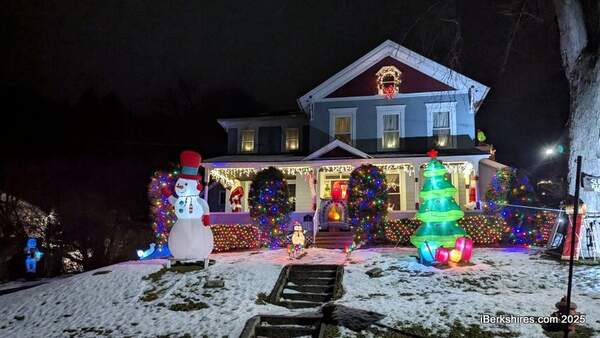
Many homeowners are showing their holiday spirit by decorating their houses. We asked for submissions so those in the community can check out these fanciful lights and decor when they're out.
We asked the homeowners questions on their decorations and why they like to light up their houses.
In Great Barrington, Matt Pevzner has decorated his house with many lights and even has a Facebook page dedicated to making sure others can see the holiday joy.
Located at 93 Brush Hill Road, there's more than 61,000 lights strewn across the yard decorating trees and reindeer and even a polar bear.
The Pevzner family started decorating in September by testing their hundreds of boxes of lights. He builds all of his own decorations like the star 10-foot star that shines done from 80-feet up, 10 10-foot trees, nine 5-foot trees, and even the sleigh, and more that he also uses a lift to make sure are perfect each year.
"I always decorated but I went big during COVID. I felt that people needed something positive and to bring joy and happiness to everyone," he wrote. "I strive to bring as much joy and happiness as I can during the holidays. I love it when I get a message about how much people enjoy it. I've received cards thanking me how much they enjoyed it and made them smile. That means a lot."
Pevzner starts thinking about next year's display immediately after they take it down after New Year's. He gets his ideas by asking on his Facebook page for people's favorite decorations. The Pevzner family encourages you to take a drive and see their decorations, which are lighted every night from 5 to 10.
In North Adams, the Wilson family decorates their house with fun inflatables and even a big Santa waving to those who pass by.
The Wilsons start decorating before Thanksgiving and started decorating once their daughter was born and have grown their decorations each year as she has grown. They love to decorate as they used to drive around to look at decorations when they were younger and hope to spread the same joy.
"I have always loved driving around looking at Christmas lights and decorations. It's incredible what people can achieve these days with their displays," they wrote.
The Wilsons' invite you to come and look at their display at 432 Church St. that's lit from 4:30 to 10:30 every night, though if it's really windy, the inflatables might not be up as the weather will be too harsh.
In Pittsfield, Travis and Shannon Dozier decorated their house for the first time this Christmas as they recently purchased their home on Faucett Lane. The two started decorating in November, and hope to bring joy to the community.
"If we put a smile on one child's face driving by, then our mission was accomplished," they said.
Many homeowners are showing their holiday spirit by decorating their houses. We asked for submissions so those in the community can check out these fanciful lights and decor when they're out.
click for more