Math and Science Generating Student Missions
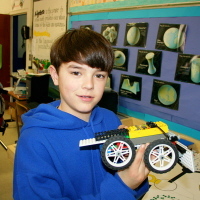 |
| Alex Boulger, 12, with a robotic vehicle. [Photo by Sue Bush] |
Last week, a Kid's Inquiry Conference was held at the Pine Cobble School in Williamstown and a Regional Science Fair was hosted by the Massachusetts College of Liberal Arts.
On Saturday, students from 15 Berkshire region schools and two "neighborhoods" will compete at a Berkshire Robotics Challenge 2007 "nanoQuest" at the Lenox Memorial High School. And in May, Western Massachusetts middle school students will participate during a Region 1 Middle School Science Fair at MCLA.
Robotics
<L2>Clarksburg Elementary School math teacher Brenda Johnson is the coach for the Clarksburg Cougars robotics team. The team will travel to Lenox for the Saturday event, Johnson said.
"This is our second year at the competition," Johnson said during an after-school interview at a robotics club meeting. "We came in second to last last year and this year, we're hoping to do better. We'll keep plugging along. I enjoy this. I enjoy it because it helps [students] problem solve. And [students] have to do most of this by themselves."
"Most of this" includes building a functioning robotic unit that is programmed to complete specific missions designed by the Berkshire Robotics Challenge Committee.
Individual missions are assigned a point value; for example, a "smell mission," which requires a robot to transfer molecules from pizza toward the nose, is worth five competition points, while a "molecular motor mission", described as "the robot must deliver one of the two ATP molecules through the molecular motor's black frame, is worth 40 points. Teams may attempt to accomplish all nine missions and a special bonus points task, or may choose certain missions. The event is sponsored by the Berkshire Applied Technology Council, Inc..
The public may attend and the event begins at 9 a.m..
Missions Accomplished
Cougars team member Brodey Moran, 12, was among the 2006 competitors.The team may use only one robot during the competition but during practices, the group tests their missions with two robots, he explained.
Team members were required to create the missions and then pre-program the missions into the robots and conduct multiple tests to work out any kinks. The process is challenging and time-consuming, Brodey said.
"We have to start from a certain starting point and complete the missions," he said. "We are accomplishing our missions."
Brodey said that the challenge is a mix of fun and strong<R3> competitive spirit.
"Some schools get really into the competitive side," he said. "I really like it. It's a real fun experience and I think [all the competitors] really like it."
Allie Bona, 12, is competing for the first time.
"It's been fun but it's kind of challenging, too,"she said.
Johnson said that several schools enter more than one team.
The work is complex and the Cougars begin meeting at the beginning of the school year. As the challenge event approaches, after-school meetings increase from Fridays to about three times weekly, she said.
"It does take a lot of time to build the missions," she said.
Quest Guest
The nanoQuest guest speaker will be Michael Wright, director of operations, planning, and development for the MassNanoTech Institute at the University of Massachusetts Amherst campus. He is expected to speak about "Nanotechnology and the Developing World: Tackling Big Problems With Tiny Tools."
The host school has entered a team as has the Adams Memorial Middle School, the Nessacus Middle School, Craneville Elementary School, Herberg Middle School, Farmington River Elementary School, Undermountain Elementary School, Monument Mountain Valley Regional Middle School, St. Agnes School, Silvio O. Conte Community School, Gabriel Abbott Memorial School, Sullivan Elementary School, the Berkshire Arts and Technology Charter School, and the Williamstown Elementary School. Neighborhood teams are the Williamstown Neighborhood Team and a Williamstown/North Adams Neighborhood Team comprised of Girl Scout Troop #3 members.
From Failure Comes A Hovercraft
<L4>Clarksburg students who participated during the K.I.C. event remained enthusiastic about their projects and the exhibits were at the school and intact. Courtney Rolnick, Emma Gregory and Cory Roy, who built a small hovercraft, confessed that the idea came from a prior failure.
"We were going to do something with Venus fly traps but Venus fly traps didn't work for us," said Courtney.
That comment begged the question "Why not?".
"We got them but we didn't know what we wanted to do with them. They died."
The trio then searched the Internet and found the hovercraft project.
A class pet named "Cory the Rabbit" was the focal point of two experiments conducted by students including Mike Schmidt, 11, and Kodey Bryce.
"You Can't Believe What A Little Candy Will Do"
During one experiment, the students used construction paper of differing color to try and detect a preference. Because rabbits are color-blind, the students knew that "Cory" would not see specific hues but would differentiate shade. The results indicated the the rabbit preferred green paper but Schmidt acknowledged that a number of external factors, including the rabbit's possible unease at being part of the experiment, likely influenced the outcome and therefore, the conclusion was not definitive.
An experiment designed to determine what food the rabbit liked the most from choices of grain, lettuce and carrots indicated that the rabbit's ordinary diet of grain was preferred. Carrots ranked as the rabbit's least favorite meal.
Kennedy Valois, 11, and Vanessa Ramos, 12, used a variety of candy and diet and regular colas to generate reactions when the items were mixed.
"All the candies we tested had a reaction because of the acid [in the soda]," said Kennedy.
"You can't believe that a little piece of candy can get these reactions," said Vanessa.
Wesley Winch, 12 and Alex Cleary, 12, used hot water and food coloring to determine if the dyed water would produce steam that held the color. The steam produced did leave colored markings on white paper, and proved conclusively that water molecules can carry color.
Science teacher Audrey Witter noted that the fairs and competitions are the catalysts for deeper interest in science and math.<R5>
"The students come away [from events] with more ideas," she said.
School Principal Karen Gallese said that the educational benefits extend beyond the student population.
"I end up learning more from the kids," she said.
GE Plastics provides major support to the Berkshire Robotics Challenge.
Additional information about the robotics challenge may be acquired by calling Denise Johns at 413-236-2125 or a djohns@berkshirecc.edu e-mail address.