LENOX - In the much-loved children’s classic "Hitty, Her First Hundred Years," the small peg-jointed doll led a life of adventure and travel, much of it perilous, to end up where she began.
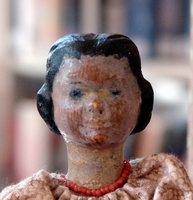
Now, the doll that inspired the book almost never leaves home. But one of those rare occasions will be Saturday, Oct. 27, when Hitty will emerge from the historical collection at the Stockbridge Library in company with collection curator Barbara Allen for an excursion to Ventfort Hall.
There, Allen will tell Hitty's story: How she was found in a New York City antique shop window by author Rachel Field and artist Dorothy Lathrop, who bought her and made her the centerpiece of their award-winning 1929 book "Hitty, Her First Hundred Years," chronicling her imaginary saga.
Hitty was, in her book, dropped any number of times, left frequently in places as various as a wagon and a sofa relegated to the attic - a stay that lasted 10 years. She was dropped under a church pew and on Fifth Avenue, where she was retrieved by noted author Charles Dickens. Each time, she was found by someone who launched her on another chapter. Most dramatic and exotic were her earliest misadventures, the shipwreck of the whaler her first owner, the captain's daughter, had taken her on, being marooned on a South Sea island whose inhabitants worshipped her as an idol, and enlisted into the act of a Bombay snake charmer.
Field was a frequent Berkshires visitor with relatives in Stockbridge. And she wrote on a range of topics - she is probably best known for "All This and Heaven Too," made into a film starring Bette Davis.
That was, Allen said, "about a family member. The governess Henriette, the character played by Bette Davis, married Henry Field, so she was Rachel's great aunt."
Field was "an extremely talented woman ... . We have an entire shelf of her work, poetry, plays and novels," said Allen.
She said her lecture will include "the book, the doll, the women responsible for it, a little bit of everything. I'm not going to concentrate on any one part. People come to Hitty from different directions. She connects in so many ways with things people are interested in - history and folk art and even textiles."
Hitty the book, Allen said, "really is an excellent book, well written, the tone is adventurous, not sugary. And it's intriguing how true the action is to the doll. As a peg doll, the arms work together, not separately, so she is limited by her construction.
"The theme is similar to 'The Velveteen Rabbit,' in that toys and their owners have their ups and downs," she continued.
After Field's death in 1942, the doll stayed with Lathrop, then was left to Lathrop's sister, Gertrude, a sculptor, and finally to a nephew, the now retired editorial page editor of The Berkshire Eagle Roger Linscott, who gave her to the Stockbridge Library Association for the historical collection.
"It was really serendipity," Allen said.
Hitty, a nickname of Mehitibel, was made in the mid-19th century of white ash, and the 6 1/4-inch figure was painted in the style of a china doll.
Plain and simple, she is, Allen noted, "almost the complete opposite" of the dolls on exhibit at Ventfort Hall, all in Gilded Age apparel.
On view at the Museum of the Gilded Age at Ventfort are 59 dolls wearing exquisitely made fashions from 1855 to 1914. All 29 inches tall, they are the creations of John R. Burbidge, retired senior designer for the bridal house Priscilla of Boston, and represent nearly 30 years of research and work. Their elegant outfits are all Burbidge's original design in historical mode.
The exhibition has proved extremely popular, according to Ventfort Hall's Executive Director Jeffrey Folmer, and has been extended through the end of May 2008.
Burbidge has called the venue "a match made in heaven - Ventfort Hall provides the perfect backdrop for my ladies." They are known as Les Petites Dames de Mode, in translation, the "Little Ladies of Fashion."
Another exhibit of dolls dressed in historical costumes by Williamstown designer Rita Watson has proved popular at the Williamstown House of Local History.
Dolls have staying power, but their roles have changed along with the times of the people who make them and the young girls - and they are usually girls (boys get "action figures").
Dolls in the sense of today date from late medieval Europe, where they wore finery expected of highborn ladies - and those were the little girls who were given them.
Some of the earliest surviving dolls from the 17th through 19th century are made of papier mache, carved wood, cloth or wax. Like Hitty, wooden dolls were often painted to look like the more expensive china dolls that started being produced in the 19th century. Composite materials and the plastics revolution led to the mass production of dolls of all sizes and shapes - from babies to fashion plates by the turn of the last century.
Dolls of color are now widely available but in the past, black writers have noted the exclusionary message of having only white dolls to play with.
Victorian- and Edwardian-era dolls, usually with bisque heads, had finely painted features and real hair, and wore frocks of expensive material and ruffles and tucks aplenty. The work that went into them was reflected in their price, so only the well-to-do would have them. Perhaps these little girls got the message that they were, in time, supposed to wear elegant clothes appropriate for a lady.
At the other extreme were the homemade dolls, the hand-carved or Raggedy Ann-style stuffed creations for little girls on farms and in factories.
From the now-over-40 Barbie (who's moved from shiny fashionista to serious career girl in tune with the times, without sacrificing her improbable measurements!) to the popularity of the more realistic American Girl series (which, not unlike Hitty, reflect moments in American history) dolls have remained a staple toy for girls of all ages.
Antique dolls, particularly china dolls, can command high prices, but few of the wooden and cloth dolls, like Hitty, have survived. One supposes they were just literally loved to pieces.
Hitty, now kept safe behind Plexiglass in the Stockbridge Library, has a worldwide following and numerous copies have been made of her.
Admission for the Hitty lecture and tea is $15 per person; members $12. For more information or reservations, call 413-637-3206. Ventfort Hall is at 104 Walker St.
For research and photos of Hitty, see www.Hitty.org
For more on Barbie, dip into "The Barbie Chronicles: An American Doll Turns Forty," (Simon & Schuster, 1999), edited by Yona Z. McDonough with particular reference to "Barbie Meets Bouguereau: Constructing an Ideal Body for the Late-Twentieth Century," by Williams College art history professor Carol Ockman.
"A Brief History of Antique Dolls" by Denise Van Patten can be found at http://collectdolls.about.com/library/weekly/aa032799.htm
If you would like to contribute information on this article, contact us at info@iberkshires.com.
Your Comments
iBerkshires.com welcomes critical, respectful dialogue. Name-calling, personal attacks, libel, slander or foul language is not allowed. All comments are reviewed before posting and will be deleted or edited as necessary.
No Comments
Lanesborough Fifth-Graders Win Snowplow Name Contest
LANESBOROUGH, Mass. — One of the snowplows for Highway District 1 has a new name: "The Blizzard Boss."
The name comes from teacher Gina Wagner's fifth-grade class at Lanesborough Elementary School.
The state Department of Transportation announced the winners of the fourth annual "Name A Snowplow" contest on Monday.
The department received entries from public elementary and middle school classrooms across the commonwealth to name the 12 MassDOT snowplows that will be in service during the 2025/2026 winter season.
The purpose of the contest is to celebrate the snow and ice season and to recognize the hard work and dedication shown by public works employees and contractors during winter operations.
"Thank you to all of the students who participated. Your creativity allows us to highlight to all, the importance of the work performed by our workforce," said interim MassDOT Secretary Phil Eng.
"Our workforce takes pride as they clear snow and ice, keeping our roads safe during adverse weather events for all that need to travel. ?To our contest winners and participants, know that you have added some fun to the serious take of operating plows. ?I'm proud of the skill and dedication from our crews and thank the public of the shared responsibility to slow down, give plows space and put safety first every time there is a winter weather event."
The Wildcats marched 84 yards in a drive that consumed 11 minutes, 17 seconds of the third quarter for a critical touchdown in a 48-36 win over Boston’s Cathedral High in the quarter-finals of the Division 8 Tournament. click for more
Evelyn Julieano and Leanne Maschino each put down seven kills, and the Lenox volleyball team came out strong in advancing past Whitinsville Christian in three sets in the Division 5 State Tournament quarter-finals on Friday.
click for more
Kofi Roberts and Everett Bayliss remained tied for the team lead with 14 goals apiece, and Lucas Burrow notched his second goal as Mount Greylock (11-6-1) won for the fourth time in five games and earned its third shutout victory in the Western Mass tournament. click for more
GG Nicastro scored in the 37th minute to break a 1-1 tie, and the Mount Greylock girls soccer team Wednesday went on to a 2-1 win over Monson in the Western Massachusetts Class C Championship Game at Berkshire Community College.
click for more
Primary setter Grace Julieano had 22 assists – 10 of them to her sister Evelyn and eight to Sara Isby in Saturday's three-set win over Mount Greylock. click for more
The License Commission will be informing local establishments of a new law allows restaurants serving beer and wine to change their license to all-alcoholic. click for more