Clarksburg School Pioneer in Holocaust Studies
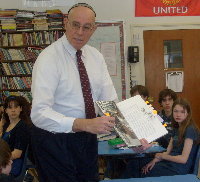 |
| Rabbi Robert Sternberg shows Clarksburg students what they'll see in Washington. |
By educating them in the root causes of prejudice and bigotry, by helping them understand that the victims are real people, by exploring both the strength and fragility of the connections that bind communities together.
That's what Clarksburg students have been learning in their studies of the Holocaust. But coming face to face with what the Nazis did is overwhelming for adults, never mind eighth-graders.
"You're going to see some pretty horrible, horrible pictures," Rabbi Robert Sternberg told Michael Little's class Monday as he prepared them for their trip Thursday to the U.S. Holocaust Memorial Museum in Washington, D.C.
The museum was designed to re-create the experience of American GIs as they liberated some of the 18,000 concentration camps spread across Europe during World War II. Entering the museum, the visitor is bombarded with pictures and film taken by soldiers of the sick, the starving, the dying and the dead at the camps. Gen. Dwight Eisenhower was among those shocked and apalled by what he saw, Sternberg said.
"You don't have to spend to much time there ... and I recommend that you don't spend too much time there."
Field Trip
This will be the school's first field trip to the national museum but not its first encounter with the Holocaust. For the last three years, Little has integrated Holocaust studies into the eighth-grade curriculum, culminating in a student exhibit each spring that grows bigger by the year. This year the exhibit and student research is "Smoke and Ashes," which will include the rise of the Nazis and life in the ghettos.
Little teaches the course but relies on the expertise of Sternberg, director of Hatikvah Holocaust Education Center in Springfield, the only Holocaust museum in the area, and well-known World War II authority Darrell K. English, whose vast collection of artifacts supplies exhibit pieces for both Clarksburg and Hatikvah. (English is also accompanying the class to D.C.)
It was English's astounding collection that first sparked the idea, said Little. "I checked out his artifacts and said, 'Let's do an exhibit.'"
That fit into the efforts of 4-year-old Hatikvah, which describes itself as a living memorial dedicated to eradicating prejudice and bigotry by examining the past. The center is involved in anti-bias training for law enforcement and the Restorative Justice Circle Program, which brings transgressors into appropriate community service through probation and opens lines of communication to restore the community and restore the transgressor back into the community.
"We do not teach people about the Holocaust to depress them or only to remember the past," said Sternberg. "But in order to empower people to make a difference in the world they live in, and the society and community they're living in, because every act of oppression in the past and the present and certainly the future are connected in some way."
These students will likely never have to face life or death, but they do have to deal with discrimination, he said. "Even the best societies are never free of it. It can be contained through education and law."
The Springfield museum doesn't so much stress the horrors of the Holocaust as it does the stories of people who lived - or not - through it.
It was the people that Nicole Bona, 14, and her cousin Allie Bona, who'll be 14 next week, remembered from the class trip there last week.
"It was interesting because of the different families we learned about," said Nicole.
Allie agreed: "It doesn't have lots of artifacts and pictures but it was still good because it was more meaningful because it was about actual people."
Holocaust Curricula
There aren't many schools, if any, in the region spending this much time on the Holocaust. Mostly it's up to the teacher; that may mean a cursory overview while studying World War II.
Sternberg and the museum have been especially helpful with his course, said Little. "Everything I do goes through Bob first. He really know his stuff."
"What we're trying to do is add some substance and depth to what they're doing," said Sternberg. "This is an extraordinary project – it draws in the entire community, not just the school, and Mike has drawn in other schools as well."
Clarksburg, however, may not be alone for long.
Little, Sternberg and others are working on Holocaust curricula for the high school and middle school levels. Little has been driving down to Springfield every six weeks or so to meet with other educators to hammer out a courses of study for English language arts and for social studies that the Department of Education has pledged to support and promote. Field testing on some units will begin this year.
The high school language arts program would center around Elie Wiesel's memoir "Night," and the middle school around "The Diary of Anne Frank."
"We're hoping that every student in every school in Massachusetts will learn about the Holocaust," said Sternberg.
First, he had to finish preparing the three dozen eighth-graders who'll be making the two-day trip to D.C., courtesy of Robert and Elaine Baum. Passing around a pictorial volume of the museum, he explained what they would see, how they would see it and what they should be looking for.
He suggested they spend time in the "Daniel" exhibit, "Remember the Children: Daniel's Story," which takes the real experiences of Holocaust victims and distills them into a relatable microcosm – the story of fictional Daniel and his family. The exhibit is similar to the focus of the Hatikvah Center and provides a starting point to try to grasp the overwhelming numbers – 6 million Jewish people murdered, 1.8 million Polish people murdered.
"Now you have to take those single stories that you saw in Springfield and expand on them, and multiply them and try to see them as huge, huge things that were happening in lots of different places in exactly the same way," the rabbi said.
When they come back, the students will break into groups to tackle separate research projects that will become the exhibit "Smoke and Ashes" later this spring.
The annual event draws hundreds of parents, residents and students from other schools to Clarksburg.
"I think the Springfield museum is very important in the journey that we're on all the way up until we have our own exibit here in Clarksburg," said Brodey Moran, 13. "It's going to provide us with most of the information we're going to use. The Washington, D.C., trip is such a great honor that they gave us."