Patrick Describes Her Fall and Rise
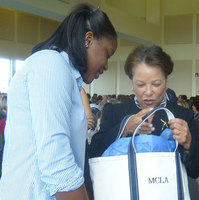 |
| MCLA sophomore Shabori Burton presents Diane Patrick with a gift.View Slide Show |
But that doesn't seem to deter Diane Patrick, the state's first lady, as she offered glimpses into her failed first marriage, her rocky road to a very public breakdown shortly after her husband was elected and her emergence from depression.
Being first lady, mother, wife and practicing partner in a law firm isn't easy, she said. Quoting Alaska Gov. Sarah Palin's speech last week, she added, "I have a little news flash for you, I don't always do it so well.
"Somewhere around February or March of 2007, you know I didn't do it very well. I fell out splat in front of the public," Patrick told the more than 330 people filling the banquet room at the Berkshire Hills Country Club for the Berkshire Chamber of Commerce's 5th annual Women in Business Luncheon. "What kind of role model is that?"
This roomful of very accomplished women already knows how to balance work and family, she said. So instead, Patrick wanted to talk about how it can all come tumbling down; how it plays out when you're in the public eye.
Ellen Ruberto is "a real role model as a first lady," she said, turning to Ruberto who was sitting next to her husband, Mayor James Ruberto. "I don't know if I've ever said that to you but I mean it sincerely."
Patrick said some of her self-esteem issues may lie in her childhood among a family of strong, caring men and intelligent but submissive women who had always put their husband's needs before their own. "Frankly, I found it quite disturbing."
Following in her mother's footsteps, she became an elementary teacher; then went off to law school. She married a man who was older, and strong in ways not unlike the men she had grown up around. But as she struggled through law school, she realized that his attitude couldn't change.
"I had no interest in doing laundry or cooking," said Patrick, but it became clear that "he was to make the dough; I was to make it into bread."
Patrick said her self-worth began to diminish under his demands — she was "depressed, demoralized, paralyzed."
It was not until she met the younger Deval Patrick, newly graduated from law school, that her life began to turn around, she said. The Patricks became friends, then spouses and, always, partners.
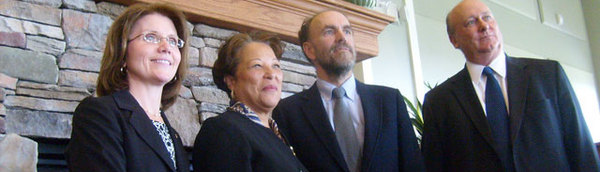
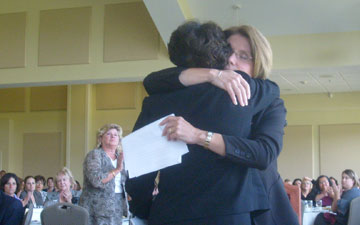 First lady Diane Patrick gets a hug from MCLA President Mary Grant. First lady Diane Patrick gets a hug from MCLA President Mary Grant. |
First the campaign and then the move into the governorship brought up long-buried insecurities, said Diane Patrick. She became not Diane the powerful lawyer but "his lovely wife." At governer's school (yes, there is such a thing) she attended seminars on managing mansion staff and was brutally critiqued on what to wear on camera.
Then there were the criticisms, rumors and innuendo (Deval being at Coke the company became Deval doing coke); "You constantly had to prove the negative."
The final straw was the hiring of a chief of staff for her as she tried to maintain her own workload and the demands of first lady. The attacks were swift; the chief of staff short-lived.
And there she was again: demoralized, diminished and exhausted. And she withdrew from the public eye for weeks with depression.
But what she called a public humiliation also touched a chord in that public and she was showered with cards and letters from people describing their own struggles, and that they understood. "You gave me the strength talk about it," said Patrick.
It also began to put her fractured self-esteem back together knowing that her own troubles may have helped others. Knowing that her lessons in caring had been transmitted to her children by the actions of one of her daughters.
Feeling that you have value, that you have worth is the first step in coming back, because if you believe you have value you'll seek help, she said.
Patrick encouraged others to reach out, particularly to children, to assure them that they have value. Children who feel worthless aren't leaders but followers, she said, "they make bad choices."
More than a year after her own struggles with depression, Patrick seems every inch the law partner, the activist, the first lady.
"Today, I'm as strong as I think I ever have been or ever will be," she said. "I'm in great shape. Maybe you can learn something from that."
Patrick's speech was greeted with thunderous applause even as she swiftly exited the building for her next appointment. "Wow. Oh, wow," said chamber President Michael Supranowicz as he took the microphone. "People will never forget how you made us feel."
As Patrick first took the stage she was presented with the gift of a Massachusetts College of Liberal Arts sweater and book by one its history professors, Frances Jones-Sneed, from students Shabori Burton of Mattapan and Jihan Leonard of Boston.
Burton, a sophomore, thought Patrick's talk "was really motivating. ... It was very good."
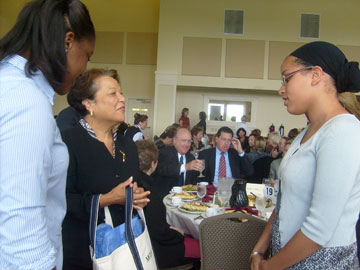 Jihan Leonard, right, a senior at MCLA, speaks with Patrick. Jihan Leonard, right, a senior at MCLA, speaks with Patrick. |
Leonard said she's doing some of things Patrick suggested by volunteering. She's been involved with the Special Olympics, such as the "Polar Plunge" in Boston. It's worth it, she said, just "getting a little smile from someone."
The master of ceremonies for the luncheon was MCLA President Mary K. Grant, whom James Kolesar of Williams College introduced as a woman of strong determination, particularly in her pursuit of a $55 million science center for MCLA.
"She was going to get that science center if she had to build it brick by brick with her own hands," he said to laughter. "I don't know if she ever killed a moose but I've seen her field dress a donor."
Grant responded that she may not have ever killed and dressed a moose but "I've had to tackle a few purple cows in my day."
In a more serious vein, Grant said she was a strong advocate for higher education as a door to opportunity for women and minorities.
"We're talking about the role of women in business, women in education. We still have some work to do on that front. That's something that I think many of us here in this room are deeply committed to, to open those doors very, very wide."
Grant pointed to the low numbers of women and minorities in Congress even as women make up 58 percent of the student body on college campuses. The fact that pay equity (women still make only 77 cents for every dollar a man does) is being discussed on the national stage was "tremendously important," she said.
"I'm not simply one who says that because a candidate for office is a woman that she's naturally going to be better; at this time in our country's history, we really have to pay attention ... this is a transformational moment," said Grant, repeating what she had told last week's incoming MCLA class. "Democracy is not a spectator sport. We can talk till the cows come home, the purple cows, but this generation will be deeply affected by this election. You have to get out and vote in this election."
The luncheon was sponsored by TD Banknorth and Berkshire Life Insurance Co./Guardian Life Insurance.