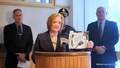
Capeless: Youngsters Must Understand Consequences of 'Sexting'
 |
| Berkshire District Attorney David F. Capeless said he wants to be proactive in combating 'sexting.' |
The images were meant to be private, but like so many things transmitted over digital devices, the pictures were shared beyond the smaller circle. It had been going on for more than six months before adults became aware of it, said District Attorney David F. Capeless, causing distress for students and parents.
"Most importantly, I think people were shocked and surprised to learn what the potential consequences were," he told media assembled in his office on Tuesday.
Teens who send each other explicit pictures of themselves are flirting with serious consequences, and could find themselves running afoul of the state's child pornography laws — the very laws put in place to protect them.
He's hoping more outreach from his office and a partnership with Pittsfield Community Television will raise awareness of the problem with parents and youngsters before it becomes a law-enforcement issue.
| It is a felony to posses or disseminate nude or sexually suggestive images of children, or to pose children in such a way to take an image. * A 16-year-old who takes a picture of himself and sends it to a friend breaks the law. * A teen who encourages a friend to take a nude picture, breaks the law. * A teen who receives a picture and keeps or sends it someone else, breaks the law. |
| Cape Code Sexting Case Six middle-schoolers facing child pornography charges |
| Sexting survey (pdf) * 21 percent of teen girls and 39 percent of teen boys say they sent such content to someone they wanted to date or hook up with. * 83 percent of young adult women and 75 percent of young adult men they have sent/posted such material to a boyfriend/ girlfriend. 15 percent of young adult women and 23 percent of young adult men say they have sent such content to someone they only knew online National Campaign to Prevent Teen and Unplanned Pregnancy |
"Incidents of sexting in Berkshire County need to be taken seriously with law-enforcement intervention if necessary," said Capeless. "But I'm hoping to avoid that possibility through education and awareness of the public."
The Berkshire district attorney declined to name the school, but added he assumed the same behavior was taking place in others around the region. The incident is still under investigation.
What he wanted to get across was that while charges had not been brought the incident shouldn't be dismissed as "no big deal." Beyond any embarrassment or humiliation felt by the teens, creating, transmitting and possessing such images could carry felony charges for those involved.
Violators of the child pornography laws could face up to 20 years in prison, up to $50,000 in fines and years on the state's sex offender list. It doesn't discriminate between the gender of the offender, and it doesn't matter if the child is taking and transmitting photos of himself or herself.
While there are no misdemeanor charges, Capeless said he would be interested in exploring those for child cases.
He cited "disturbing" results of a recent survey conducted by the National Campaign to prevent Teen and Unplanned Pregnancy and Cosmogirl.com.
Nearly a third of the 1,280 teens surveyed admitted to sharing nude or semi-nude images. Half of those surveyed said they had sent sexually explicit texts; at least a quarter thought it was no big deal.
The proliferation of digital devices, such as new handheld gaming platforms with cameras that can connect to the Internet, are just part of a growing knowledge gap between youngsters and parents. Capeless hoped that gaming manufacturers will work to police themselves for inappropriate images as MySpace has been doing.
Many parents seem overwhelmed by the technology, said Carol Mulcahey, director of community outreach and education in Capeless' office. The office offers training in Internet safety to students, school staff at all levels and parents, but the parents' sessions have been poorly attended. A new interactive initiative has been designed to walk parents through the cyberspace their children inhabit, such as MySpace.
More worrying, the calls for training sessions are coming increasingly from elementary schools, she said. "You've got to get this information to the students at a very young age."
Both Capeless and Mulcahey said the key is teaching kids to make smart decisions, to consider what they're doing and how fast it can be spread. (Capeless showed a YouTube video created by some anonymous person with photos snatched from the Web of adolescents in various forms of undress — many obviously shot by themselves using a mirror and cell phone.)
"Those people may feel humiliated and distressed at the ease and speed that that image has been passed around," said Capeless. "Once one of these messages, images, videos or photos is put on cell phone or other digital device it can then be put on the Internet and the whole world can evenutally have access."
For more information on sexting and training sessions for schools, parents and businesses, contact the district attorney's office at 413-443-5951.