Public Forum Planned for Greylock Glen Trail Proposal
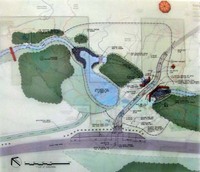 |
| Plan for mediation work connected to the Mount Greylock Parkway project. |
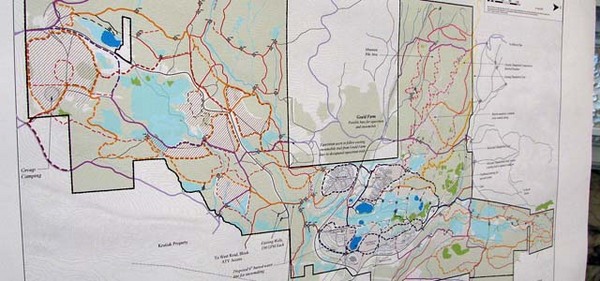
"We are trying to get the best system for the best amount of money," said Harry Dodson of trail designer Dodson & Associates at Thursday's Greylock Glen Advisory Committee. "This is a really good, sound proposal. ... I feel strongly it will at least be a regional draw if not a national one."
The public will get a chance to review and question the trail plan on Monday, June 15, at 7 p.m. at Town Hall.
The updated proposal makes more use of current trails and eliminated a tangle of cross-cutting pathways that Dodson described as "the spaghetti plan," many of which were far away from the so-called core area encompassing the lodge, environmental center and campground.
Cost, too, was an issue, said Dodson. "We've been unpleasantly supprised how expensive it is."
The cutbacks also bring the development well below the benchmark for filing an environmental impact report. Instead, the town will file the less comprehensive environmental notification form when it prepares for its Massachusetts Environmental Policy Act, or MEPA, filing.
About half the older trails will be reused, others "retired" because of their condition or location, and new trails created but the network would have about the same number of miles as the old system. The goal has been to create a diverse, four-season trail system that would still have enough Nordic, or cross country, ski trails to be viable.
The main trails, or Class 1, would be 8 to 10 feet wide and accommodate, according to season, pedestrians, bikes, horses, carriages, Nordic skiers, snowshoers. Class 2 would narrower, at 6 to 8 feet; Class 3, primarily hiking trails, would cross into steeper inclines.
The larger trails would have a gravel base extending at 3 feet beyond each side of the trail to create shoulders topped with loam and grass. "It gives the whole thing structural integreity to keep it from getting wet and rutted," said Dodson.
Dodson also suggested "parallel" earthen trails better suited for cantering or galloping horses along the wider trails in the meadow sections. There would also be some wetlands trails up to observation area and possibly some boardwalks out into wetlands, "where you can get into without a lot of money," said Dodson. "They're a small part of this system but important for wildlife study."
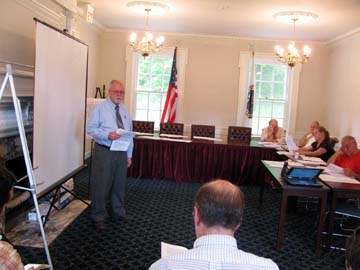 Stephen Brown of DCR discusses aspects of the MEPA process. |
"I think that would great for them, great for the project," he said. "Because I think they are potentially a big ecoomic part of this project. I know there's a way to blend the two so you don't have a conflect between the snowmobiles and unmotorized uses."
There's still the difficulty of getting the snowmobiles from Gould Farm to Bellows Pipe to Notch Road, he said.
He also suggested that the Thunderbolt trail be rerouted in part through the glen because it passes through an area of rare species of concern to environmentalist. The change would avoid those area fragile areas and make use of open meadow space in danger of being overgrown.
"It will end up in same place but by a slighty different route," he said. The old ski trail is popular with telemark Nordic skiers.
Selectman Michael Ouellette questioned if eliminating trails would affect the financial feasibility of the project. Community Development Director Donna Cesan said more trails weren't necessarily a good thing. It was not simply a matter of expense but of creating a sensible system that didn't frustrate users.
There was some concern over the creation and economic feasibility of equestrian trails. Dodson said even if not built it now was worth including them in the proposal because of how onerous the permitting process is. That should also be kept in mind for permitting a snow making operation, in case a private developer is interested in exploring that option.
It was possible a private developer might be interested in constructing a stable operation off-site, such as Gould Farm, while riders stayed at the lodge, said Cesan. "There has been a fair amount of local interest in equine riding."
"I think it's a rally nice terrain," said Dodson. "It's interesting and beautiful and it's connected to places that are good for horse riding."
However, he said horseback riding wouldn't be the top priority if "we're going to have to continue whittling this down for budget and environmental purposes."
Mediation Work
Stephen Brown of the state Department of Conservation and Recreation said the mitigation related to the Mount Greylock Parkway project should begin by mid-July. It will include dredging gravel washed down into a pond on the glen property, re-establishing a wetlands, cleaning and upgrading a snowmobile bridge, and replacing two culverts. Eight bids ranging from $438,000 to $627,00 were received, with the contract being awarded to D.R. Billings of Lanesborough as the low bidder.
He also shared some trivia when going over some of the aspects of the MEPA filing. Looking through previous filings on the far more expansive project proposed for the Glen more than a decade ago - vacation homes, conference center, Alpine skiiing, golf course - he found the current core plan of campground, lodge, amphitheater and environmental center fit snugly into the old golf course.
The Glen development is being funded in part by a $3 million matching state grant. The town, which is the project developer, allocated $150,000 toward planning purposes and along with various grant funds it has pursued. The money has to spent in parallel, rather than the town being reimbursed.