Local radio journalist Susan Arbetter remembered her amazing father and the hospice care that eased for both him and his family his death from cancer at age 53.
Arbetter, host and producer at WAMC in Albany, N.Y. of the public radio station’s Roundtable program, spoke Oct. 26 at a fund-raiser/dinner at the Orchards in Williamstown. The title of her talk was “Grace in Death — Reflecting on My Father’s Life and Death.†The event benefited the newly formed Hospice Fund of Northern Berkshire, created to help offset the costs associated with providing hospice care to the community.
“He was a cardâ€
“He was a card. My father was Michael Arbetter. He was born in 1937 in Flatbush in Brooklyn,†his daughter remembered. “He used to joke that he was one of the Lords of Flatbush, and from the stories he told of launching food grenades from his window onto neighbors, I have no doubt that he was.â€
Her father was smart and earned an MBA and a CPA degree. He met his wife, Arbetter’s mother, when they were both counselors at Camp Copake resort, a place reminiscent of the setting of the movie Dirty Dancing.
“After all of the people who came and paid went to bed, there was the shenanigans behind the fence, and they fell in love,†she said. “It was 1961, and my Dad used to say that his life as ‘a meaningful person’ did not begin until the day that he met and then married my mother.
“And you should see photographs of them, it’s like something out of the movies. They’re both really, really attractive people.â€
Arbetter’s father and mother moved from New York City when Susan was three, and her father eventually started a window manufacturing company in Pennsylvania. He and his wife became very involved in Jewish community life in Pennsylvania.
“My Dad then almost immediately installed himself as principal of the temple Sunday school,†Arbetter said. “The reason he did this ... was to insure that the three of us received a stellar education in Jewish history, Hebrew, and Judaism.
“He also took it upon himself to insure that all the kids in the temple understood and appreciated Jewish culture as well. And to him the center of Jewish culture was New York City,†she remembered.
Michael Arbetter would take a group of youth to New York City to see such places as the Lower East Side, historic synagogues, Ellis Island, and a Broadway show.
“This was an amazing, amazing trip. He did this every year for about 15 years — all of the kids in the temple. And if a kid couldn’t afford it, it didn’t matter, my dad would pay for it.â€
Her father would play a current events question-and-answer game with his children. One time before the family took an adventurous trip out west, the children first had to write book reports on each state they would visit.
“He was a joy for a person. He was bigger than life,†she said. “And he had this ... sense of morality that was very strong, and I have to say made some people feel very uncomfortable. He had a big laugh, a terrific sense of humor. When he walked into a room, he owned it.â€
He also was a bit prideful, could be impatient, could be demanding, had a temper, and was a strict parent.
“Then again, thanks to that temper my sister, brother, and I were never tempted by drugs or alcohol or any of the other traps that befall teens,†she said. “He yelled, but there was never a second that we didn’t know that this man loved all of us completely.
“He would make sure that he would sit down with each of us, and have these heart-to-heart conversations. He used to say to me that he was my biggest fan,†she said. “To someone who’s 14 and feeling fat and feeling like I don’t fit in anywhere, that is a huge boost to your self-esteem.â€
“I have so many wonderful memories of my father,†she said.
The only thing he couldn’t do
“When I was 17, we made a deal, he sat me down and he said, ‘Look, you decided you wanted to go to Boston University. It’s the most expensive school you could have possibly chosen, but that’s all right, I’ll pay, but the deal is that you have to take care of me when I’m old,’ †she said. “He made me shake his hand, and write on a piece of paper that I would take care of him when he was old.
“I think that the only thing that my father couldn’t do was live forever, or really even very long. In 1988 he was barely 50 and doctors found cancer in his throat.â€
He had never smoked in his life: “It was just this genetic weirdness that happened to my father,†she said.
The cancer was removed, he received radiation, but the cancer came back.
“At this point, here is a guy who runs two miles a day, who takes care of himself physically, who is, again, a bigger than life guy, and none of us thought for a second that this was going to be the end of his life. I mean that’s insane. This guy’s way too alive to be not.
“But the cancer returned, and it kept returning even though he had so much radiation. So they had to give my father something called a ‘flap’ ... it’s a surgery to replace the muscles in your throat. It’s very disfiguring, radical surgery,†she said. “And after this radical surgery he had this huge thing on his neck. This was a man who was very vain, who would always go to fine clothing stores to get suits tailored for his physique.â€
“One of the hardest memories for me, I was visiting my Mom and Dad and I walked down the steps and I saw him sitting in the chair, and he said, ‘Look at what they’ve done to me, Susan.’ â€
She told her father he needed to keep hoping for one more day.
“One more day we got, but not very many more days after that,†she said. “He was this man, larger than life, who up until a few months before was CEO of a large company, a man whose laugh was a rumble of joy. Now the same man was in constant pain, he can’t sit up, he can’t look at himself in the mirror, and day by day he’s dying.â€
“It was clear my mother was going to need help nursing my dying father. And when the decision was made that he wouldn’t pursue any other course of treatment, they called the hospice,†she said.
An absolute angel
The Chandler Hall Hospice Home Health Agency in Newtown, Penn., sent the family a list of client rights. First on the list: “You have the right to be treated with consideration, respect, and full recognition of dignity and individuality.†That was what convinced her parents to choose hospice care.
A social worker visited, and she asked Arbetter’s father if he had any unfinished business he needed to rectify: “She wanted to make sure he died in peace and without pain. And she wanted him to die with acceptance.
“Every day after that a man and a woman hospice worker would come to our house, and help my mom help my dad,†she said.
Arbetter’s mother recently said there were some strange and wonderful moments with hospice. She would go to the grocery store to get a protein drink to make her husband strong.
“But the act of swallowing was difficult for my dad, so when the social worker came, my father asked her, ‘Do I have to eat?’ And the woman said, ‘No, you don’t have to eat.’ And my father said, ‘I choose not to eat.’ And this was a revelation to my mother: ‘Why does he have to eat, he’s dying?’ â€
At another point, her mother was greatly worried that she was giving him too much morphine, which she swabbed on his gums because of his difficulty swallowing.
“And the woman looked at her and said, ‘So? So, you give him too much, you know, he’ll die peacefully without pain.’ It was another revelation for all of us, not just my mother.â€
The night before her father died in 1991 was horrible, his breathing laborious. Somehow intuitively knowing that he was going to die, the hospice worker came to the house at 4 a.m., five hours earlier than usual.
“She came just in time, and my mother was able to sit next to the bed and hold my father’s hand while he died, while this hospice worker took care of everything,†Arbetter said. “My mother said of Linda, our hospice worker, ‘Do you know what a blessing your are, you are an angel, an absolute angel.’ â€
“You don’t get any practice or a chance to rehearse when someone dies. You only get one shot. You’re scared, you’re confused, you’re not thinking clearly. But the hospice workers made my father more comfortable, while doing that they did much more. They helped my mother help him,†Arbetter said. “She said to me, ‘There were so many things I could have done for him at the end, but there would have been so many more things I did wrong if the hospice workers weren’t there to help. ... You get one shot and I did OK. And now as I look back on your father’s death, there are fewer ‘if onlys.’ And for that I will always be grateful.’ â€
If you would like to contribute information on this article, contact us at info@iberkshires.com.
Your Comments
iBerkshires.com welcomes critical, respectful dialogue. Name-calling, personal attacks, libel, slander or foul language is not allowed. All comments are reviewed before posting and will be deleted or edited as necessary.
No Comments
McCann Recognizes Superintendent Award Recipient
By Tammy DanielsiBerkshires Staff
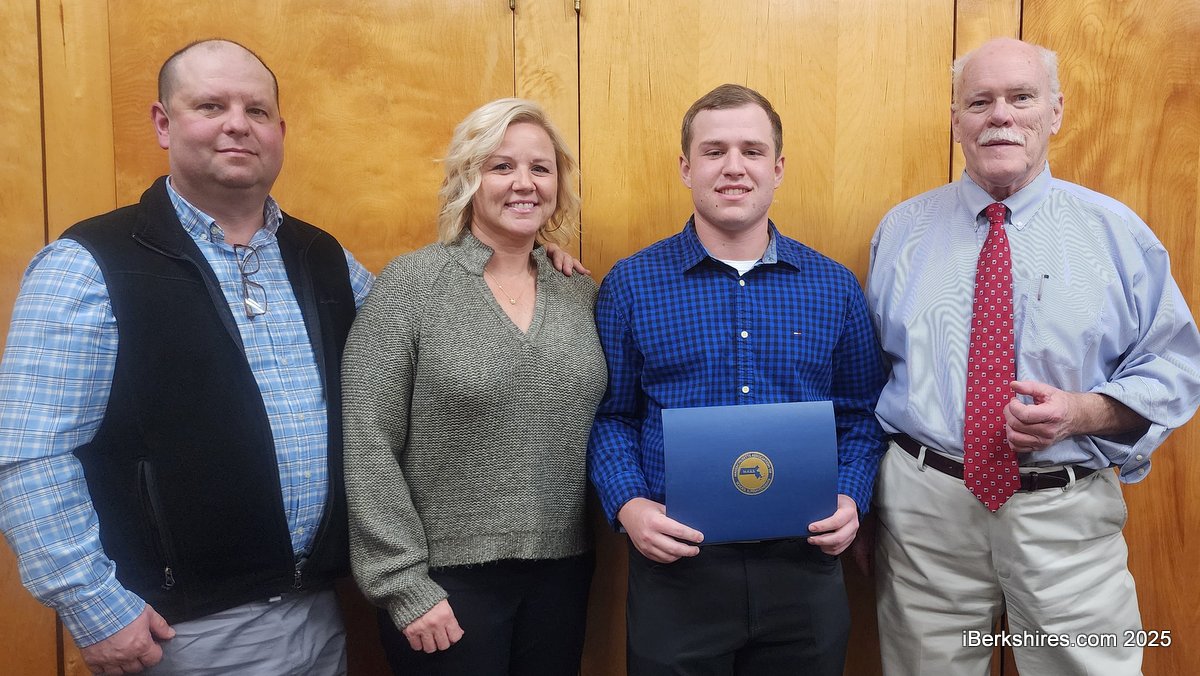
Landon LeClair and Superintendent James Brosnan with Landon's parents Eric and Susan LeClair, who is a teacher at McCann.
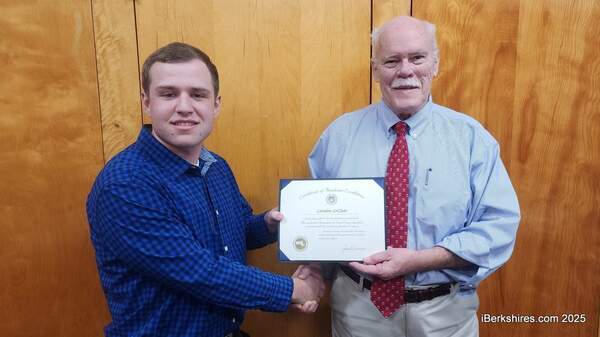
NORTH ADAMS, Mass. — The Superintendent's Award has been presented to Landon LeClair, a senior in McCann Technical School's advanced manufacturing course.
The presentation was made last Thursday by Superintendent Jame Brosnan after Principal Justin Kratz read from teachers' letters extolling LeClair's school work, leadership and dedication.
"He's become somewhat legendary at the Fall State Leadership Conference for trying to be a leader at his dinner table, getting an entire plate of cookies for him and all his friends," read Kratz to chuckles from the School Committee. "Landon was always a dedicated student and a quiet leader who cared about mastering the content."
LeClair was also recognized for his participation on the school's golf team and for mentoring younger teammates.
"Landon jumped in tutoring the student so thoroughly that the freshman was able to demonstrate proficiency on an assessment despite the missed class time for golf matches," read Kratz.
The principal noted that the school also received feedback from LeClair's co-op employer, who rated him with all fours.
"This week, we sent Landon to our other machine shop to help load and run parts in the CNC mill," his employer wrote to the school. LeClair was so competent the supervisor advised the central shop might not get him back.
The city has lifted a boil water order — with several exceptions — that was issued late Monday morning following several water line breaks over the weekend. click for more