Philliip Miller's Hottentot Venus at MASS MoCA
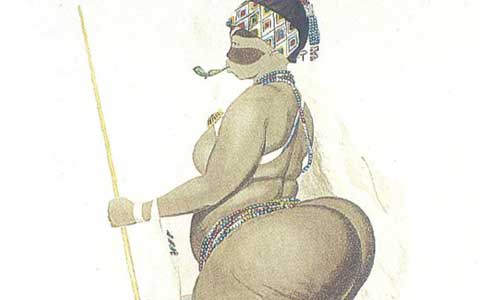
NORTH ADAMS, Mass. - South African composer Philip Miller returns to MASS MoCA on Friday, September 25, 2009, with a work-in-progress musical performance based on the tragic tale of the Hottentot Venus. Miller's music has been enjoyed by MASS MoCA audiences twice in the past - in 2002 when his score and a live orchestra conducted by Miller brought animation by renowned visual artist William Kentridge to life, and again in 2005 with Rewind... A Cantata for Voice, Tape, and Testimony which was based on the Truth and Reconciliation Commission proceedings the wake of South Africa's transition from apartheid to democracy. For this showing, which caps off a two-week residency, Miller brings to light hidden stories of South Africa once again with a musical-drama which tells the story of Sara (Saartjie) Baartman, aka the Hottentot Venus, through song, set and video projection.
Sara Baartman, a twenty-one year old slave girl belonging to the Khoisan tribe, one of South Africa's oldest, was taken from her hometown and shipped to London in 1810. Once in London she was put on display for her "unusual, exotic features." Although Baartman was an accomplished singer, dancer and musician, her only valued quality in Europe was her curious appearance.
After several years in London, Baartman was taken to Paris where an animal trainer displayed her as an exhibit for fifteen months. During her time in Paris several French scientists subjected her to their experiments to uncover the truth about her unique body. She died on December 29, 1815, from complications of depression, alcohol, and pneumonia. Adding to her mistreatment, her remains were placed on display in Paris's Musée de l'Homme. Baartman's story resurfaced in 2004 when Nelson Mandela successfully campaigned for her remains to be returned to South Africa.
Filmmaker Andrew Dosume and composer Philip Miller have collaborated on a contemporary video diary of Baartman's journey through London and Paris. The diary will be seen through the eyes of Andrew Dosume who is of Nigerian descent and has lived in Paris and London where he has experienced being perceived as the exotic "other" who does not belong in a first world country.
Music will play a vital role in the video diary, essentially telling the story of Baartman through song. The music will include contemporary electronic music collaged and layered with traditional elements of Khoisan folk music which Baartman would have sung as a performer at that time. Musical instruments like the ramkie (a traditional Khoisan guitar) and the squash-box (or concertina), as well as the one-stringed violin, will form part of the instrumentation.
Samples of archived Khoisan music will be woven together with references to burlesque and French comic opera (Baartman, during her lifetime, even inspired a comic opera in France, called The Hottentot Venus or Hatred to French Women). Contemporary music styles such as rap and hip-hop will also be part of the musical fabric emphasizing the importation and fascination of Black music into European popular culture.
The distinct sounds of various musical instruments and voices will represent individual characters throughout the video diary. Eight musicians in total will be playing varied instruments including saxophone, trumpet, double bass, cello, violin, guitar, percussion and keyboard/ sampler.
The mezzo-soprano, sung by rising South African opera star Pretty Yende, will speak for Baartman, relaying her past. The tenor will represent the French scientist George Curvier whose interest in Baartman grew from a scientific fascination to obsession and lust. Other lead singers will represent Nelson Mandela, Francois Mitterand, and Roger-Gerard Schwatzenberg, Mitterand's representative to the French National Assembly who dealt with French Parliament's resistance to returning Baartman's remains. A singing quartet composed of Williams College students will represent other roles like the gawking crowds, French scientists and anthropologists, contemporary academics and theorists who continue to obsessively study Baartman, the French politicians who fought against her return to South Africa, and South African interest groups and political parties who all claimed 'ownership' of Baartman and who could not agree where her remains should be buried.
Support for this program is generously provided by the Appelbaum-Kahn Foundation, with additional support from the National Endowment for the Arts and the Massachusetts Cultural Council.
Tickets for Philip Miller's Hottentot Venus on Friday, September 25, 2009, are $15 / $10 for students. MASS MoCA members receive a 10% discount. Tickets are available through the MASS MoCA Box Office located off Marshall Street in North Adams, open from 11 A.M. until 5 P.M., closed Tuesdays. Tickets can also be charged by phone by calling 413.662.2111 during Box Office hours or purchased on line at www.massmoca.org.