BCC Installing $3.5M Photovoltaic System
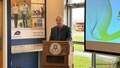
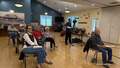
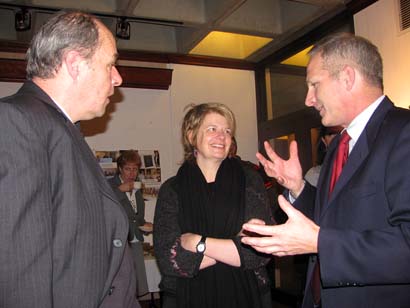 Christopher Kilfoyle of Berkshire Photovoltaic, left, BCC's Ellen Kennedy and Mark Nelson, deputy commissioner of DCAM, discuss sun power at BCC. |
The $3.5 million project — the largest so far for any educational institute in the state — was announced on Monday. It is being financed through federal stimulus funds; about a quarter of the cost will be covered by BCC through expected savings.
The project is moving forward very quickly, said BCC President Paul Raverta, and is already out to bid with contractor visits expected Tuesday or Wednesday.
The array atop five campus buildings will also be utilized as a laboratory for ongoing green energy projects, including the planned Renewable Energy Resource Training Center, being made possible through $750,000 in federal funds acquired by U.S. Rep. John W. Olver, D-Amherst. The center is also expected to be ready by fall. It fits into BCC's growing entry into green technology and educational opportunities.
"It's going to be a source of training throughout the county because, I personally believe that going forward, everybody is going to need to know some green," said Raverta. "No matter what you do, whether it's a homeowner or you're working for a company not directly related to green, everybody needs to know some green. The reality is given where energy costs are going ... it's a direction we need to go in — and sooner rather than later."
The news comes just a week after the unveiling of EOS Ventures' Berkshire Bundle, a loose partnership that together was able to leverage green-energy credits and financing to make seven solar projects feasible.
Alternative energy is an investment the region has to make in terms of new job growth and maintaining existing industry, said state Sen. Benjamin B. Downing, D-Pittsfield. More than 700 blue-collar jobs in South County mills were "gone like that," he said, snapping his fingers, "because we hadn't done enough to secure our energy future here in the Berkshires, in the commonwealth and in this country.
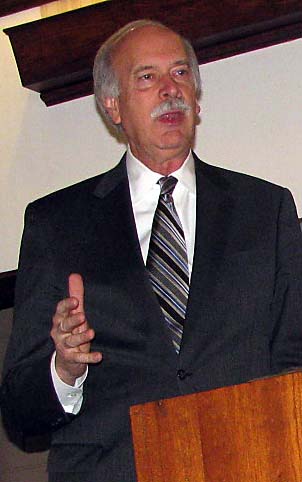 BCC President Paul Raverta said the installation will be utilized as a laboratory for the school's planned green training center. |
The tide includes teaching new skills in green energy through the Pathways Out of Poverty program, noted state Rep. Daniel E. Bosley, D-North Adams. The program grew out of the state's Green Jobs bill backed by both lawmakers and out of Downing's insistence it be focused on low-income workers, not big companies. BCC recently received a $200,000 grant over two years to integrate the program into the new green training center.
"This is the type of program we want to use as a national model," said Bosley, adding the whole package — investment in alternative energy, green jobs and training - "this really is a model for the rest of the colleges and higher institutions in this state."
The federal financing for the solar array was procured through the state's Department of Capital Asset Management, which is working to make state buildings reduce their carbon footprints in line with orders from Gov. Deval Patrick, who's set a goal of having 250 megawatts of solar energy installed across the state by 2017.
A survey of buildings was done early on to identify potential candidates for photovoltaic installations; other state property is being identified by various agencies for roof or ground placement, including prisons, waste-water treatment plants and possibly the state Police Academy.
"We looked at all the state facilities with relatively new flat roofs, so we knew who was capable," said Michael Nelson, DCAM's deputy commissioner. "We threw [BCC] into the study, it was easy."
It wasn't just the flat roofs on the 50-year-old campus that qualified the school but their structural strength. It's expensive to redo roofs to make them capable of handling the heavy installations, said Nelson.
"When they saw the waffle, they knew ... they're perfect buildings for the application," said Ellen Kennedy, dean of administration and finance, referring to the heavy concrete "waffle" pattern ceilings. "We were really excited at the opportunity."
The array is expected to generate between 400,000 and 500,000 kilowatt-hours a year and excess power will be sold into the grid. This is the second round of funding for solar projects; Worcester State College had a 106 KW system installed last summer.
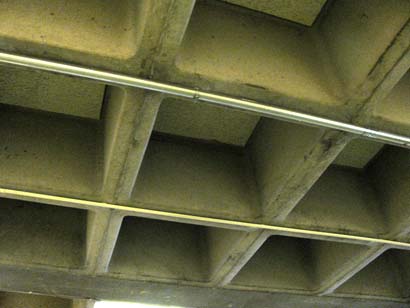 The heavy 'waffle' pattern concrete ceilings made the college a prime choice for roof installations. |
Peter Larkin, a trustee of the college and a former state representative, said the projects wouldn't have worked if so many "if not but fors" hadn't come together ... and maybe something in the Berkshire water.
"It has to do with fact that we are out here trying to solve problems we face every day. We're innovative. We think outside the box ... It's a benefit for all of us ... and it's a leadership position," he said. "If not but for all of you here, it truly wouldn't have happened. We should all give ourselves a hand."