Anthony Celebration Marks Museum Completion
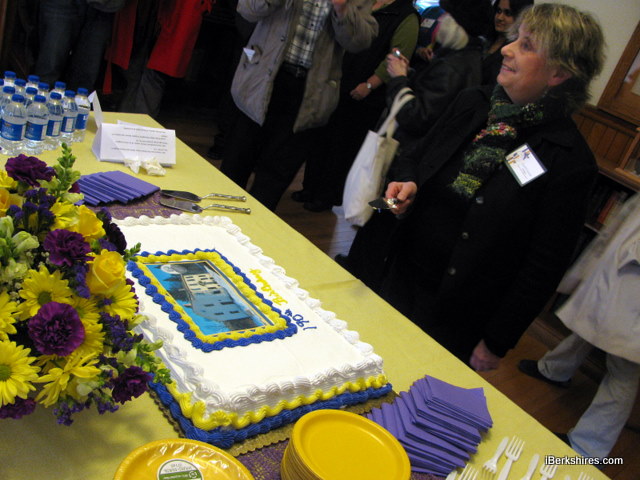 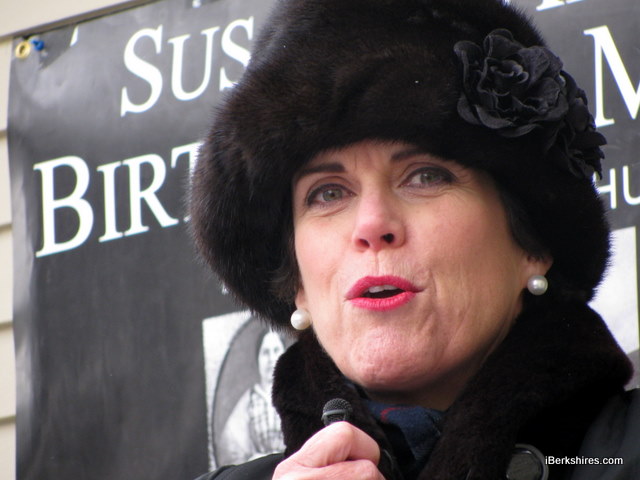 Carol Crossed prepares to cut a birthday cake for Susan B. Anthony's 190th birthday on Sunday. Right, state Sen. Marian Walsh of Boston said Anthony's message of equality continues to be relevant. Carol Crossed prepares to cut a birthday cake for Susan B. Anthony's 190th birthday on Sunday. Right, state Sen. Marian Walsh of Boston said Anthony's message of equality continues to be relevant. |
It wasn't easy; but then it hadn't been easy either to get to this Sunday afternoon celebration. Despite the delays, the costs, the controversies, Crossed had managed to do in four years what so many others had failed to do over the past century.
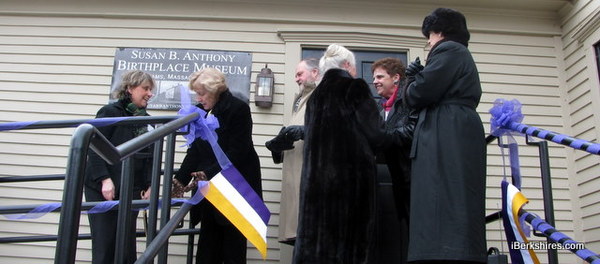
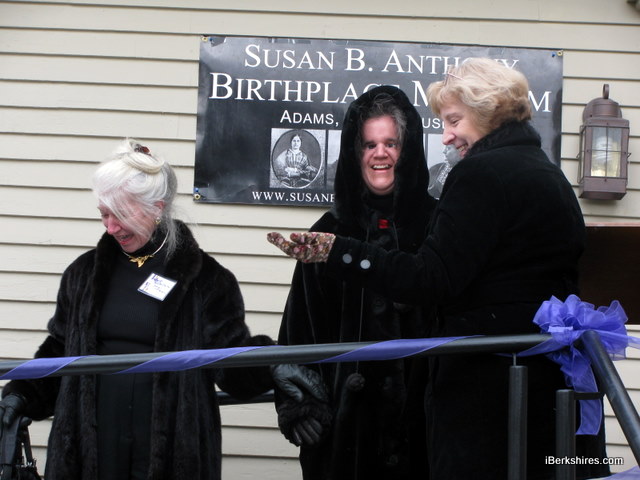
And so almost 190 years to the day of her birth, Adams' most famous daughter and one of the most important women in American history was recognized in her hometown with a former ribbon-cutting of the Susan B. Anthony Birthplace and Museum.
"It feels like I just gave birth to a baby," said Crossed at Anthony's birthday party later. "It was a long labor, but a labor of love."
The museum and gift shop will be open this week only from 10 to 4 for a free preview; it will then close for the rest of the winter and reopen in May.
Anthony was born Feb. 15, 1820, in the house her father, Daniel Anthony, built. The family would later move to New York State, where Anthony would make a name for herself as a crusader for the abolition of slavery and women's rights, particularly the right to vote. Her efforts and that of her colleagues in the movement would not be achieved until the passage of the 19th Amendment in 1920, 14 years after her death.
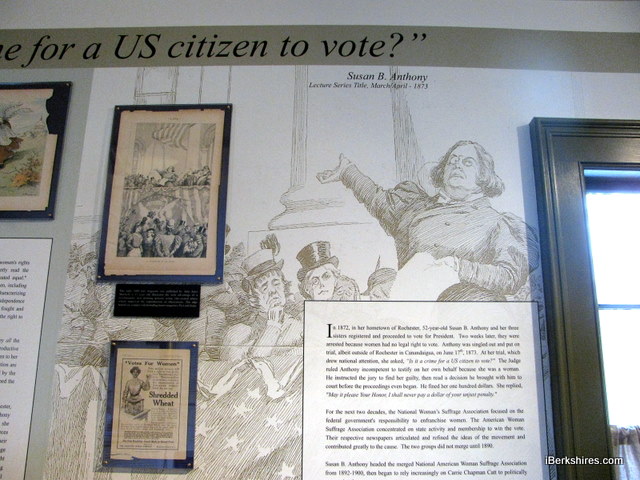 The small museum includes Anthony family history as well as the civil rights activist's adult endeavors. |
The private home was painstakingly restored to as close to its original condition as possible on the first floor (offices and a caretaker's apartment is upstairs), with great attention to paint, windows, flooring and the replication of the kitchen hearth and the small store her father, Daniel Anthony, ran in the front room.
The back parlor, named the "Legacy Room," offers a timeline and topics of Anthony's career against a background of illustrations contemporary to the period printed on vinyl wall covering.
Much of the ephemera in the museum comes from Crossed's collection; other original items and reproductions have been purchased at auction, donated or loaned. Nothing remains of the Anthony family's things, which they had to sell off after the Panic of 1837 left them bankrupt.
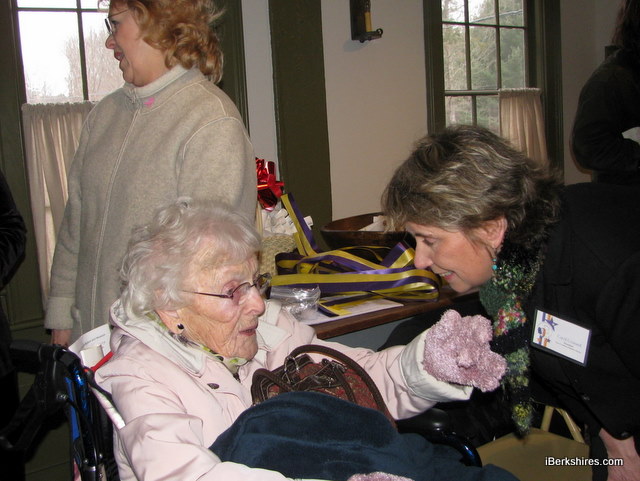 Crossed speaks with Bernice Madigan of Cheshire, who was 20 when the 19th Amendment passed. But Washington, D.C., residents couldn't vote so it would take 17 years and a move to Maryland before she and her husband cast a ballot. 'We were tickled pink to be able to vote,' she said. |
"When I purchased the house at auction 3 1/2 years ago, we didn't know what we wanted to do with it," said Crossed. "My husband thought I was quite out of my mind."
The Rochester resident said she'd told then Town Administrator William Ketcham that there were institutions in her town that could use the house. His reponse, she said, was direct: "No, no, no, no, you cannot move this house, no, no, no."
"You know it belongs here, doesn't it?," Crossed asked the crowd. "You are the family that nurtured the Anthony family that created one of the greatest, if not the greatest, person not only nationally but internationally."
A Smithsonian Institute survey had found Anthony rated the fourth most important person in America and, in 2007, she was added to the naturalization test to ensure the nation's newest citizens knew who she was.
Anthony is a major topic of a women in history course being taught this semester at Mount Ida College by state Sen. Marian Walsh, the event's guest speaker. The West Roxbury Democrat and majority whip said Anthony reminded her of an expression her mother used: "We have been warmed by fires we did not build.
 Barbara Hoffman, left, and daughter Lisa of the Susan B. Anthony neighborhood in Rochester, N.Y, presented museum planning chairwoman Mary Lou Beaudin with an Anthony dollar. The Hoffmans also gifted a framed photo of the district's statue of Anthony and Frederick Douglass having tea. |
Walsh, first woman from her district to be elected representative and then senator, said Anthony's message of equality and opportunity still very relevant.
In the 40-member state Senate, "we have had over 2,000 men serve and we have only had 29 women — and I was the 16th and I'm from the capital city," said Walsh. "How important this is that we have opportunity based on our talent and our gifts and our ambition — and not based on our gender. And that we are all set free or able to be more free when we have examples that tell us that that is there for us, too."
Gabriella Holland, 12, of Birchland Park Middle School in East Longmeadow, performed a short dramatization of Anthony's life. Submitted for National History Day, Gabriella made it to the state level with support from the museum.
Eugene Anthony, a distant relative and museum board member, and his wife, Pat, performed a sonata on acoustic guitar and flute. New Executive Director Sally Winn spoke at both events and read a poem written to Anthony on her 50th birthday.
Her efforts weren't always appreciated in Adams, where she spent her early childhood, said Adams Historical Society Eugene Michalenko at the birthday celebration. The Society of Friends Descendants was established in 1910, four years after her death, by a grandniece to mark the town's Quaker heritage and remember its daughter.
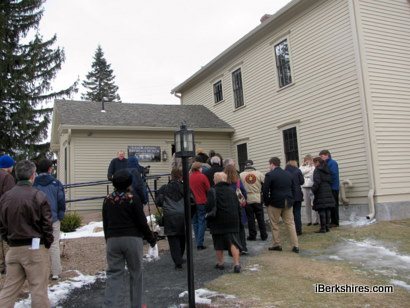 After the ribbon cutting, the museum was open for about an hour. |
That wasn't to be and the school became Hoosac Valley, said Michalenko. "I think it was because nobody wanted the football team to be called the Susie Bs."
Adams did hold weeklong celebrations in the 1970s, first to mark the issuing of postal stamp in Anthony's honor on the 50th anniversary of the 19th Amendment and again when the Susan B. Anthony dollar was issued, both times in Adams.
Now, there's a place to mark the civil right's activists close connection to the Mother Town.
"My hope is that the museum will not only bring light to the life and legacy of Susan Brownell Anthony but also to the town of Adams, where I'm sure her lively spirit lives on," said Eric Anthony, a distant relative. "The unifying theme of her life was to stand up for what is right and true and for those without voice."
A story on the abortion debate posts shortly before 10 a.m. on Monday.