Briggsville Dam Slated for Removal This Summer
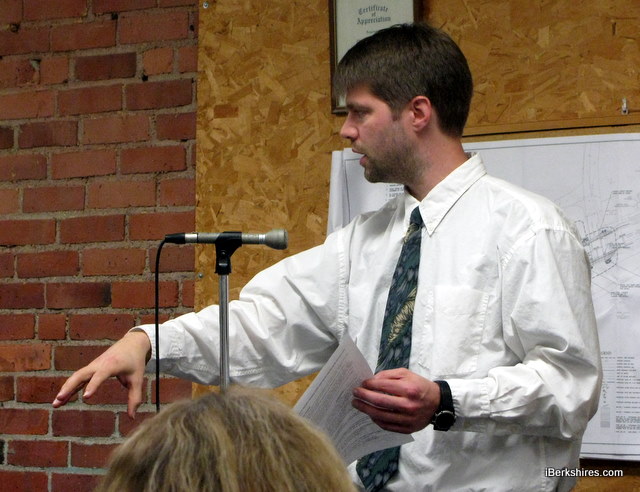 Graber said his group has removed some 800 dams across the country to restore natural habitats. |
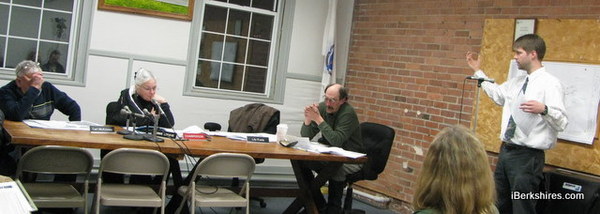
Representatives from the state and from American Rivers, a conservation group representing dam owner Cascade School Supplies, presented plans to the Conservation Commission on Wednesday night and laid out a time line for removal of the dilapidated dam.
"Removing dams is really our No. 1 river-restoration tool around the country," said Brian Graber, director of American Rivers' river restoration program. "Almost 800 dams have been removed around the country and I believe this will be the ninth in Massachusetts."
The aged dam that once powered the Strong-Hewat Woolen Mill has been deemed a safety hazard by state engineers and the cost to bring it up to safety standards have been pegged at $700,000 or more. Removing it and restoring the flow of the river will cost between $400,000 and $500,000.
Funding is being provided from sources including American Rivers, U.S. Fish and Wildlife and the federal Natural Resources Conservation Service.
About 10,920 cubic yards of sediment and rock built up over the past 20 years will be removed; about 1,000 cubic yards of larger material (15 inches or greater in diameter) will be repositioned, most in a flat section of the river bed near the Cross Road Bridge to slow the water and provide pools for fish. The rest will be hauled to Clarksburg Construction Co. for use in commercial projects.
The concrete dam will be taken down in three sections but the gear housing near the mill, now owned by Cascade, will be left in place as an historic marker. No road closures are expected as the work will be done at two access points on the river. That will include using private property; one parcel was donated to the town by the Bonas, the other requires a formal agreement for access.
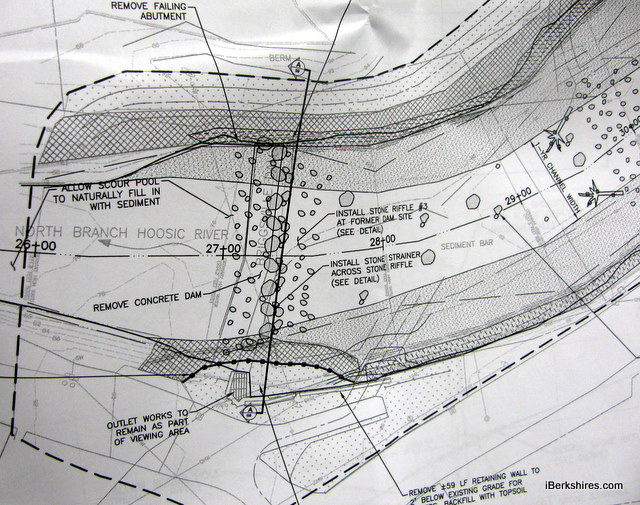  A natural stone baffle will replace the concrete dam. Right, a longnose sucker. A natural stone baffle will replace the concrete dam. Right, a longnose sucker. |
The project will proceed slowly and carefully over a period of six to eight weeks, said Nick Wildman, priority projects coordinator of the state's Division of Ecological Restoration. The construction will be monitored and assessed by licensed designer engineering firm Milone & MacBroom of Cheshire, Conn.
"From a fish standpoint, we didn't want to come into this and pump the stream down," he said. "If we move the project slowly, we'll allow natural movement of the fish."
If they have to be moved, it will be overseen by Dana Ohman, an aquatic biologist with the state's Division of Fisheries and Wildlife.
The some commissioners were less concerned with the fish and more with the safety of the Cross Road Bridge and nearby homes that would affected if the dam collapsed.
"Everything is in place so nothing catastrophic can go wrong and take the bridge out? Right?" asked commission member Debra LeFave, also chairman of the Selectmen.
Wildman said the state Highway Department had signed off on the project but borings will be taken to assure that the material under the anchoring hasn't moved.
"We've learned a lot mostly over the last 20 years, in how to proceed with these projects," said Graber. "We're extremely careful with all the analysis and design ... there's two years of analysis in this site."
Lauren Stevens of Stamford, Vt., representing Hoosic River Watershed Association, said his group "strongly endorsed" the project.
"We think it's terrific both for the fish and we think it will be a very attractive feature for the town," he said.
The project has received a waiver from the Massachusetts Environmental Policy Act review but requires several more permits and acknowledgment letters from state and federal agencies before proceeding.