New Williamstown Homes Could Be Held to Higher Standard
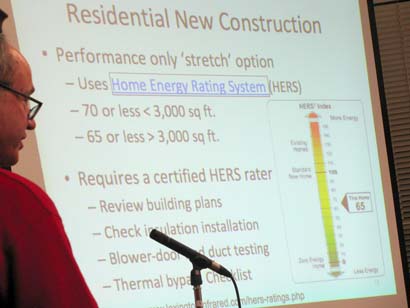 COOL Committee member Thomas Ennis explains the criteria for the 'stretch' code. |
The designation could loosen up state grant money for green projects in town. The building code is one of five criteria that also includes purchasing fuel-efficient vehicles, zoning for "as-of-right" renewable and alternative energy facilities and expedited permitting, and plan to reduce carbon emissions by 20 percent in five years.
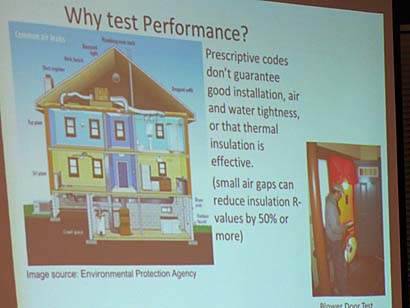
An article on the town warrant asks if the town will accept a more stringent building code that reinforces its commitment to energy reduction. New buildings would have to align with HERS, the Home Energy Rating System, based on insulation, equipment, thermal efficiency and a "blower" test to determine air leakage.
Adopting the code is a final step in the town's application to the state to become a Green Community, COOL Committee member Nancy Nylen told the Selectmen on Monday night.
"The state just adopted a new energy code ... new performance standards," she said. "The stretch code is a little 'stretch' beyond that."
About 100 municipalities are pursuing a Green Community designation, said Nylen, who also works for the Center for Ecological Technology.
Fellow COOL member Thomas Ennis said the added cost of building to the stretch code is anywhere from $1,000 to $8,000, depending on the region and building, another $300 for a HERS tester subsidized by the Energy Star program. The annual net gain for the average homeowner is about $1,300 a year, nearly double the average monthly mortgage.
Buildings would have to hit at least a 70 for buildings less than 3,000 square feet and 65 for those greater.
The code would be somewhat different applied to additions, renovations and certain commercial buildings, said Ennis, since it would follow the "prescriptive" option: slightly better insulation and higher equipment and appliance efficiency standards.
 "There's no question it's going in the right direction," said Selectman David Rempell, who, however, was concerned that it created the idea it was more costly to build in Williamstown. "My fear is this piece somehow falls through our fingertips and leads to an inappropriate perception of what we do here."
Nylen said most builders are already incorporating higher energy-efficiency standards and paying greater attention to detail.
"We believe we will need to work on builder education ... Particularly in the area of building science," said Ennis, adding, "So they can understand the savings potential so they can tell homeowners."
The town already has already been working on emissions reductions and vehicle fuel efficiency. A zoning bylaw for alternative energy facilities is in the works. The deadline to apply for this round of funding is May 14.
CET will hold a meeting on the building code for residents and builders on Thursday, April 29, at Town Hall on a date to be announced.