When Fannie Tash was 11 years old, she started working as assistant in her father, John Tash’s, grocery store on Water Street. That was in 1922, and she ran the store for more than 50 years, its candy counter serving as a magnet for generations of Williamstown children.
And women in the family of Roxana Freeman Duncett were among the first African-American women to travel to Liberia as teachers in the 19th century, subsequently returning to Troy, N.Y., to work in the first school there for African-American children.
These and other women in the work force in Williamstown, through 1953, are the focus of a research project sponsored by the House of Local History and underwritten with a $2,500 grant from the Massachusetts Foundation for the Humanities. The collaborative grant program is in conjunction with the Bay State Historical Society.
Titled “Becoming Visible: Two Centuries of Women’s History in Williamstown,†the project will be presented at the HLH Sunday, March 26, at 2 p.m.
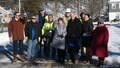
Scholar-in-residence Marla Miller, with the assistance of Jill Mudgett, collaborating scholar, examined the lives of women in Williamstown as revealed in records through 1953, focusing on women and work.
Miller is assistant professor of history at the UMass-Amherst; Mudgett is a graduate student in the history department.
Miller, whose specialties include U.S. women’s history and the social history of Colonial America, completed a comprehensive inventory of the historical assets in the village center, a project in 1997-98 initiated by the Historical Commission and funded by the Mass. Historical Commission.
In the course of that research, she noted that she found evidence of extensive entrepreneurial activity by women at the turn of the century — references to women who were shopkeepers, dressmakers, store managers, peddlers.
She worked on a similar project at Historic Deerfield, where she developed a guide to women’s history that had been hidden within the manuscript collection because it was overlooked by traditional finding aids.
Miller earned her Ph.D. in U.S. history in 1997 from the University of North Carolina at Chapel Hill, where her dissertation was titled My Daily Bread Depends Upon my Labor: Craftswomen, Community and the Marketplace in Rural New England, 1740-1820.
Miller also received her M.A. from UNC, and her B.A. in the History of Culture from the University of Wisconsin at Madison in 1988.
Mudgett, a Ph.D. candidate at UMass, holds an M.S. in American and New England studies from the University of Southern Maine, and a B.A. in historic preservation and women’s studies from Goucher College.
In her scholar’s statement, Miller said that in her research, she “found colonial gentlewomen who managed the town’s most privileged households, freedwomen who migrated to Williamstown in the years following the Civil War, cotton (millworkers) who gambled on upward mobility by abandoning factory work to open their own dressmaking shops, and businesswomen who oversaw the day-to-day operations of stores owned — and so known in the historical records — by their husbands.â€
Miller wrote that the materials could potentially “continue dismantling longstanding myths about women’s participation in the public world of work.
Calling Williamstown “an extraordinarily well-documented small-town community,†Miller wrote that the town “affords an unusual opportunity to investigate not only the ways in which women in rural Massachusetts have entered the work force from the Colonial era to the mid-20th century, but also the means by which that activity has been obscured in the documentary record.â€
“Pulling together and investigating further the clues and fragments ... yield[s] a picture of women’s labor history that will unsettle longstanding beliefs about women, work and business in rural Massachusetts communities,†she wrote.
HLH curator Nancy Burstein, in the project description, wrote that the scholar-in-residence grant enables the organization “to begin the systematic documentation and interpretation of the role of minorities and other under-documented groups in the history of our community.
“Despite the commonly held belief that married women did not enter the work force until the second half of the 20th century, documentary records from Williamstown — including newspaper clippings, census records, business directories, organizational records, and oral histories — indicate women in the work force far earlier, unsettling longstanding beliefs about the roles of women in rural Massachusetts communities.â€
“One of the most significant changes in the current approach to history has been an attempt to make it more inclusive. In the past, the lives and contributions of minorities, whether African-American, Native American, immigrant groups or women, have been neglected, giving the appearance of a past inhabited solely by white, protestant males,†she wrote.
And while academic institutions and large museums have tried to shift their focus to include formerly excluded groups, and to alter the way history is taught, that shift is “harder for small, local historical societies without resources.
“In order to present an accurate picture of a town’s past, and to be meaningful and relevant to its entire audience, it is incumbent upon local historical societies to preserve and present history that is inclusive of all elements of the town.â€
This week, Burstein said the research is a matter of “finding them and pulling them out.â€
“I’m really excited by it. As a feminist myself, I’m delighted to learn what we have in the collection about the accomplishments of women in Williamstown at a time when we thought women were just sitting home.â€
If you would like to contribute information on this article, contact us at info@iberkshires.com.
Your Comments
iBerkshires.com welcomes critical, respectful dialogue. Name-calling, personal attacks, libel, slander or foul language is not allowed. All comments are reviewed before posting and will be deleted or edited as necessary.
No Comments
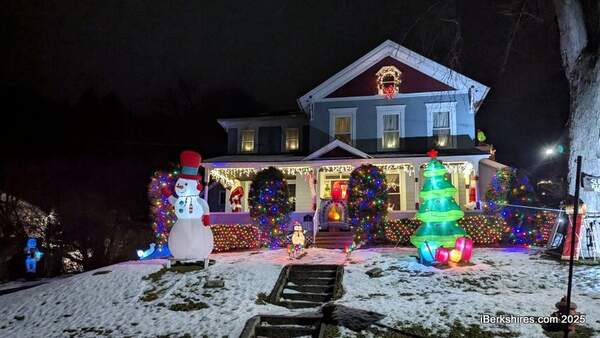
Berkshire County Homes Celebrating Holiday Cheer
By Breanna SteeleiBerkshires Staff
There's holiday cheer throughout the Berkshires this winter.
Many homeowners are showing their holiday spirit by decorating their houses. We asked for submissions so those in the community can check out these fanciful lights and decor when they're out.
We asked the homeowners questions on their decorations and why they like to light up their houses.
In Great Barrington, Matt Pevzner has decorated his house with many lights and even has a Facebook page dedicated to making sure others can see the holiday joy.
Located at 93 Brush Hill Road, there's more than 61,000 lights strewn across the yard decorating trees and reindeer and even a polar bear.
The Pevzner family started decorating in September by testing their hundreds of boxes of lights. He builds all of his own decorations like the star 10-foot star that shines done from 80-feet up, 10 10-foot trees, nine 5-foot trees, and even the sleigh, and more that he also uses a lift to make sure are perfect each year.
"I always decorated but I went big during COVID. I felt that people needed something positive and to bring joy and happiness to everyone," he wrote. "I strive to bring as much joy and happiness as I can during the holidays. I love it when I get a message about how much people enjoy it. I've received cards thanking me how much they enjoyed it and made them smile. That means a lot."
Pevzner starts thinking about next year's display immediately after they take it down after New Year's. He gets his ideas by asking on his Facebook page for people's favorite decorations. The Pevzner family encourages you to take a drive and see their decorations, which are lighted every night from 5 to 10.
In North Adams, the Wilson family decorates their house with fun inflatables and even a big Santa waving to those who pass by.
The Wilsons start decorating before Thanksgiving and started decorating once their daughter was born and have grown their decorations each year as she has grown. They love to decorate as they used to drive around to look at decorations when they were younger and hope to spread the same joy.
"I have always loved driving around looking at Christmas lights and decorations. It's incredible what people can achieve these days with their displays," they wrote.
The Wilsons' invite you to come and look at their display at 432 Church St. that's lit from 4:30 to 10:30 every night, though if it's really windy, the inflatables might not be up as the weather will be too harsh.
In Pittsfield, Travis and Shannon Dozier decorated their house for the first time this Christmas as they recently purchased their home on Faucett Lane. The two started decorating in November, and hope to bring joy to the community.
"If we put a smile on one child's face driving by, then our mission was accomplished," they said.
Many homeowners are showing their holiday spirit by decorating their houses. We asked for submissions so those in the community can check out these fanciful lights and decor when they're out.
click for more