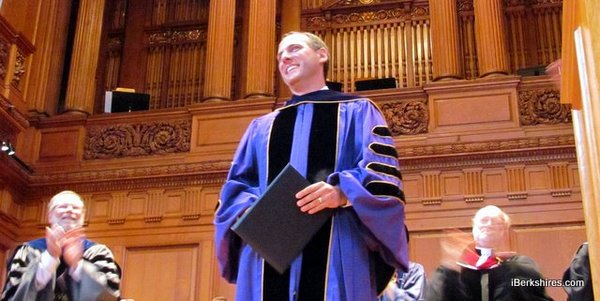
Williams Inducts 17th President at 2010 Convocation
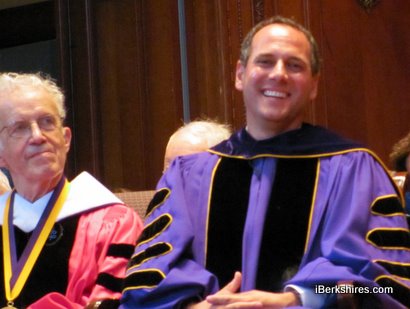 Falk and convocation speaker Daniel Kleppner, left, on the stage. |
Adam F. Falk was welcomed as the college's 17th president — and only the second scientist to lead the liberal arts college in its 217-year history — at the annual convocation in Chapin Hall. Falk's wife, Karen, and children Briauna, David and Alex were seated in the front row; the senior class, guests and faculty filled the hall.
The new president called upon students, faculty and staff to continue the college's role as an innovative leader and educator both nationally and internationally, and its promise to broaden the college community across multiple boundaries.
"Perhaps nothing has nothing has inspired me more in the past six months than discovering the remarkable depth, commitment and quality of our students," said Falk. "But how can all this difference flourish while at the same time we build a single community that welcomes and support all. ...
"If we can accomplish this — internalize this perspective on difference — we can become truly global and teach and learn as never before."
Falk pointed to the famous Haystack Prayer Meeting of 1806, at which the missionary movement was created by Williams students; it was a commitment to use their education to better the world. From that time, the college became more an educator of the elite and the wealthy until breaking free in the 1960s to reflect a global diversity.
 |
Falk was named president last fall after a nearly yearlong search that included input from the college and local community. He replaced Morton O. Schapiro who left to head Northwestern University in 2008 after a decade at Williams.
Falk, who was dean of the School of Arts and Sciences at Johns Hopkins University, has been on campus since earlier this year. On Saturday, he was handed a copy of the college charter and the symbolic key to the school by Gregory Avis, chairman of the board of trustees and a 1980 graduate of the college.
Falk's background in theoretical physics prompted comments from several speakers, linking him to Einstein and the college's other scientist president, Paul A. Chadbourne, a naturalist with a medical degree who served from 1872 to 1881. Chadbourne thought professorship a "dangerous place for a man," where one would grow narrow minded and "more unlike other men."
"The difference between two presidents can be striking," said Eiko Maruko Seiniawar, associate professor of history who gave greetings from the faculty. "In President Falk, the faculty have and recognize someone who not just understands what animates our work, but who embodies and supports that which we value."
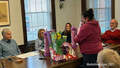
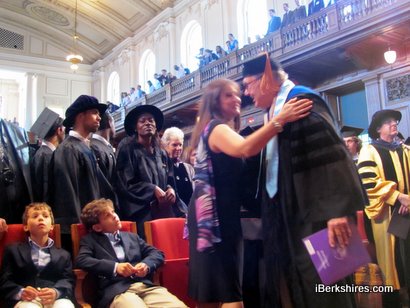 Karen Falk greets faculty while sons David and Alex wait for the convocation to begin. |
Daniel Kleppner, class of 1953 and a 2010 Bicentennial Medal honoree, gave the convocation address. The groundbreaking physicist and professor emeritus at Massachusetts Institute of Technology said his time at Williams wasn't easy. Socially awkward and outside the then-fraternity dominated cliques, he graduated from Williams early with the help of his professors and won a Fulbright Scholarship to Cambridge College in England (where his stipend outpaced the local economy: "I was wealthy for two years: my social skills improved.")
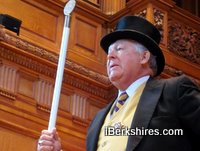 Sheriff Carmen C. Massimiano brought the convocation to order for the last time. |
Kleppner's work in quantum mechanics and particles in ultracold temperatures ("You are idolized as the man who maded the ultracold ultracool.") was recognized with a Bicentennial Medal presented by Falk. Also awarded medals were William H. Eddy Jr., class of 1949, for his work in environmental education; William E. Spriggs, class of 1977, for public policy; Joshua M. Kraft, class of 1989, for youth services, and Camille L. Utterback, class of 1992, for interactive art.
Twenty-seven seniors were inducted into Phi Beta Kappa and the college bid farewell to retiring Berkshire County Sheriff Carmen C. Massimiano, who has lead the college's graduation and convocation processionals for three decades.
"It's time for someone else to do it," said Massimiano.