image description
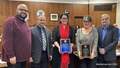
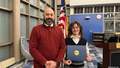
Ruby Bridges Hall and her former elementary school teacher Barbara Henry reunite in front of Norman Rockwell’s painting 'The Problem We All Live With' at Norman Rockwell Museum, June 5, 2004. Photo ©Norman Rockwell Museum. All rights reserved.

Rockwell's 'The Problem We All Live With' Remains Symbol of Struggle for Racial Equality

Print Story | Email Story
“The Problem We All Live With,” Norman Rockwell, 1963 Oil on canvas, 36” x 58” Illustration for “Look,” January 14, 1964 Licensed by Norman Rockwell Licensing, Niles, IL. From the permanent collection of Norman Rockwell Museum
STOCKBRIDGE, Mass. — Six-year-old Ruby Bridges’ history-changing walk integrating the William Franz Public School in New Orleans took place nearly 50 years ago, on Nov. 14, 1960. The moment took place six years after the 1954 United States Supreme Court Brown v. Board of Education ruling declared that state laws establishing separate public schools for black and white students were unconstitutional,  and represented a definite victory for the American Civil Rights Movement.

Among those Americans to take note of the event was artist Norman Rockwell, a longtime supporter of the goals of equality and tolerance. In his early career, editorial policies governed the placement of minorities in his illustrations (restricting them to service industry positions only), however in 1963 Rockwell confronted the issue of prejudice head-on with one of his most powerful paintings—”The Problem We All Live With.” Inspired by the story of Ruby Bridges and school integration, the image featured a young African-American girl being escorted to school amidst signs of protest and fearful ignorance. The painting ushered in a new era in Rockwell’s career, and remains an important national symbol of the struggle for racial equality.

“I was about 18 or 19 years old the first time that I actually saw it,” says Ruby Bridges Hall, who now serves on the board of Norman Rockwell Museum, which owns the original painting. “It confirmed what I had been thinking all along—that this was very important and you did this, and it should be talked about… At that point in time that’s what the country was going through, and here was a man who had been doing lots of work—painting family images—and all of the sudden decided this is what I am going to do… it’s wrong and I’m going to say that it’s wrong.”

The illustration appeared in the Jan. 14, 1964 issue of “Look” magazine, and earned Rockwell letters of both praise and criticism from readers unused to such direct social commentary from the illustrator. Rockwell would revisit the theme of civil rights in several other illustrations from the period, and in 1970 received the Million Dollar Club Award from The National Association for the Advancement of Colored People, for having contributed $1,000 to the organization.

“The Problem We All Live With” was the first painting purchased by Norman Rockwell Museum in 1975, and is currently on view in the national touring exhibition “American Chronicles: The Art of Norman Rockwell.” An intimate installation commemorating Ruby Bridges’ historic walk will be exhibited at the museum starting Saturday, Nov. 13, and will include studies, photographic references, and the original “Look” magazine tear sheet featuring Rockwell’s iconic image. On Sunday, Nov. 14, curator Corry Kanzenberg will give a one hour talk about the painting, starting at 11:30 a.m.

Bridges Hall, who founded The Ruby Bridges Foundation in 1999 to promote the values of tolerance, respect, and appreciation of all differences, commends Rockwell for having “enough courage to step up to the plate and say I’m going to make a statement, and he did it in a very powerful way.” Learn more about the Ruby Bridges Foundation at www.rubybridges.com.

Norman Rockwell Museum is located on 36 park-like acres in Stockbridge, Rockwell’s hometown for the last 25 years of his life. The museum is open year-round. From May through October, hours are 10 a.m. to 5 p.m. daily; from November through April, hours are 10 a.m. to 4 p.m. Monday through Friday, and 10 a.m. to 5 p.m. on weekends and holidays. Rockwell’s studio is open May through October, 10 a.m. to 5 p.m.. Museum admission is $15 for adults, $10 for students, and $13.50 for seniors. Antenna Audio Tour of select paintings from the museum’s permanent Norman Rockwell collection is available. For more information, the public is invited to visit www.nrm.org or call 413-931-2221.
If you would like to contribute information on this article, contact us at info@iberkshires.com.

Capeless Students Raise $5,619 for Charity

By Breanna SteeleiBerkshires Staff

PITTSFIELD, Mass. — Students at Capeless Elementary School celebrated the season of giving by giving back to organizations that they feel inspired them.

On Monday night, 28 fourth-grade students showed off the projects they did to raise funds for an organization of their choice. They had been given $5 each to start a small business by teachers Jeanna Newton and Lidia White.

Newton created the initiative a dozen years ago after her son did one while in fifth grade at Craneville Elementary School, with teacher Teresa Bills.

"And since it was so powerful to me, I asked her if I could steal the idea, and she said yes. And so the following year, I began, and I've been able to do it every year, except for those two years (during the pandemic)," she said. "And it started off as just sort of a feel-good project, but it has quickly tied into so many of the morals and values that we teach at school anyhow, especially our Portrait of a Graduate program."

Students used the venture capital to sell cookies, run raffles, make jewelry, and more. They chose to donate to charities and organizations like St. Jude Children's Research Hospital, Berkshire Humane Society and Toys for Tots.

"Teaching them that because they have so much and they're so blessed, recognizing that not everybody in the community has as much, maybe not even in the world," said Newton. "Some of our organizations were close to home. Others were bigger hospitals, and most of our organizations had to do with helping the sick or the elderly, soldiers, people in need."

Once they have finished and presented their projects, the students write an essay on what they did and how it makes them feel.

"So the essay was about the project, what they decided to do, how they raised more money," Newton said. "And now that the project is over, this week, we're writing about how they feel about themselves and we've heard everything from I feel good about myself to this has changed me."

Sandra Kisselbrock raised $470 for St. Jude's by selling homemade cookies.

"It made me feel amazing and happy to help children during the holiday season," she said.

Gavin Burke chose to donate to the Soldier On Food Pantry. He shoveled snow to earn money to buy the food.

"Because they helped. They used to fight for our country and used to help protect us from other countries invading our land and stuff," he said.

Desiree Brignoni-Lay chose to donate to Toys for Tots and bought toys with the $123 she raised.

Luke Tekin raised $225 for the Berkshire Humane Society by selling raffle tickets for a basket of instant hot chocolate and homemade ricotta cookies because he wanted to help the animals.

"Because animals over, like I'm pretty sure, over 1,000 animals are abandoned each year, he said. "So I really want that to go down and people to adopt them."

View Full Story

More Stockbridge Stories