Groups Seek Emergency Shelter for Area Homeless
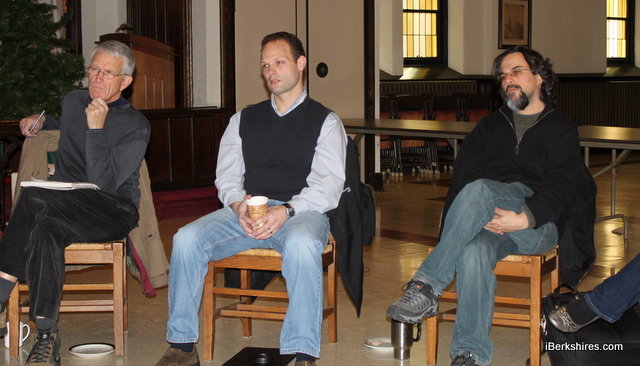 Mark Miller, Paul Gage and David Christopolis were among the nearly 20 people gathered at the meeting. |
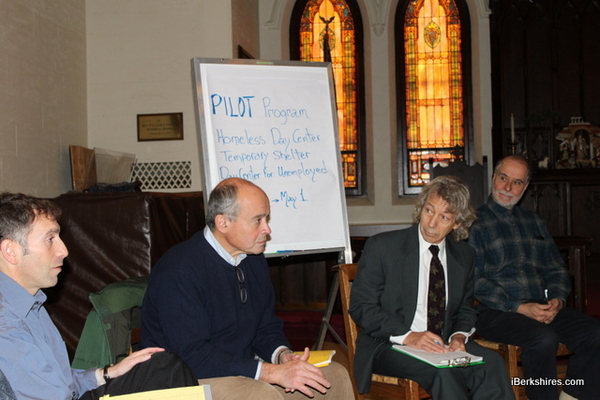
The extreme temperatures and the extreme economy prompted nearly 20 community and faith-based leaders to meet last Friday at First United Methodist Church on Fenn Street to discuss the possibility of setting up a temporary emergency night shelter for the winter months as well as a day center for the homeless and the unemployed. The meeting was chaired by Paul Deslauriers, executive director of Community Organizing for Action, or Co-Act.
"We're looking for a solution that would involve the faith-based community and other collaborations that would help with a pilot program," he said. "If you haven't had an opportunity to head out with the homeless on a cold day, I encourage you to do so. It's miserable. This is an immediate need."
Providing much-needed warmth and shelter is a priority for David Christopolis of Berkshire Community Action Council. As an administrator for the area Continuum of Care program that operates under the auspices of the U.S. Department of Housing and Urban development, Christopolis is very familiar with the specific needs of residents who are homeless and couch surfing or tripling up in tiny apartments as their options become slimmer.
"We developed a 10-year plan to end homelessness and that was two or three years ago," he said. "We've set forth goals for the community, particularly in distinguishing between chronic and episodic homelessness."
There are few shelters in Berkshire County — the
The Methodist church is, according to Deslauriers, thus far the only feasible location for an emergency shelter that would run from the end of January to the beginning of May of 2011.
"We’re looking primarily at the needs here in Pittsfield. We’re not looking to cast anything in concrete at this time,” he said. "The FUMC is opening up its doors to this possibility. We've already had fire, building and food inspectors here to look things over. It looks like the place needs some hard wiring, including smoke and CO2 detectors. It would be very possible to make this transition.”
Any shelter, even a seasonal one, would be a welcome relief said the Rev. Hannah Anderson, rector of St. Stephen's Episcopal Church on East Street. She said as the temperatures decrease, the number of homeless visitors to the parish increases.
"We have three to five people coming to the church every day seeking food or shelter of some sort," she said. "People have come into our building and hidden during the day. They make a nest in our closets or other small spaces. And we've had food stolen from our soup kitchen. Very often it's hard to know what to do with these folks. The police station sends people to us. Clearly, this is not a solution."
Before any move toward providing temporary housing is taken, the group must take into consideration the many distinct populations that would most likely use the shelter, said Brad Gordon, director of the Berkshire County Regional Housing Authority.
"We need to be careful of mixing different populations; we don't want to be putting people at risk" he said. "Typically it's been more singles. This presents a challenge, especially as we are seeing more families. The face of homelessness is very different in rural areas."