Museum Opens its Doors to Students, Scientists
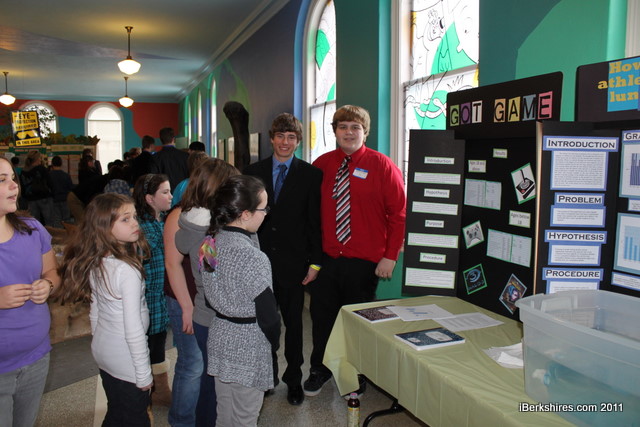 Taconic HIgh students Brandon Knights and Eamon Connor researched stereotypes related to gaming. The teens presented their research at a science fair at the Berkshire Museum on Thursday. |
The museum was hosting its first annual Science and Innovation Fair, sponsored by SABIC Innovative Plastics.
Student-scientists filled the first floor of the museum with exhibits and experiments that many have been working on since the beginning of the school year.
Brandon Knights, a sophomore at Taconic who did a study on stereotypes surrounding the videogaming world, said his project was a learning process in more ways than one.
"You learn from your teacher differently than you learn from yourself," he said. "When we think of gamers we think mostly in negative stereotypes; some 40-year-old guy still living at home playing games all day. We wanted to see if this stereotype, which is pretty universal, was actually true."
Knights and his lab partner sophomore Eamon Connor, also a student at Taconic, surveyed gamers both younger and older than 18. What they found was that common misconceptions about gamers were, for the most part, invalid to the people in their study.
"We were surprised at the results once we started talking to people," Connor said. "We found that generally gamers have an education and a job, they don't sit around all day and play video games. Most adults treat it like a hobby and spend the same amount of time playing games as other people do collecting things or going for a hike."
Knights said the results made him pause in his thinking about more than just gamers.
"I'm really not going to pay attention to stereotypes," he said. "I've learned that it's important to identify with the individual on that level."
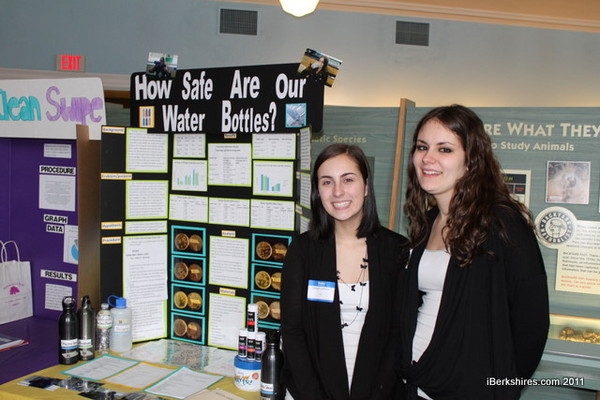
In addition to the gaming study, other projects included a study on the health benefits of raw honey, a foot-drying invention, a fingerprint lab and an umbrella invention to name a few. Ally Blasioli and Abigail LeRose, both seniors at Taconic, opted for a practical study of germs as their research topic.
"We both play lacrosse and we see a lot of kids on sports teams reusing their plastic water bottles," Blasioli said. "We wanted to see which bottle was the best in terms of staying clean and not hanging on to bacteria."
The girls' conclusion was somewhat surprising. Of the four bottles they tested, Nalgene, aluminum, stainless steel and plastic, the aluminum bottle proved to be the least laden with bacteria. Plastic was a close second, followed by the Nalgene bottle and finally stainless steel, which retained the most bacteria.
"The stainless steel was surprising," LeRose said. "But with any bottle, if you wash it out, you can get rid of half of the bacteria, and yes, water bottles are safe to drink from."
The projects were about more than just reaching a hypothesis or a conclusion. According to Maureen Boino, a chemistry and forensics teacher at PHS, the process itself is as important as the conclusions that are drawn.
"This counts as 20 percent of their final exam grade," she said. "Initially there was a lot of apprehension but once the students got into it they got very excited. This fair has been growing over the years, you never know how it's going to turn out. I've had to teach them more practical skills, too, like shaking people's hands and making eye contact. It's not just about the science. It's about the design process and presenting the design to others."
Presenting the design is yet another important aspect of the fair. Only 12 students of those who are presenting at the museum will be selected to participate in the Region 1 Science Fair that will be held at Massachusetts College of Liberal Arts on March 11. The winners there move on to the state competition held every year at Massachusetts Institute of Technology.
The trend, according to Boino, has moved toward practicality.
"In a lot of ways this is applied science that they will use more than once," she said. "It's built in innately to the curriculum."