North Adams, Pittsfield See Drop in Population
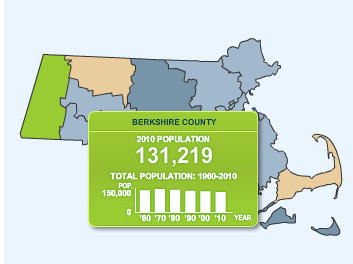 NORTH ADAMS, Mass. — The Berkshires' two cities lost population over the past decade, according to numbers released Tuesday by the U.S. Census.
The trend isn't surprising — the communities have been trending downward at a fast pace since the loss of their two biggest employers, General Electric and Sprague Electric.
North Adams took the biggest hit, slipping under 14,000. The state's smallest city saw a decrease in population of 6.63 percent, dropping from 14,681 in the 2000 Census to 13,708 in 2010.
According to the American Community Survey from 2005-2009, two-thirds of the population is over age 25, or 8,558; almost 2,300, or 16 percent, are 65 and older. More than half live in their own homes, about 10 percent less than the national average. Eighty-two percent graduated high school and 22 percent hold a bachelor's degree. About half of all men and women are married and 4 percent speak a language other than English at home, compared with nearly 20 percent of the U.S. population.
Sixty percent are employed and drive 20 minutes to get to work. The median income is $35,000.
Pittsfield posted a smaller decline of 2.31 percent, dropping from 45,793 to 44,737.
Its profile, based on the ACS data, is similar to its smaller neighbor to the north. Just over two-thirds of its population is over age 25, and 18 percent are 65 and older. Both cities have an older than average population; about 12 percent of the nation is 65 and older. More than 61 percent of Pittsfield residents live in their own homes; residents have a median income of $43,507, about $7,000 more than in North Adams.
Nearly 89 percent have a high school diploma, above the national average of 84.6, and 26 percent have a bachelor's degree. Sixty-three percent make up the labor force and the average commute to work is 17 minutes.
Both cities have more women than men, although fewer people overall are married in Pittsfield compared to North Adams.
Once upon a time, North Adams had more people than Pittsfield. In the northern city's manufacturing heyday in 1900, North Adams had 24,000 residents; Pittsfield had 21,700. In 1980, before the manufacturing exodus, their populations were 18,063 and 51,974, respectively.
The county's third largest community, Adams, decreased by 3.68 percent, from 8,809 to 8,485. Like the two cities, the loss of manufacturing in Adams, particularly the textile industry, has resulted in a gradual decline from its peak of 13,000 in 1910. As late as 1980, the Mother Town had more than 10,000 residents.
Williamstown lost about 700, or 7.95 percent, pushing its population down to 7,754. That's down about 1,000 since its peak in 1980. The ever-expanding Williams College and the tourism and arts industry have meant the Village Beautiful is less susceptible to the loss of its manufacturing past. Despite a drop over the past decade, its population it still far higher than the first part of the last century.
Nineteen of the county's 32 communities lost population. The highest percentage was Stockbridge, which saw a decrease of 329, or 14.4 percent. The greatest increase percentagewise was the tiny town of Mount Washington, which saw its population jump from 130 in 2000 to 167 last year, or 28.46 percent.
The county, in total, lost about 3,700 residents. More information on the Berkshire towns can be found here.