Noam Chomsky Questions Humanitarian Intervention At Williams
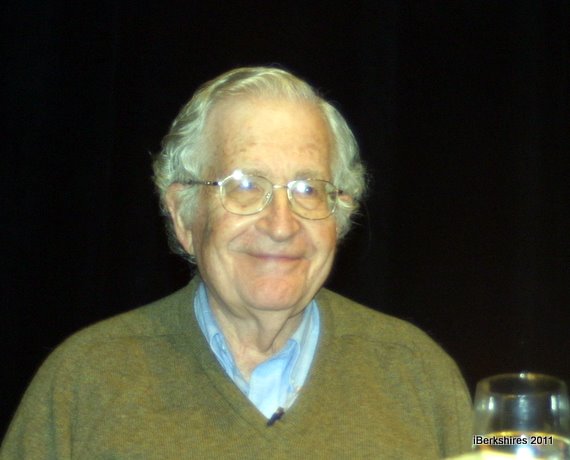 Noam Chomsky is one of the most controversial figures in American politics because of his criticism of U.S. foreign policy. |
The Massachusetts Institute of Technology professor weaved through the history of humanitarian intervention to make the point that those actions are not simple and come with political baggage while simple things that could truly save lives are overlooked.
Chomsky started with the 1850s with John Stuart Mill posing the idea that England should intervene not only when its safety and interest are in danger but because it is dedicated to peace. Philosophers added to the growing thought — painting a "saintly glow" of modernized countries — by saying "barbarians" needed the protection of the civilized power.
But it wasn't until after the Cold War that the idea of peace through intervention began to pick up momentum. When the Soviet Union fell, NATO — against handshake agreements with Mikhail Gorbachev — expanded to the entire world.
"The condition was that NATO does not expand one inch to the east. That meant east of Germany. NATO immediately moved east of Germany and then further east," Chomsky said. "These were only gentleman's agreement. ... He was stupid enough to believe Western diplomats."
The North Atlantic Treaty Organization (established to protect Europe from Soviet invasion) has continued to expand to become a "global, U.S.-run intervention" organization and, with that, the United States also shifted foreign policy, Chomsky said. Former President George H. W. Bush continued to keep a large military presence to ensure global safety by keeping an eye on the Middle East.
"It wasn't because of the Russians, it was because of the technological sophistication of Third World powers," Chomsky said. "There was an ideological change, too, a large, sudden interest in the concept of humanitarian intervention."
In 1999, the "crown" of humanitarian intervention came with the bombing of Serbia. In what is sometimes considered NATO's first humanitarian intervention, the goal was to end ethnic cleansing of Albanians in Kosovo. When most of the world condemned the move, humanitarian intervention took another turn, he said.
"At that point a new concept was invented. That was called the 'responsibility to protect,' " Chomsky said but added there were two versions — the West's and the rest of the world's.
When Western cultures point to the responsibility to protect and say it was supported by the rest of the world, that is not entirely correct, he contends.
"It provides for NATO and NATO alone to intervene freely anywhere without authorization from the [U.N.] Security Council," Chomsky said. "There is only one region that can do this. ... The one regional group that can do that is NATO and the region of their authority is the world."
While Kosovo is often considered the first humanitarian intervention, Chomsky claims there are many others that have fallen off the radar.
.jpg) |
"They all had the properties of humanitarian intervention," Chomsky said. "They meant it."
Also left out of consideration, Chomsky contends, is India's intervention of East Pakistan to end Pakistani atrocities and Vietnam's invasion of Cambodia that ended Pol Pot's reign.
"Neither of these figure in the literature of humanitarian intervention because of two reasons. One reason is, wrong agency. They did it. We didn't do it. The second and more powerful reason is the U.S. was bitterly opposed to both of these interventions," Chomsky said. "There are cases where intervention has had benevolent effects."
But with all the political jargon and political forces that have changed humanitarian intervention throughout history, 6 million infants die every year in countries that lack the ability to perform simple medical procedures that would cost very little to the wealthiest nations, Chomsky said. With a "tiny percentage of the GDP" from the largest nations, the most elementary form of humanitarian intervention could save 6 million, he said.
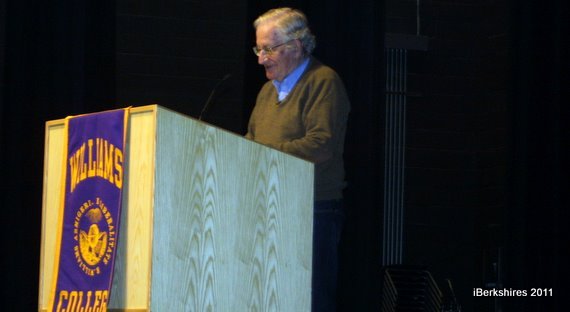
Chomsky appeared at Williams as the first part of a two-part dialogue about the dilemmas in humanitarian intervention. Fiona Terry will be the next speaker on Tuesday, Oct. 18, at 8 p.m., also at the '62 Center.