'Anonymous': Guess Who
 Popcorn Column Popcorn Columnby Michael S. Goldberger
|
 Sony Pictures
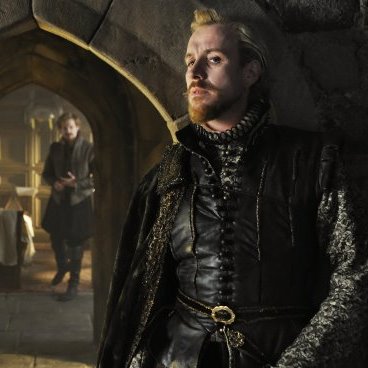
The conspiratorial 'Anonymous' claims Edward de Vere (Rhys Ifans) is the real Bard. |
Roland Emmerich's movie isn't one you just drop in on haphazardly. The first half hour, off-putting by the comings and goings of unidentified, 16th-century intriguers and the dark anterooms wherein they conspire, is bewildering. Yet, in an amazing testament to human ability, by film's ends you kind of, sort of figure out what it's all about, maybe.
|
|
 |
| out of 4 | ||
It's an untidy thought. Gosh, it's disconcerting enough when you can't find your keys. But here's the case of a whole country misplacing its literary heritage. Surely the Bard, if there was one, would find the matter equally tragic and comic. Rhys Ifans' touching embodiment of this compelling enigma supplies the film's most heartbreaking element.
He's the Earl. You see, as the supposition informs, it won't do for a person of Edward's station to be dabbling in the arts when there are estates to run, conquests to be made and battles to be won. So, he does the ghost writer thing in reverse, securing a beard to present his secretly written plays to Merry Olde England, only it's not that merry of late.
The question of succession is ever-present in the minds of those powers that be as an aging Queen Elizabeth I, superbly played by Vanessa Redgrave, nears the end of her reign. A litany here of the players and their causes would be tedious and confusing. Just suffice it to note that the script chooses the occasion to make its philosophical points.
It is where Edward, having led a life of quiet desperation, decides to at last make a stand, albeit anonymously, and try out the axiom that is his raison d'etre ... that the pen is mightier than the sword. Vehemently opposed to William Cecil and his son Robert, chief advisers to the queen who favor the ascension of James, he fashions his own coup.
Adding a nice chunk of humanitarian fantasy to the film's world-changing hypothesis, Edward means not to simply affect future generations, but the very present, through a daring nexus of art and politics. Hence, in order to support its cause célèbre, not only does the film play fast and loose with literature, but with the established facts of history.
As behooves things dealing with Shakespeare, there is dirty pool afoot, on two fronts no less. This is an equal opportunity look at man's corruption. Offering a mini-monograph on comparative treachery, the lens alternates its focus from the perfidy at court to the lower-class duplicity that takes place among those entrusted to do the Earl's bidding.
Note that Ben Jonson (Sebastian Armesto) is the writer originally summoned from the dreggy pubs and entrusted with fronting Edward's plays. But then an upstart, a reputedly illiterate actor by the name of Willy Shakespeare (Rafe Spall), gets hip to the ploy and blackmails his way into the grand scheme. For 400 pounds a year, he'll suffer the glory.
That's all you want to know. It only gets more confusing, especially when Emmerich goes the flashback route, forgetting that we are not scholars in hypothetical history. All of which leads us to musings like: 'Wait a minute, is that him young, or the other guy now?' And, 'Are those two illegitimate dudes brothers? Oh, this is too hard.'
Helping soothe the racked furrows of your brain, the computer re-creation of Elizabeth's England is a stunning eyeful that both helps establish the temper of the times and offers yet another sociological comparison of the classes. Astute, if not esoteric, what comedy relief there is comes from the story's integral, Shakespearean examples of human folly.
Free of blame for the tangled web woven by this tale of deceits and deceptions, Rhys Ifans and supporting cast do a fine job of sewing themselves into the fabric and filigree of the epoch. Sebastian Armesto's Jonson is duly rapt as he observes the nature of greatness, and Rafe Spall's waggish Shakespeare surely couldn't have written those masterpieces.
Still, I'm not convinced ... not even a little. Though the intellectual byproducts of filmmaker Emmerich's flight of fancy — its contemplations on literary ambition, humility and pride — have value, I can recommend "Anonymous" only to a very small group of Shakespeare aficionados. And even then I'd appreciate it if you didn't say 'twas I.
"Anonymous," rated PG-13, is a Columbia Pictures release directed by Roland Emmerich and stars Rhys Ifans, Vanessa Redgrave and Sebastian Armesto. Running time: 130 minutes