Wind Power Slowly Making Headway In Berkshires
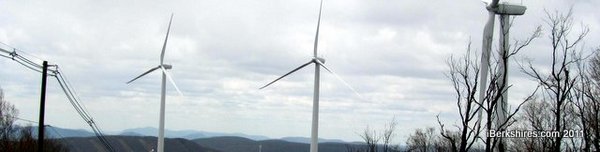
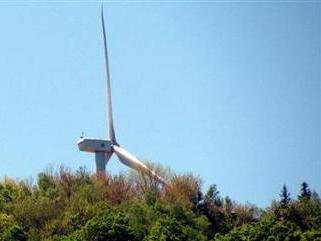 Five-year old Zephyr peaks above the trees at Jiminy Peak Ski Resort. |
In Florida, a 20-turbine project should be running by the end of this year.
And in Savoy, the planners of a five-turbine farm remain optimistic they can overcome the remaining hurdles to breaking ground.
The wind energy business is making strides in and around Northern Berkshire County, and advocates can point to a number of successful local projects.
None is bigger than the 10-turbine, 15-megawatt Brodie Mountain installation operated by the Berkshire Wind Power Cooperative Corp., a project of 14 municipal utilities and the Massachusetts Municipal Wholesale Electric Co.
The commonwealth's largest wind farm came online in May 2011, and after some early hiccups, Berkshire Wind is humming, according to a spokesman.
"I think we've worked most of the bugs out of the project with the turbines and the systems, and it's been running very well the last few months," David Tuohey said. "There are a certain number of incidents that happen with the startup of any project, and we are within the range of normal for those kinds of incidents."
Some of the problems were attributable to the electricity generating turbines being kept in storage for a year while Berkshire Wind settled litigation associated with the project, Tuohey said.
Once the legal issues were resolved and the mechanical bugs were addressed, the turbines have been doing their job.
"The last few months, we've had pretty high capacity factors," Tuohey said, referring to the industry measure depicting the average power output compared to peak power capability for the turbine.
"In January, the project ran at a 53 percent capacity factor, which is huge. ... For a wind project, which only runs when there is enough wind to start with, a capacity factor of around 30 percent is kind of normal. Based on the wind studies that were done on top of Brodie Mountain, a capacity factor of around 40 percent on average for the year was projected because it's such a high wind location."
Nearby, a privately-owned, net-metered turbine owned by Jiminy Peak Ski Resort has been turning since 2007. The man in charge of the turbine called Zephyr said it has produced right around the amount of electricity it was projected to produce.
"The turbine was forecast to produce 4.6 million kilowatt hours per year, and we've seen a low of 4.1 million and a high of 5.5 million. We're in the ballpark," said Jim Van Dyke, the mountain's vice president of environmental sustainability.
In terms of capacity factor, Zephyr is averaging between 33 to 35 percent on an annual basis, right in line with projections, Van Dyke said.
"Another unit of measurement is availability: If the wind is blowing or the wind is not blowing, is the turbine available to run?" he said. "On an annual basis, Zephyr is north of 98 percent."
That is a number the folks at Iberdrola Renewables would like to see when their latest wind farm comes online later this year. Iberdrola is the Portland, Ore.,-based company behind Hoosac Wind, a planned 20-turbine project in Florida and Monroe.
When it comes online, it will be the largest such project in the commonwealth, with the capacity to produce 30 MW.
"We expect turbine component delivery in the third quarter of the year and anticipate commercial operation by the end of the year," Iberdrola spokesman Paul Copleman said.
Iberdrola has an agreement in place to sell the electricity it generates to Nstar, which serves 1.1 million electric customers in eastern and central Massachusetts.
Such a purchase agreement is one piece of the puzzle that is missing for Minuteman Wind, the Framingham firm attempting to build a five-turbine, 12.5-megawatt wind farm atop West Hill in Savoy.
Earlier this year, it was announced that Nstar would purchase a quarter of the power produced by the planned off-shore Cape Wind development. That 15-year agreement was part of a settlement with the commonwealth allowing Nstar's merger with Northeast Utilities.
Minuteman Wind complained to the Department of Public Utilities that the settlement unfairly favored the massive, 130-turbine Cape Wind over more modest projects like the planned Savoy wind farm.
"For every wind project, and certainly Cape Wind as well, in order to get financing you need to guarantee to your lenders you have a long-term revenue stream," Minuteman Wind principal Steven Weisman said. "Otherwise, [lenders] are left with the risk of spot market pricing, and a lender won't lend against that."
Weisman said Minuteman Wind is pursuing a long-term purchase agreement of his own, but he couldn't provide any details.
He also could not predict when Minuteman will overcome the last regulatory hurdle it faces, a wetlands protection permit that currently is under appeal by opponents of the project to the Massachusetts Department of Environmental Protection.
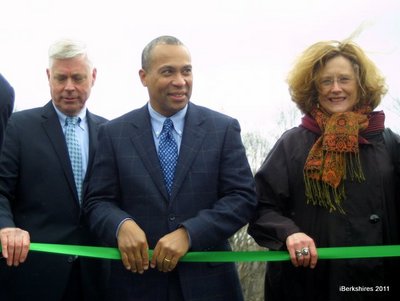 Gov. Deval Patrick was on hand to mark the Berkshire Wind project's near completion last year. The governor has been a strong proponent of wind power, with a goal of generating 2000 MW by 2020. |
On April 9, a U.S. Forest Service forester in Milwaukee handed down a judgment in favor of Iberdrola's Deerfield Wind development. Copleman said there are indications that opponents will continue the fight to a higher authority, but the company is confident the decision will hold up. The White House selected the project as a high priority.
"The Forest Service review was very extensive and thorough," he said. "We are confident that the decisions reached in the (Record of Decision) are well supported and look forward to moving through this part of the process."
It can be a long process because wind power, while having the appeal of being a renewable source of energy, is not without its detractors.
Opponents include those who object to marring the landscape and nuisance noise from the whirring of the rotors to those who are concerned about the environmental impact of tower construction and transmission lines on ridgelines. The Berkshires are considered a prime site for wind generation.
Without opposing wind power, per se, environmental groups like Pittsfield's Berkshire Natural Resources Council are pushing to make sure that wind farms are built responsibly.
"While recognizing the global imperative to reduce carbon emissions, and the role that wind power generation may play in this goal, Berkshire Natural Resources Council opposes wind energy development that fails to meet high standards for environmental review, production efficiency and long-term economic sustainability," according to the group's website.
The BNRC advocates for a statewide standard siting of wind turbines. The industry does, too.
The question is what that standard would be.
A bill in Boston to establish such standards died this legislative session, but an aide to the House Committee on Global Warming and Climate Change said it could be reintroduced in the next session. The measure, H. 1775, was "sent to study" by the Joint Committee on Telecommunications, Utilities and Energy, which is chaired by Sen. Benjamin Downing, D-Pittsfield.
The current process for building a large-scale wind farm can be long and difficult. Berkshire Wind's Tuohey calls it a "hard knocks experience" for his cooperative, which spent four years bringing to fruition a plan that had percolated for 10 years before BWPCC got involved.
Minuteman Wind started its project in 2005. It has strong support from residents and elected officials in Savoy, which stands to see an estimated $200,000 in annual property tax revenue. And still there is no end in sight.
"There's not much question that it's a difficult process," Weisman said. "I think we would do it again if we had to. We definitely believe in what we're doing. I think the scale of the project is very appropriate. The site is good. We are all actively involved in other energy businesses. We think wind makes sense as part of the mix.
"I certainly think every one of us had the expectation going in that this would have happened more quickly given the tremendous local support from the very beginning. ... But the process allows for a lot of people to have a voice, and it takes a long time."
.gif)