Michael Cassin brings great enthusiasm to education at the Clark

Print Story | Email Story
When Michael Cassin was about nine years old, he and his older brother came in out of the rain — into the shelter of a museum. The boys were enthusiastic, perhaps audibly so. Cassin, now curator of education at the Sterling and Francine Clark Art Institute, recalled, “We were thrown out.” “That’s exactly what I don’t want to happen to either kids or grown-ups,” said Cassin, whose career aims at spreading his own enthusiasm for pictures as widely as possible. Saturday’s family event at the Clark drew well over 200 youngsters, ages 3 to 12. The focus was on light, in keeping with the season and the weather. “We wanted to get the kids to think about how artists go about painting light,” he said. The children’s activities grew out of their ideas and observations in the galleries. “I like the idea, not of standing in front of kids telling them things, but of having a conversation,” he said. “I like to explore, rather than tell people things.” “I want them to have the idea that looking at a painting is fun, not just something you have to do,” he said. “Education isn’t just about kids or about school, it’s about getting people excited about looking at pictures.” “I get really excited personally looking at pictures — they’re multi-layered, they’re stimulating — and I like the idea of offering that excitement to other people.” Cassin came to the Clark six months ago from The National Galleries of Scotland in Edinburgh, where he was head of education for nine years. Previously he had worked in the education department of The National Gallery, London, for 10 years. He has lectured widely on museum education at international conferences and has advised the Van Gogh Museum on the future of its education programs. He has written for numerous publications. An anthology of poetry written by children about works of art in the Scottish National Gallery of Modern Art won a Gulbenkian Award for the Best Museum Publication, 1998-99. In his Clark post, he directs public education for children and adults, including the school and docent program, family events, and lecture and concert programs. Earlier this week he talked about his approach. “Most people are familiar with music and books, but for a lot of people, looking at real paintings is not something you do if nobody’s ever shown you how. I suggest to people that knowing about techniques of visual imagery gives them skills for reading pictures, and that they can enjoy doing that.” Sharing his excitement extends, he said, to discussion of the artist’s methods. “Painting is a rational process that we can explore,” he said. “We talk about a batch of decisions artists make on how to technically convey effects.” “We can do this with anybody of any age and any background,” he said. “When I worked in London, groups of boys would come from a correctional center once a year. They were completely knocked out. And they were beautifully behaved.” “I like the music of Mozart and Aretha Franklin. And I like introducing people to pictures they wouldn’t look at otherwise,” he said. “I really do think it can change peoples’ lives.” Cassin, who grew up in Manchester, England, recalled that “I got interested in looking at paintings by other people because I could draw — that was my kind of route to museums. Now I’m much, much more interested in looking at pictures than in making them.” “I get really excited by these things, and I think, if I like them this much, let’s offer this kind of excitement to as many people as possible.” Cassin acknowledged that his approach coincides well with the aim of museums to increase the numbers of their visitors, and, like all cultural institutions, spread the knowledge of their treasures as widely as possible. On Saturday, Cassin asked youngsters where they thought the light reflected on the glass goblet in a painting by the 17th-century artist Pieter Claesz could be coming from. The painting depicts, along with the glass of wine, a ham, bread, and a lemon. “We talked about how artists think about light, how they use paint and color to show light, whether it was natural or artificial light, and how light reflects off different surfaces,” he said. A painting attributed to the circle of Fra Angelico shows John V Palaeologus, emperor of Constantinople, setting out for Venice in 1369. Only by crouching down on the floor to look up at the painting does the emperor’s robe gleam with golden stars. Probably, the painting was hung much higher, and probably illuminated from below by candles, to show the golden highlights. Winslow Homer’s Sleigh Ride and Saco Bay, and Frederic Remington’s The Scout: Friend or Foe all show light at night. And Thomas Lawrence’s circa-1800 portrait of the Hon. Caroline Upton shows the young woman in profile. “That profile led to talking about silhouettes, and to the children’s doing shadow drawings of each other, which they cut out,” he said. Afterwards, Will Kirby, age 6, said his favorite part of the morning was “the paintings.” Will’s mother, Mary Kirby, said, “I thought it was great that he kept that range of children interested and engaged.”
If you would like to contribute information on this article, contact us at info@iberkshires.com.

McCann Recognizes Superintendent Award Recipient

By Tammy DanielsiBerkshires Staff
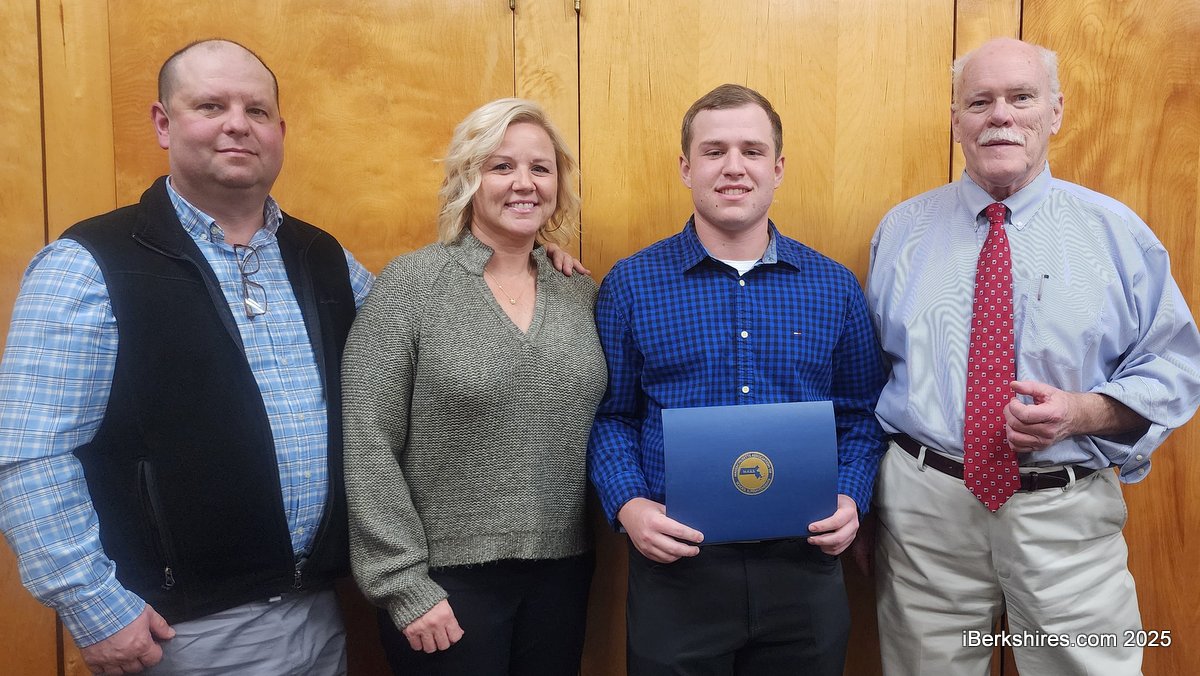
Landon LeClair and Superintendent James Brosnan with Landon's parents Eric and Susan LeClair, who is a teacher at McCann. 
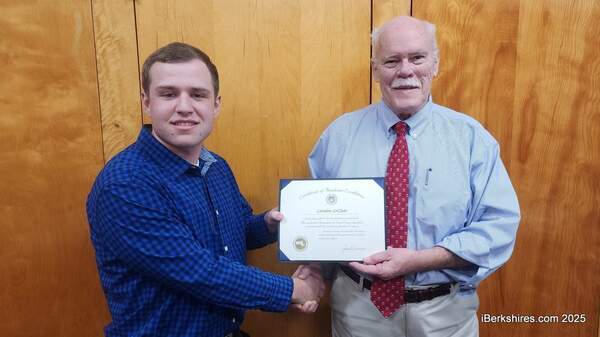
NORTH ADAMS, Mass. — The Superintendent's Award has been presented to Landon LeClair, a senior in McCann Technical School's advanced manufacturing course. 
 
The presentation was made last Thursday by Superintendent Jame Brosnan after Principal Justin Kratz read from teachers' letters extolling LeClair's school work, leadership and dedication. 
 
"He's become somewhat legendary at the Fall State Leadership Conference for trying to be a leader at his dinner table, getting an entire plate of cookies for him and all his friends," read Kratz to chuckles from the School Committee. "Landon was always a dedicated student and a quiet leader who cared about mastering the content."
 
LeClair was also recognized for his participation on the school's golf team and for mentoring younger teammates. 
 
"Landon jumped in tutoring the student so thoroughly that the freshman was able to demonstrate proficiency on an assessment despite the missed class time for golf matches," read Kratz.
 
The principal noted that the school also received feedback from LeClair's co-op employer, who rated him with all fours.
 
"This week, we sent Landon to our other machine shop to help load and run parts in the CNC mill," his employer wrote to the school. LeClair was so competent the supervisor advised the central shop might not get him back. 
 
View Full Story

More North Adams Stories