North Adams Keeping Eye on Public Safety Overtime
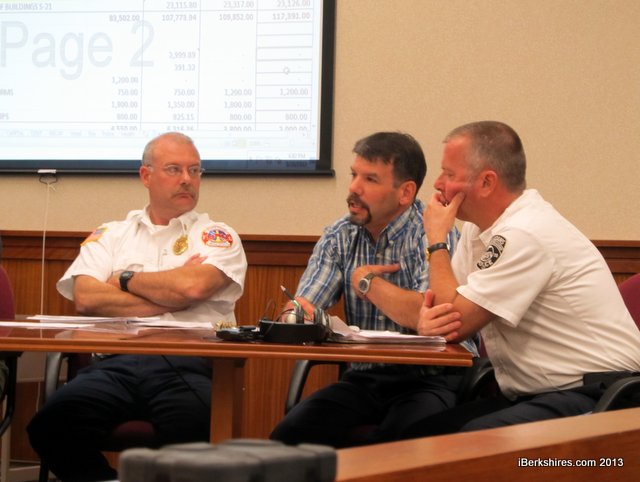 Fire Director Stephen Meranti, left, Building Inspector William Meranti and Police Director Michael Cozzaglio appeared before the Finance Committee. Fire Director Stephen Meranti, left, Building Inspector William Meranti and Police Director Michael Cozzaglio appeared before the Finance Committee. |
|---|
NORTH ADAMS, Mass. — The administration is hoping to reduce the amount of overtime being paid out in the Public Safety Department by calculating coverage needs ahead of time.
The city's ended recent fiscal years well into the red on those line items to keep staffing requirements for firefighters and patrol officers 24 hours a day, 365 days a year. By studying historical data, the city's budgetmakers are hoping to anticipate more accurate figures going into fiscal 2014.
"We think this brings as tight a budget as we can get," said Administrative Officer Michael Canales at Tuesday's Finance Committee meeting. "We've been off by large amounts of money."
The police overtime budget was off by $173,000 in 2012; fire by $90,000. The numbers aren't much better this year. It's in part caused by long-term employees, particularly in the Fire Department, who are at or near the top in earned vacation time.
Canales, working with Auditor David Fierro Jr. and the police and fire directors, have looked into the usage of vacation and sick time, and factored in potential disability time. It can't cover all the possibilities, but Canales believes it gets the city's proposed spending closer to its actual spending.
"We believe that gets us a much more accurate budget," he said. "We tell them to stick to the budget but if we're not going give them the actual resources to cover the known costs, they won't be able to."
He expects to keep the lines of communication open on a monthly basis to track how the budgeting goes.
"We think we are now going to have a budget where we should be talking thousands of dollars (in unbudgeted overtime), not tens or hundreds of thousands," said Canales.
Finance Committee member Lisa Blackmer questioned if it would be more useful to hire new firefighters rather than pay overtime — and get a jump on the looming number of retirements.
But Fire Director Stephen Meranti said the department's complicated rotating schedule made it difficult to hire a single "floater" to fill in on vacations.
Overall the 2014 budget for the Fire Department is at $1.48 million, including $185,000 for overtime. The Police Department is set at $1.6 million with $171,000 in overtime budgeted.
The public safety commissioner salary has been eliminated with some of budgeted amounts being used toward raising salaries of the directors to reflect their increased responsibilities. The loss of the position is reflected in a $90,000 decrease in the public safety administrative budget.
The city is expecting to see savings with the consolation of building and health inspections into an inspection services department, similar to that used in Williamstown.
Canales and Mayor Richard Alcombright said they have taken the opportunity to review departments whenever there have been staffing changes. Former Health Inspector Manuel Serrano's departure for a new job lead to the decision to consolidate inspection services.
The new structure will eliminate a $40,000 a year health inspector 1 and a retiring clerk will return at half-time. The building inspector and current clerk will get raises related to increased responsibilities and the current health inspector will become director of health services.
Canales and Building Inspector William Meranti did not anticipate any difficulties or significant delays in providing services to residents but noted that the changes will be watched closely. Canales said that the city will use Berkshire Health Alliance as needed to fill in for inspection duties.
The mayor also informed the Finance Committee that the city is in negotiations with its public unions and they have been informed of the city's continuing difficulties.
The meeting was the third held by the Finance Committee to review the fiscal 2014 budget. Last week, the committee reviewed unclassifed, insurance, pension and capital items.
The mayor noted the fiscal 2014 budget still has a structural deficit, though it has been slowly reduced over the past few years. The gap of $353,000 will be covered with reserves, which are limited.
"We will not overrun our budget this year we can't do it," he said. "Not only are we trying to keep the budget flat, we're being real fiscal hounds on this."
Tags: Finance Committee, public safety,