North Adams Group Details Plans for 'Greylock Market'
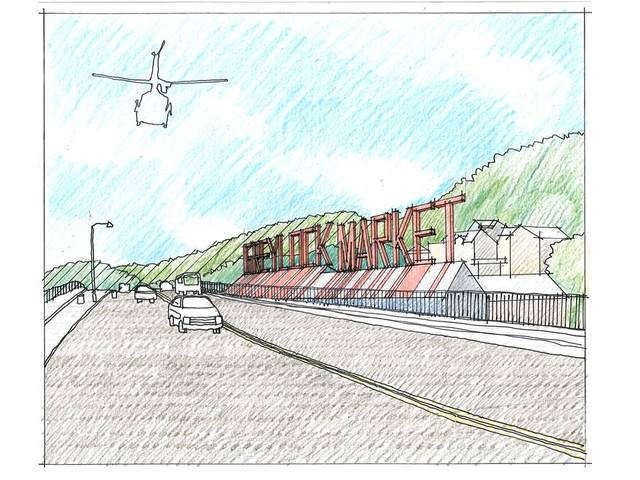
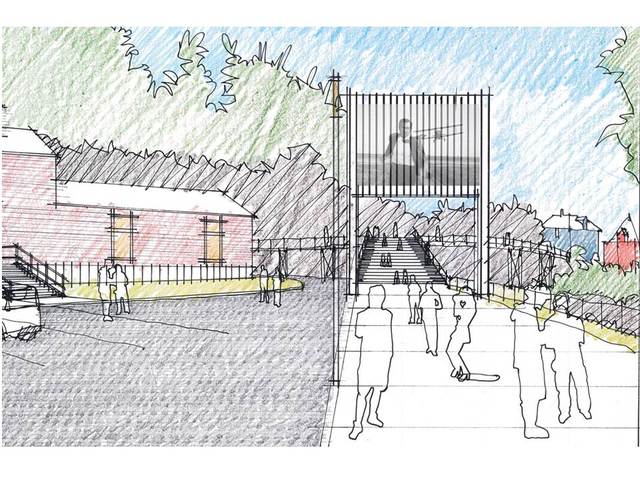
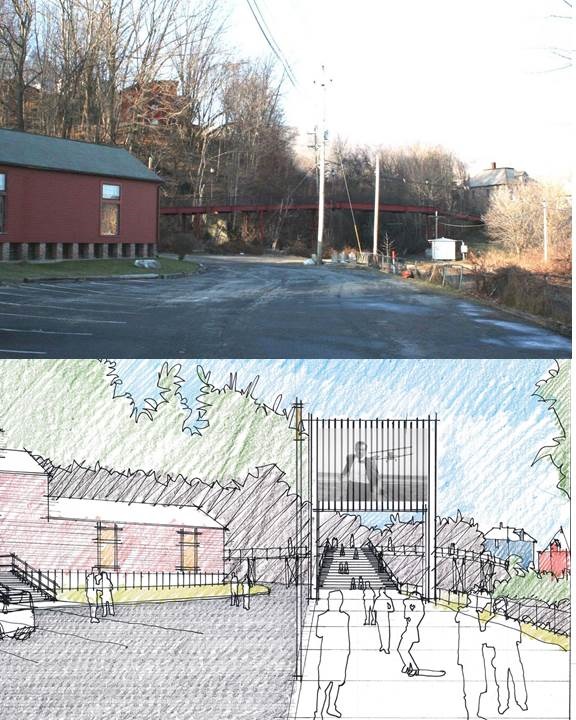
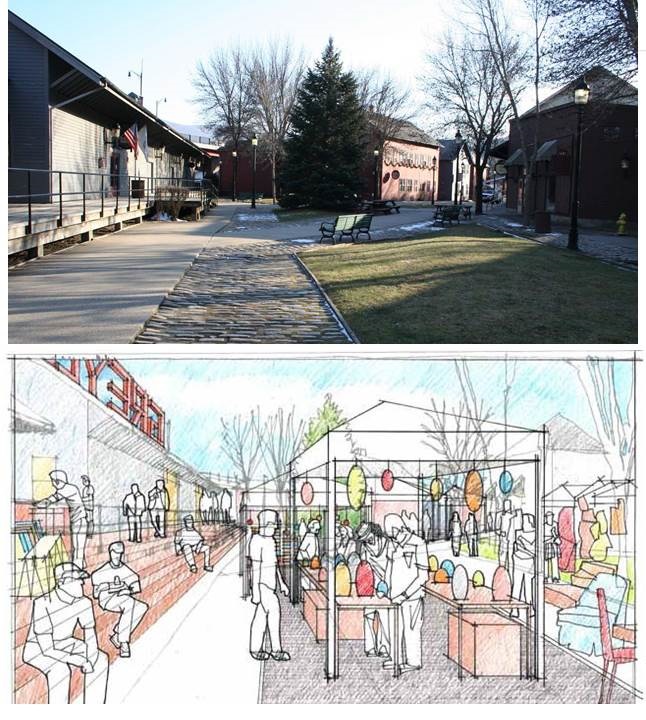
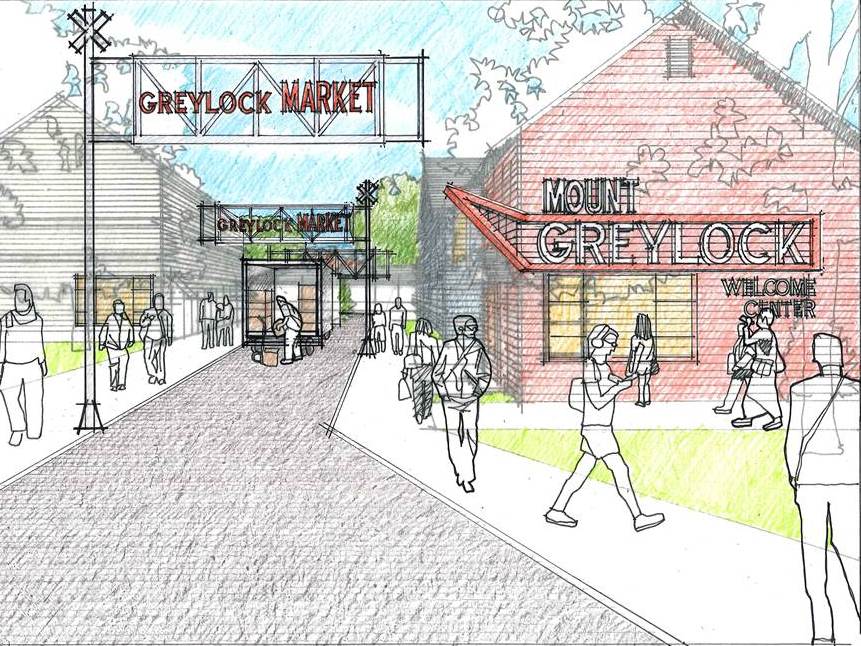 The new Greylock Market will include activities within and around the courtyard and welcome visitors to Mount Greylock. The new Greylock Market will include activities within and around the courtyard and welcome visitors to Mount Greylock. |
|
 |
|
NORTH ADAMS, Mass. — Some $6 million in private and public funds will be invested over the next two years in Western Gateway Heritage State Park to capitalize on the growing — and profitable — artisan movement.
The 30-year-old park will be rebranded as "Greylock Market" to tap into its position as a gateway to Mount Greylock State Reservation and to better communicate its retail potential.
"What we have concluded is that the ideal use for Heritage Park is as a mixed-use artisan center," said Blair Benjamin, president of Greylock Market LLC, the investment group formed to undertake the project.
"The artisan economy is taking off," he said, in announcing the plans on Wednesday at City Hall. "We've been watching what's going on in communities around the country, some near and some far."
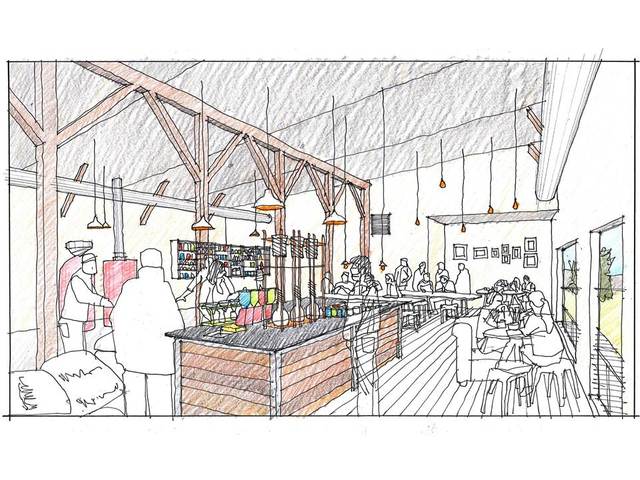
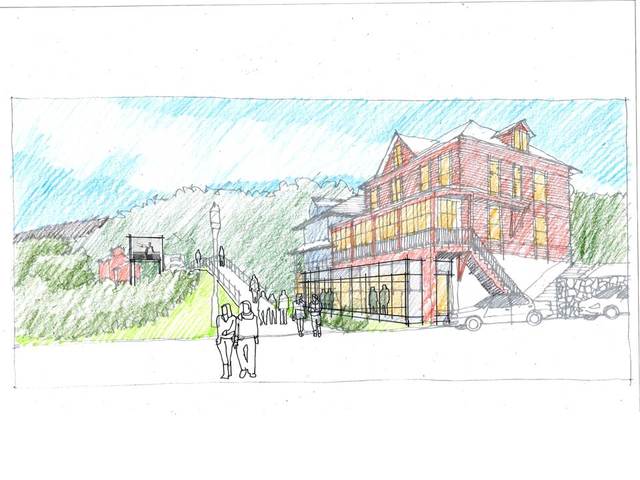
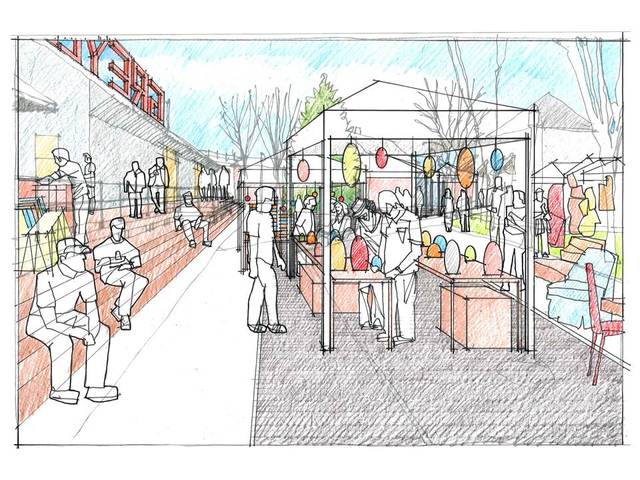
Benjamin said the park — including the former Sons of Italy property purchased by the city earlier this year, the footbridge (expected to be part of the bike path) to West Main Street, and the two city-owned houses on West Main — will be transformed into a mixed-use center including retail, artisan production spaces, 15-20 residential units and event programming.
Artisans ranging from cheesemongers to woodworkers will be able ply their trades in view of visitors and have access to a central retail marketplace. Longtime tenant Freight Yard Pub would partner with a microbrewery. The residential units will be marketed to artisans, similar to the way Eclipse Mill is marketed to artists, to create a community of artisans.
The market would also have a cafe or coffee shop and community kitchen, and link to resources including Massachusetts Museum of Contemporary Arts, the new Berkshire Scenic Railway rides, the planned extension of the Ashuwillticook Rail Trail and the downtown.
The artisan and crafts movement had a $13.8 billion impact nationwide in 2001 — long before Internet economics (ala Etsy) took off, said Benjamin, adding a 2008 study of western North Carolina found an economic impact of more than $206 million.
He gave the example of the Simon Pearce glass-blowing and pottery center in Vermont. "They get some 300,000 visitors per year to their site in Quechee, Vt., population 656 people," he said.
The vision for Greylock Market has been developed over the past year after the North Adams Development Trust was selected by the city to privatize the languishing property.
"I don't want to say, 'voila!' but it is 'voila!' Here we are and it's just really, really a good day," said Mayor Richard Alcombright. The mayor said the city could ill afford the millions required to renovate the aging park.
"It needed the commercial attention and the retail attention that only private development could give it," he said. "We provide the processes for private industry, for a private developer to come in and do their thing.
"We should not be competing with the private sector."
Its redevelopment rests on a public-private partnership that includes $1.5 million in private investment through Greylock Market LLC and a MassWorks grant of $881,000 that will be used to leverage nearly $4 million in financing.
"What was lacking was private investor capital and a strong vision on how to use this property until now," said Benjamin.
The key in moving the project forward was state participation through the Department of Conservation and Recreation, which operates the visitors center and Hoosac Tunnel museum at the park, and the MassWorks grant that had been held up since being awarded last year.
Alcombright said the residential aspect of the park was reinforced during discussions with state officials several weeks ago. "Less than two days, we got a call and the grant was released," he said. "I think the housing component of this was of interest to the governor."
Architectural and engineering work and site planning have begun, with the anticipation of construction beginning in 2014 and the market opening for business in 2015. Benjamin said there has been interest in the project, but signing up tenants would not happen until architectural work was much further along.
Colleen Taylor, an owner of the Freight Yard Pub that's been in the park for 25 years, said she was "thrilled by all the energy being directed at this redevelopment."
Taylor has previously expressed support for the project. But the future of the nonprofits currently in the park, including the North Adams Museum of Science and History and Northern Berkshire Community Television Corp., isn't so sanguine.
|
|||||
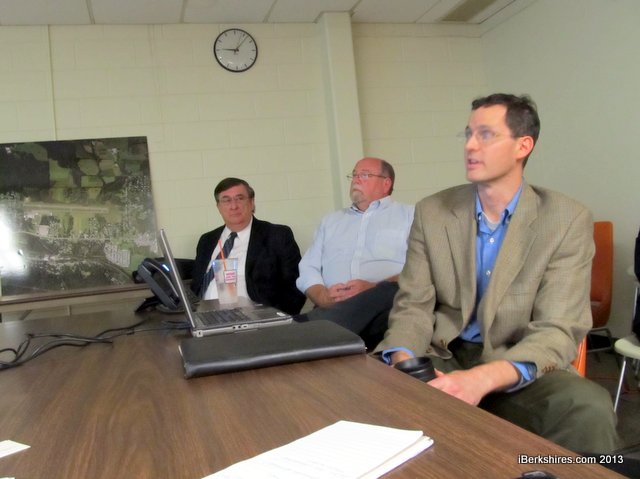


"There is likelihood that certain tenants may need to work with the city and the North Adams Partnership to identify another location that might be a better fit for them," said Benjamin. "We need to be able to create a cluster of activity here that has a thematic connection to each other. In some cases that means using the spaces differently."
DCR is expected to remain an essential element in the park and Benjamin said talks are ongoing on how the agency can formulate programming that ties in with the artisan and recreational themes.
Greylock Market will lease the property for 20 years from the city, technically from the Redevelopment Authority, for $750,000 upfront. An agreement that is still being worked out will have to be approved by the Redevelopment Authority.
City Solicitor John DeRosa said it was not unusual for a project of this complexity to take two years in landing investments and articulating agreements considering how difficult it is to "take something from where it was, from concept to design" then package it in a way to find an investment group and put financing together.
"One-point-six million is a terrific investment in North Adams, the likes of which we haven't really seen," he said. "That was difficult to do but the response to it was absolutely phenomenal."
The broad range of investors putting up the money include the management team of Timur F. Galen, managing director of Goldman Sachs, local philanthropist James Hunter and Anders Schroeder, chairman of the Asgard Group. All are members or former members of the Mass MoCA Foundation Board of Directors.
Benjamin also is connected to Mass MoCA, having managed its commercial real estate arm for some years.
Among the 18 investors who stepped forward to fund the project are local business leaders Nancy Fitzpatrick, Jack Wadsworth and Francis "Bigs" Waterman.
"This is a group of very serious social impact investors who are excited by the opportunity to create some economic opportunities," said Benjamin.
The force behind Greylock Market is the nonprofit Partnership for North Adams made up of DeRosa, Massachusetts College of Liberal Arts President Mary Grant and Mass MoCA Executive Director Joseph Thompson, as well as the mayor. The group formed several years ago to help promote development in the city.
All three expressed confidence in the project and thanked the many partners involved in bringing it to fruition.
"I feel privileged to have had the opportunity to play a catalytic role through the North Adams Partnership in helping everyone coalesce around this vision," said DeRosa. "This is a great project for North Adams. It builds upon the success so far Mass MoCA and MCLA and its exactly where we should be and its an exciting day for North Adams.
Grant expected students from the college to take advantage of the creative opportunities posed by the market, and pointed to the small-business entrepreneurship already on display at the weekend farmers' market.
"It's building on the strength of this city and I think it's such an exciting step forward," she said.
Thompson saw it as a way to attract a dynamic demographic in light of the area's diminishing population.
"If you look at the people who are choosing to stay, more and more are the creative people and the younger people and that's absolutely vital to the future of our hometown."
Tags: artisans & crafters, entrepreneurs, greylock market, Heritage State Park, redevelopment, redevelopment authority, small business,