To listen to Jim Lynch talk about his 34-year Berkshire career is to listen to history and to realize how much has changed in a very short time.
A man who studied business and banking, but says he could just as likely have studied art and history at Northeastern University, talks about the birth of the credit union movement, the history of banking, and some of the landmark businesses that were once around the site on which the Greylock Federal Credit Union main office now stands.
He talks about the Pittsfield that had a Busy Bee Restaurant, Robin Hood’s, Johnny’s, the Pickwick Hotel, and a grand train station. West Street has had a few manifestations, from its original marshland before the Housatonic was diverted, through busy development and then the infamous urban renewal to a period of neither — nature nor thriving business — and finally to now.
Those 34 years — from the time Lynch moved here to take a job at the Agricultural Bank, to this year, when he will retire as president of the Greylock Federal Credit Union — have brought a lot of change in Pittsfield and the world. Jim Lynch has it all in his head and he enjoys telling it.
In 1935, blue-collar workers didn’t have access to banking services. Banks were for commercial transactions and for “those who were rich or filthy rich.†The credit union movement opened up banking type services to the working class. It was at this time, on the heals of federal legislation enabling it, that the Pittsfield GE Employees Credit Union was formed.
The credit union stayed with the plant until 1972, when it moved slightly off site to Kellogg Street. Where’s Kellogg Street? — that’s the question that haunted those who ran the institution and wanted it to attract other than GE employees to become members.
The name didn’t help with that mission either, and when Lynch came over from the Agricultural Bank, one of the first things he wanted to do was to come up with a new name, one that would identify the growing organization as county wide and for everyone.
Another of the goals Lynch soon identified was a new home for the growing credit union. At the time he came aboard, that plan wasn’t on the radar screen, he said, but quickly became a major project, from 1995, when they began to deal with the city for that piece of land, to 1998 when they moved in.
No longer seen as the socialist organization over on Kellogg Street, the Greylock Federal Credit Union had new visibility and actually looked like a bank. Still, says Lynch, the tax exempt institution is still “deeply rooted in service to people of modest means, working people.â€
Business banking is a growing piece of the picture, but Lynch says only because some of the members have businesses and the credit union wants to serve its members. Business banking will always be subordinate to the services for individuals.
When the credit union moved from Kellogg Street to its glossy new headquarters on West Street it “came out of the closet as a financial institution.†The Pittsfield GE Employees Credit Union was fairly well known, but people really didn’t know what it was, he says: Something like a Phil Rizzuto Money Store or a secret place that dealt with a small group of people. One of the benefits of the new building was change of image.
They needed a West Side Branch and office space, he says, but the reason they developed their elegant headquarters was to shed the assumption that the organization wasn’t a bona fide, competent financial institution.
The image change didn’t go unnoticed by the banking community, nor was it appreciated, says Lynch. The credit union couldn’t have survived had it remained only linked to GE, because GE was quickly shrinking. Many in the banking world said it shouldn’t maintain its tax-exempt status.
With GE (Martin Marietta, General Dynamics) just a shadow of its once 12,000 employees, the credit union, he says, had no other choice but to branch out.
Literally, that’s what the credit union did. It opened branches up and down the county, with another larger one planned for Great Barrington this year. It is still servicing people of modest means, but more of then: 54,000 members, up from 23,000 in 1991.
Their success is due in part to hard work, a new image and branches. It’s also due to the failures of other local banks. Bought by large banks from outside the area that later moved out, many banks in the Berkshires have suffered tremendously in recent years. The sad story is told a few times: acquisition and then abandonment of the Berkshire market. The banks here who have “done well have remained fiercely independent ... and true to the mission of servicing people here.â€
To illustrate a point, Lynch says if he were the president of BankBoston, which bought the Multibank system (First Agricultural), “being driven to work with the Journal tucked under my arm and thought about where would I spend my time today,†he says, it would most likely be where the money would be made for the bank. The Berkshire market didn’t stand up. When the senior person had his attention away from the area he’s serving, he loses that area.
The tax-exempt status of the credit union — aside from local and property taxes — comes with great privilege and significant responsibility, he says. Congress made credit unions tax exempt from the beginning for people of modest means and as such it’s important to remain faithful to that mission, turning money back to the benefit of the members, he says. The tax-exempt status is an almost constant issue, says Lynch, but he believes that the populace would not tolerate legislation that would change it. The history of the challenges is the subject of another article.
As president of the Agricultural Bank, he was a “staunch opponent of the credit union†because of its tax-exempt status. At a bank you work for the benefit of the stockholder. Everyone works for the stockholder, the equity owner, he says. Here, at Greylock it’s the member owner he works for. “We don’t have seven-figure accounts here.â€
The directorate of Greylock is the member-owners, who are elected by the membership at an annual meeting. Four or five director seats open at each meeting; there may be as few as no candidates for these seats or as many as 14. No less than 400 people attend. Newer members aren’t as likely to attend or vote, he says, but they are welcome.
Lynch moved over to the Credit Union because he was tired of banking and was excited to have the “opportunity to create a vision†and work to see it through. It was like pushing the restart button, he says, and it was fun.
Aside from the serendipitous choice of college major, Lynch made another choice that turned out to be a lucky one: where he would go to work on his Northeastern co-op assignment. It was either Merrill-Lynch or Second National Bank-State Street Trust Company. He chose the latter, where his future-wife used to come in weekly as an employee of Paine Webber Jackson Curtis. He was the middle teller; the two on either side, in a friendly collaboration, closed their windows and put arrows directing traffic to Lynch whenever she entered the bank.
They have three children and will go to live nearer to them and their grandchildren, in Barrington, R.I., when he retires at the end of this year.
If you would like to contribute information on this article, contact us at info@iberkshires.com.
Your Comments
iBerkshires.com welcomes critical, respectful dialogue. Name-calling, personal attacks, libel, slander or foul language is not allowed. All comments are reviewed before posting and will be deleted or edited as necessary.
No Comments
McCann Recognizes Superintendent Award Recipient
By Tammy DanielsiBerkshires Staff
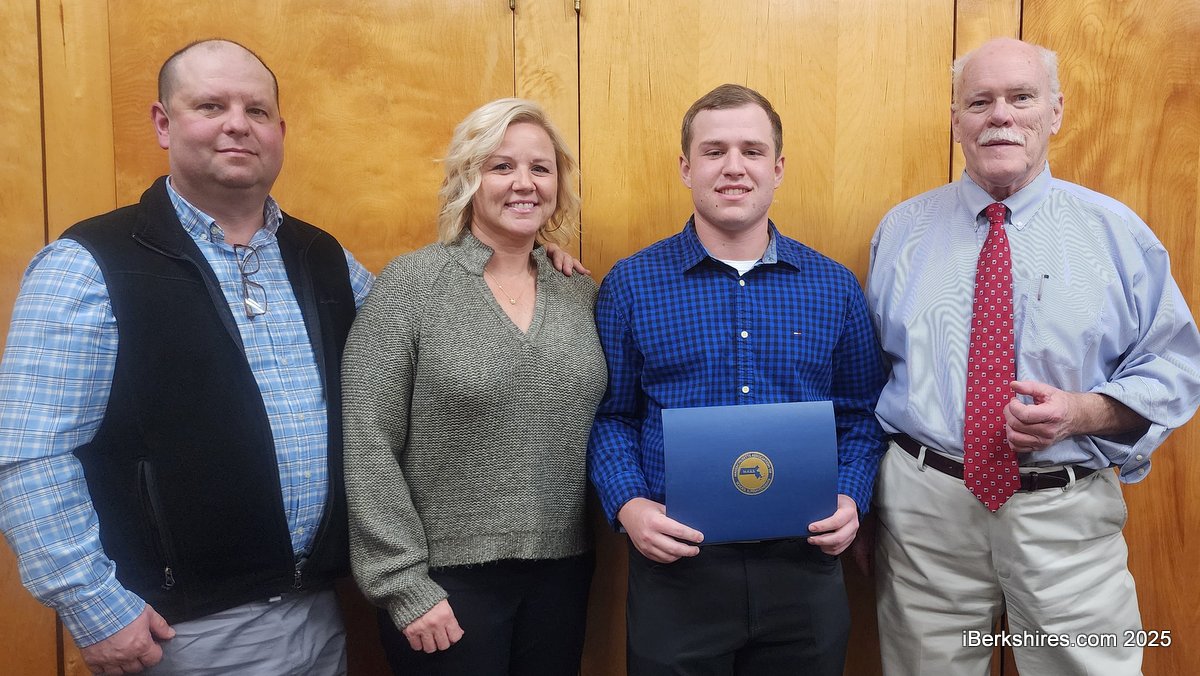
Landon LeClair and Superintendent James Brosnan with Landon's parents Eric and Susan LeClair, who is a teacher at McCann.
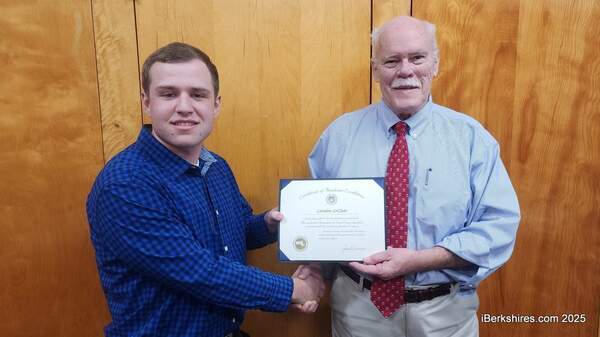
NORTH ADAMS, Mass. — The Superintendent's Award has been presented to Landon LeClair, a senior in McCann Technical School's advanced manufacturing course.
The presentation was made last Thursday by Superintendent Jame Brosnan after Principal Justin Kratz read from teachers' letters extolling LeClair's school work, leadership and dedication.
"He's become somewhat legendary at the Fall State Leadership Conference for trying to be a leader at his dinner table, getting an entire plate of cookies for him and all his friends," read Kratz to chuckles from the School Committee. "Landon was always a dedicated student and a quiet leader who cared about mastering the content."
LeClair was also recognized for his participation on the school's golf team and for mentoring younger teammates.
"Landon jumped in tutoring the student so thoroughly that the freshman was able to demonstrate proficiency on an assessment despite the missed class time for golf matches," read Kratz.
The principal noted that the school also received feedback from LeClair's co-op employer, who rated him with all fours.
"This week, we sent Landon to our other machine shop to help load and run parts in the CNC mill," his employer wrote to the school. LeClair was so competent the supervisor advised the central shop might not get him back.
The city has lifted a boil water order — with several exceptions — that was issued late Monday morning following several water line breaks over the weekend. click for more