Williamstown Economic Development Panel Talks Jobs, 'Creative Economy'
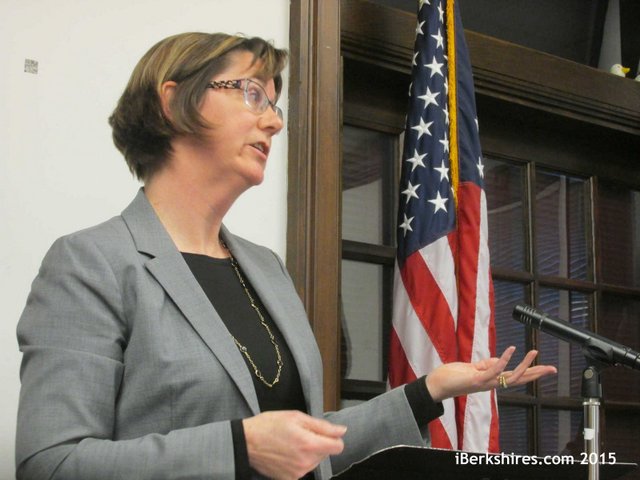 Marybeth Mitts, Williams College's manager of spouse partner resources, told the Economic Development Committee how hard it is to find jobs for 'trailing' spouses. Marybeth Mitts, Williams College's manager of spouse partner resources, told the Economic Development Committee how hard it is to find jobs for 'trailing' spouses. |
The director of North Adams' Massachusetts Museum of Contemporary Art and a Williams College administrator addressed the committee at its twice-monthly meeting.
The former told the panel that cultural attractions need to work together to cross-promote their offerings. The latter talked about how the college helps spouses of incoming staff adjust to the challenging Berkshire County economy.
"The primary task is managing peoples' expectations," said Marybeth Mitts, the college's manager of spouse partner resources. "You have to help people understand it's going to take six months to a year to find a position if it is in a challenging industry — financial services or a highly skilled profession of some type.
"It's easier to help academics [find jobs]. We have 30 higher ed institutions within a 50-mile radius of the college."
Mitts said the spouses of professors and staff relocating to Williams are generally reluctant to travel more than an hour for work, which can add to the challenge of finding meaningful employment.
"People are reticent to travel because of the snow we have in the winter," she said. "I tell people I travel from Lenox, and I have one bad day [on the road] per year.
"But people sometimes have younger children — especially if new faculty are coming in. And the professor or staff person is working hard, so the 'trailing spouse' might be the glue making sure the children are in place. So they'd rather stay closer or work remotely."
On the positive side on the economic development front, Mitts told the committee that Williamstown's public schools are a draw for those new families.
On the negative side, Mitts was asked if the college has lost potential faculty members because job prospects were bleak for his or her spouse.
"It's happened, and I think that's part of the reason this position was created," she said, referring to the spot that was created in 2002 and which she has held for 2 1/2 years.
A few years before Williams created the spouse partner resources position, Joseph Thompson's Mass MoCA opened its doors in the former Sprague Electric complex.
Thompson discussed how Mass MoCA has grown over the years in terms of visitors and exhibition space and its plans to add additional exhibition space in the next few years.
But as big as it gets, Mass MoCA likely will not be able to — on its own — attract visitors to stay multiple days in the area, and extended stays are the key to boosting the local economy, Thompson said.
"No single institution can be a multi-day attraction except during festivals or conferences," Thompson said. "People don't tend to go to museums for multi-day visits. Marketing multiple locations as a multi-day attraction is an attractive thing to do."
Thompson talked about Mass MoCA's relationship with the Clark Art Institute. As both institutions have grown physically, it has become impossible for patrons to see them in the same day trip.
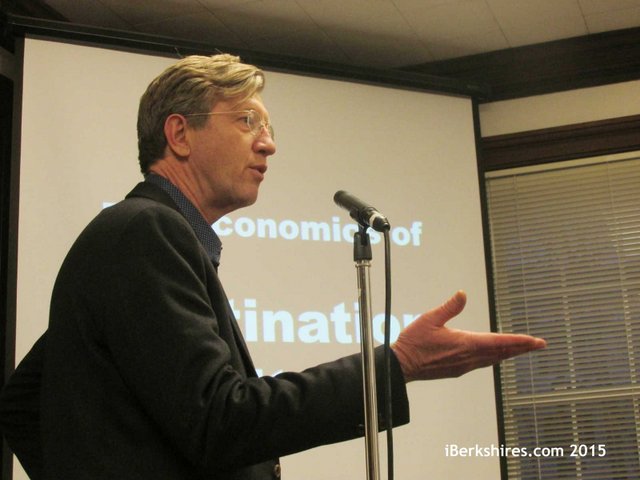 Mass MoCA Director Joseph Thompson said the public sector should aid in promoting marketing and off-season programming. Mass MoCA Director Joseph Thompson said the public sector should aid in promoting marketing and off-season programming. |
And the same goes for Mass MoCA, which currently has 400,000 square feet of exhibition space with more to come.
Cross-promotion between North County's three art museums — the Clark, Mass MoCA and the Williams College Museum of Art — and other cultural institutions can drive demand to keep tourist in the area longer, which drives demand for hotel rooms, meals and shopping, Thompson said.
He said municipalities should provide incentives for cross-promotional marketing and encourage "shoulder season" and off-season programming.
Thompson noted that North County has no trouble filling its hotel rooms in July and August but has plenty of vacancies the rest of the year. That's part of the reason Mass MoCA schedules its two big music festivals outside that peak tourist season window.
He said the public sector also should facilitate the development of more lodging opportunities — whether that means new hotel rooms, encouraging room/house sharing services like airbnb.com or allowing the development of seasonal "Glam-cing" or "glamour camping" sites.
The EDC has a couple more visits from experts on its horizon. It is scheduled to hear from Sen. Benjamin Downing, D-Pittsfield, on Tuesday, April 21, and from Berkshire Health Systems Senior Vice President Ruth Blodgett next month.
On April 29, the committee will hold a pair of public forums — one at 7:45 a.m. and another at 5:30 p.m. — to seek input from community members.
Meanwhile, EDC Chairman Jeffrey Thomas reported that the committee has received 160 online survey responses and another 80 hard-copy surveys have been returned. The online survey can be found here.
Tags: creative economy, economic development,